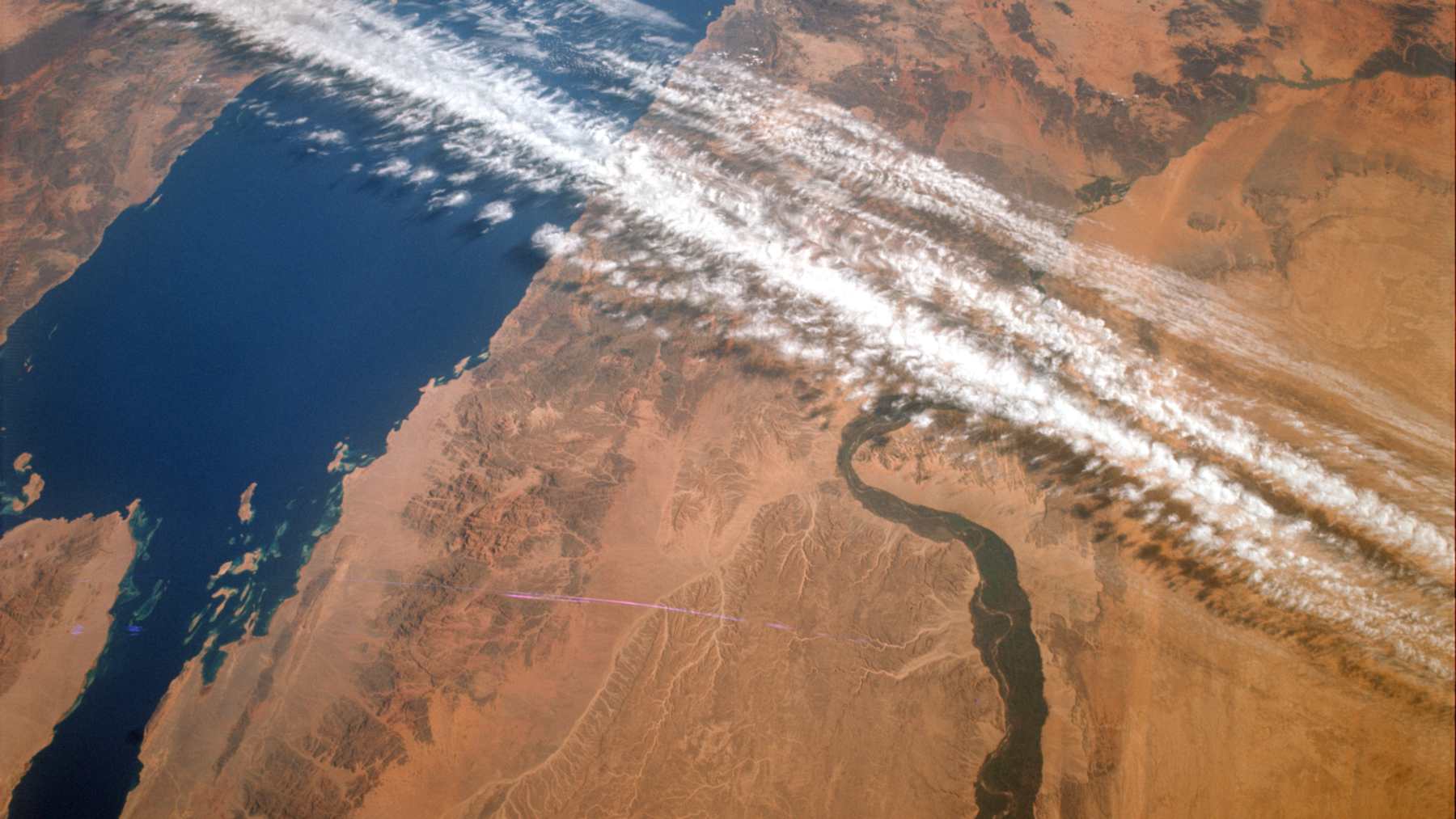
Sixty years ago this week, on November 14, 1966, Gemini XII astronauts Jim Lovell and Buzz Aldrin photographed the Red Sea and the Nile River valley from orbit. NASA’s History Office published the picture on November 13, 2026. It tied the image to a lesser-known legacy of the flight, the push for satellites that watch Earth.
According to the agency’s image article, photos from Lovell, Aldrin and other Gemini crews showed the value of orbital imagery. Those images helped scientists argue for a dedicated Earth observation program, which later led to Landsat.
In the frame, a long band of white cloud cuts across orange-brown desert. The dark blue Red Sea lies on one side and the winding Nile on the other.
Fifty-nine orbits in four days
Gemini XII lifted off from Complex 19 at Cape Canaveral on November 11, 1966, on a Titan II rocket. NASA’s mission page lists 59 revolutions and a flight time of 94 hours, 34 minutes and 31 seconds.
It was the tenth and final crewed flight of the Gemini program, the series that bridged Mercury and Apollo. The plan called for docking with an Agena target vehicle, three spacewalks and 14 experiments.
Before the docking, the rendezvous with the Agena ran into trouble. “We seem to have lost our radar lock-on at about 74 miles,” Aldrin reported, according to a NASA history of the mission.
Aldrin had earned a doctorate in astronautics at MIT in 1963, with a thesis on orbital rendezvous. He pulled out a sextant and a slide rule and measured the angle between the horizon and the Agena. Then he checked his charts and fed corrections into the spacecraft’s computer.
During the third orbit, Mission Control asked how things were going. “We’re taking pictures of the beautiful Agena here,” Lovell answered.
A cabin selfie, three spacewalks
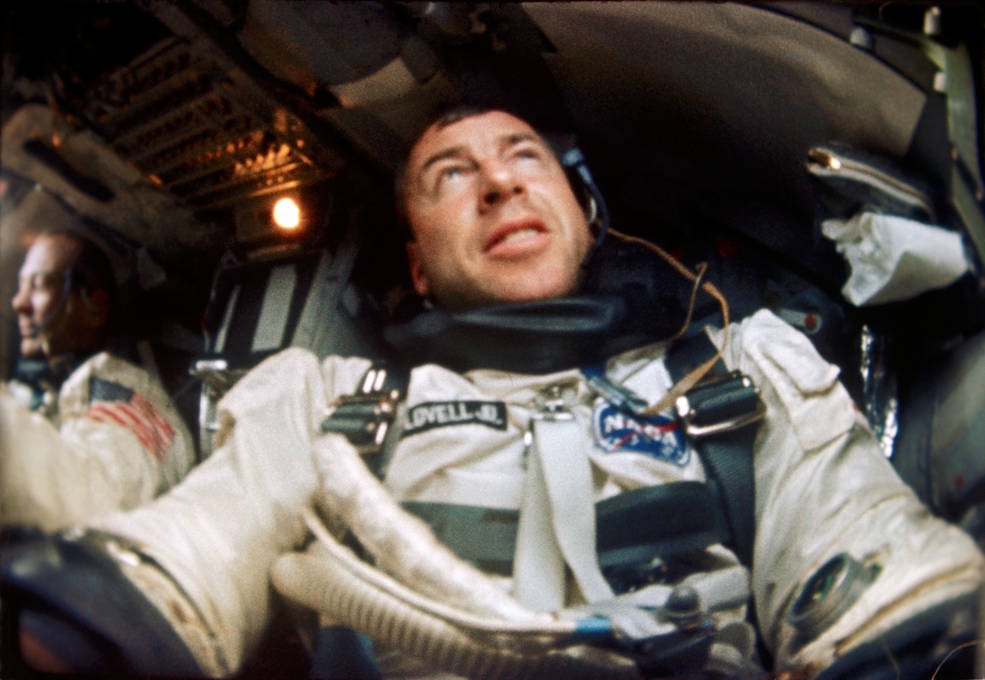
On launch day, Lovell turned a camera on himself inside the cramped cabin, with Aldrin at the left of the frame. NASA shows that shot on its Gemini XII mission page.
Before the flight, NASA made spacewalking the main goal of Gemini XII. Earlier Gemini crews had struggled with fatigue outside the spacecraft, the agency recalls. So Aldrin trained in a pool near Baltimore, in sessions of more than two hours each.
In NASA’s timeline, the training shows. Aldrin made a standup spacewalk of 2 hours and 29 minutes on November 12 and worked outside the capsule for 2 hours and 6 minutes the next day. On November 14, the day of the Red Sea photo, he added a 55-minute standup session.
Underwater training is still the main method today. Spacewalks have also become routine on the International Space Station, where two astronauts were set to install the last roll-out solar arrays this fall.
Pecora’s 1969 statement
One of the people paying attention was William Pecora, who led the Geological Survey from 1965 to 1971. NASA calls him one of the strongest advocates for speeding up the use of Earth-observing satellites.
Pecora championed the Earth Resources Observation Satellite program, or EROS. In a 1969 statement quoted by NASA, he said it was “conceived in 1966 largely as a direct result of the demonstrated utility of Mercury and Gemini orbital photography to Earth resource studies.”
Gemini XII flew in November of that same year, while the idea was taking shape. Even so, the NASA article credits the Gemini crews as a group rather than one single mission.
From EROS to eight Landsats
EROS paved the way for Landsat, a series of satellites that NASA and the USGS run together. The first one launched on July 23, 1972, and the program page counts eight successful launches since then.
NASA calls the archive the longest continuous space-based record of Earth’s land surface. Researchers use it to follow crops, wildfires, floods, forests and growing cities across more than five decades.
By the agency’s estimate, free Landsat data added $25.6 billion to the American economy in 2023 alone. Other satellites have since brought new kinds of measurements, such as the groundwater losses tracked in the Upper Colorado River Basin.
Both Gemini XII astronauts moved on to the Moon program. Lovell flew on Apollo 8, the first crewed flight around the Moon, which followed two Soviet tortoises that circled the Moon in 1968, and later commanded Apollo 13. Aldrin walked on the lunar surface during Apollo 11, whose footage still turns up in surprising places.
Which frames swayed the USGS
NASA’s short article does not say how many Earth photos the Gemini XII crew took. It also does not name the pictures that Pecora and his colleagues actually studied.
Pecora’s own words credit the Mercury and Gemini programs together. The Red Sea image shows what those crews brought home, but nothing in the record cited by NASA singles it out as the picture that changed minds.
The NASA History Office published the image and the account on November 13, 2026. That was two days before the 60th anniversary of the Gemini XII splashdown in the western Atlantic.
Photo: NASA