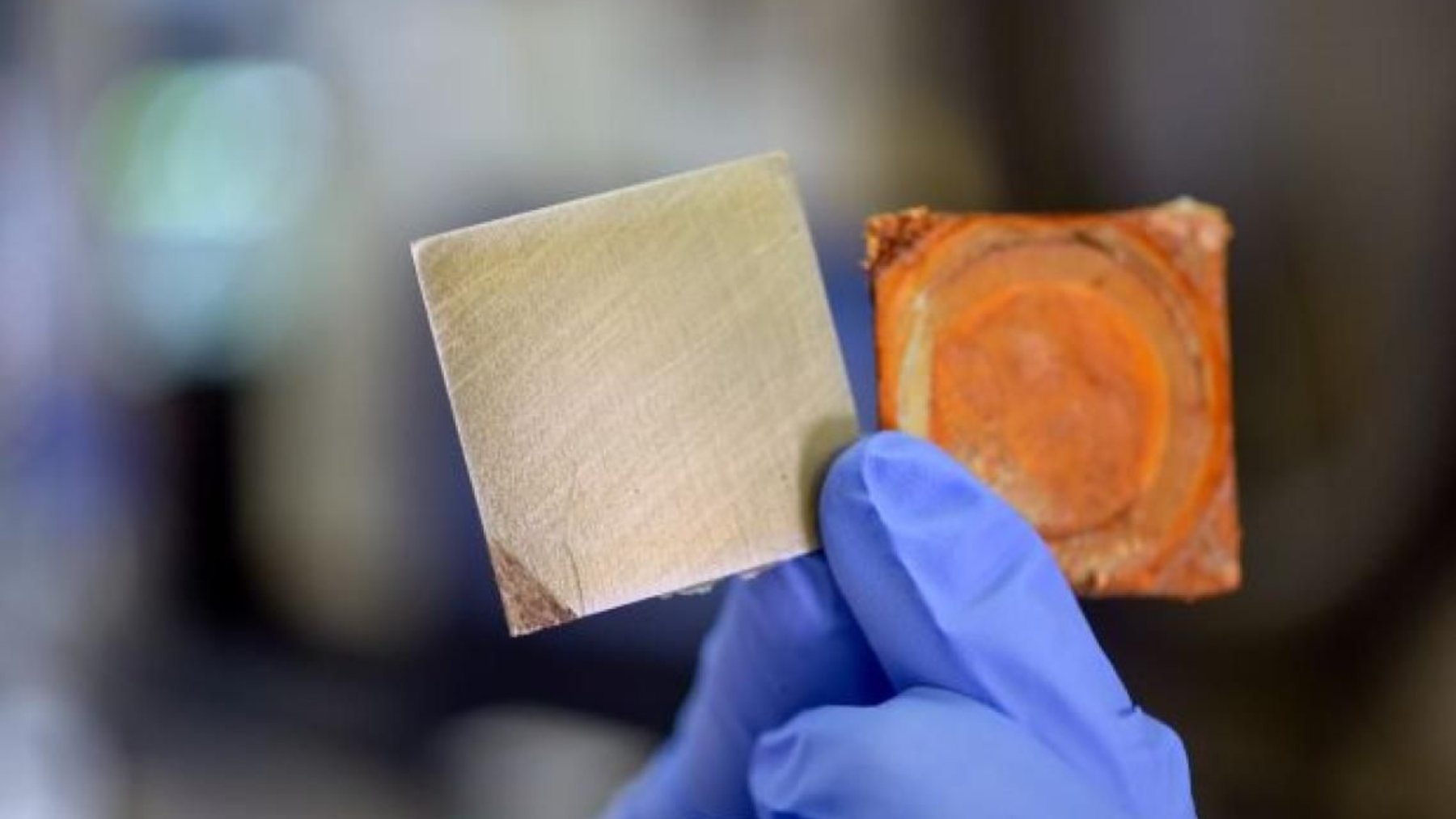
A scratch in protective paint can give rust a foothold, turning a small flaw into an expensive maintenance problem. Researchers at the University of Queensland have developed a coating designed to respond to that damage, with laboratory testing indicating a corrosion rate more than 600 times lower than the benchmark cited by the university for some high-performance products.
The technology uses tiny containers that release corrosion-inhibiting molecules when surrounding conditions change. It could eventually help protect bridges, buildings, and vehicles for longer, although the striking laboratory result does not establish that a single application will keep a real bridge rust-free for a century.
How the coating responds to damage
The research centers on particles developed by Dr. Asep Nugraha and colleagues at the university’s Australian Institute for Bioengineering and Nanotechnology. Mixed into water-based polyurethane, these particles give the coating a reserve of chemical protection that can become available when corrosion threatens.

Inside the particles is benzotriazole, a corrosion inhibitor. Changes in local acidity or alkalinity trigger its release, allowing the coating to respond chemically at damaged areas instead of relying entirely on an intact physical barrier.
“Each tiny particle is basically a nanocontainer that releases repair molecules only when the conditions demand it,” Nugraha explained. Here, “self-healing” describes renewed corrosion protection at vulnerable spots, rather than the replacement of steel already lost to rust.
What the 600-fold improvement actually means
The university reports that electrochemical testing indicated a corrosion rate of about 37 nanometers per year. Its comparison figure for many existing high-performance coatings is 0.025 millimeters annually, equivalent to 25,000 nanometers.
Putting both measurements in the same units makes the difference easier to understand. Dividing 25,000 by 37 gives roughly 676, supporting the university’s description of a more than 600-fold improvement against that benchmark.
But a corrosion rate and a coating’s service life are different measurements. The result should not be read as proof that every coated structure will last 600 times longer, or that the material has outperformed every commercial alternative under identical conditions.
The study goes beyond a headline number
Published in Small Science, the research describes containers built around a metal-organic framework called ZIF-8, with an additional silica shell. The shell helps strengthen the particles and improve their compatibility with the surrounding water-based coating.
The containers released about 4% of their inhibitor at neutral pH, compared with approximately 35% under acidic conditions and 32% under alkaline conditions in the reported tests. That contrast helps explain the intended behavior, keeping more of the protective chemical stored until changing conditions prompt its release.
The researchers also reported sustained protective performance during 39 days of immersion in a 3.5% salt solution. This provides useful evidence of laboratory durability, but decades outdoors would expose a coating to a much broader combination of weather, wear, and damage.
Why longer protection could matter
For infrastructure owners, repainting steel is more than a trip to the hardware store. Nugraha highlighted the substantial effort and expense involved in applying protective coatings to bridges, where maintenance costs can ultimately fall on the public.
He used Brisbane’s Story Bridge to illustrate the ambition, asking readers to imagine one application providing protection for more than 100 years. That is a possible future outcome being envisioned, rather than a demonstrated lifespan or a guarantee attached to the experimental coating.
There is also a potential environmental benefit if longer protection means fewer repainting cycles and less replacement material. Those savings remain a possibility rather than a measured outcome here, and the reported corrosion results alone do not quantify reductions in waste or carbon emissions.
When could the coating reach the market?
In the university’s September 2026 announcement, Nugraha said pilot-scale testing was approaching, with a commercial product targeted within five years. That puts the stated ambition around 2031, although a development target is not a confirmed launch date.
The next practical question is how well the laboratory performance translates into a coating that can be manufactured and applied consistently at larger scales. For someone responsible for a bridge or a fleet of vehicles, dependable protection over time matters more than a single impressive laboratory measurement.
For now, the research offers a promising way to make protective coatings respond when trouble starts, potentially stretching the interval between maintenance jobs. The official press release was published on the University of Queensland website on September 16, 2026.
Photo: University of Queensland