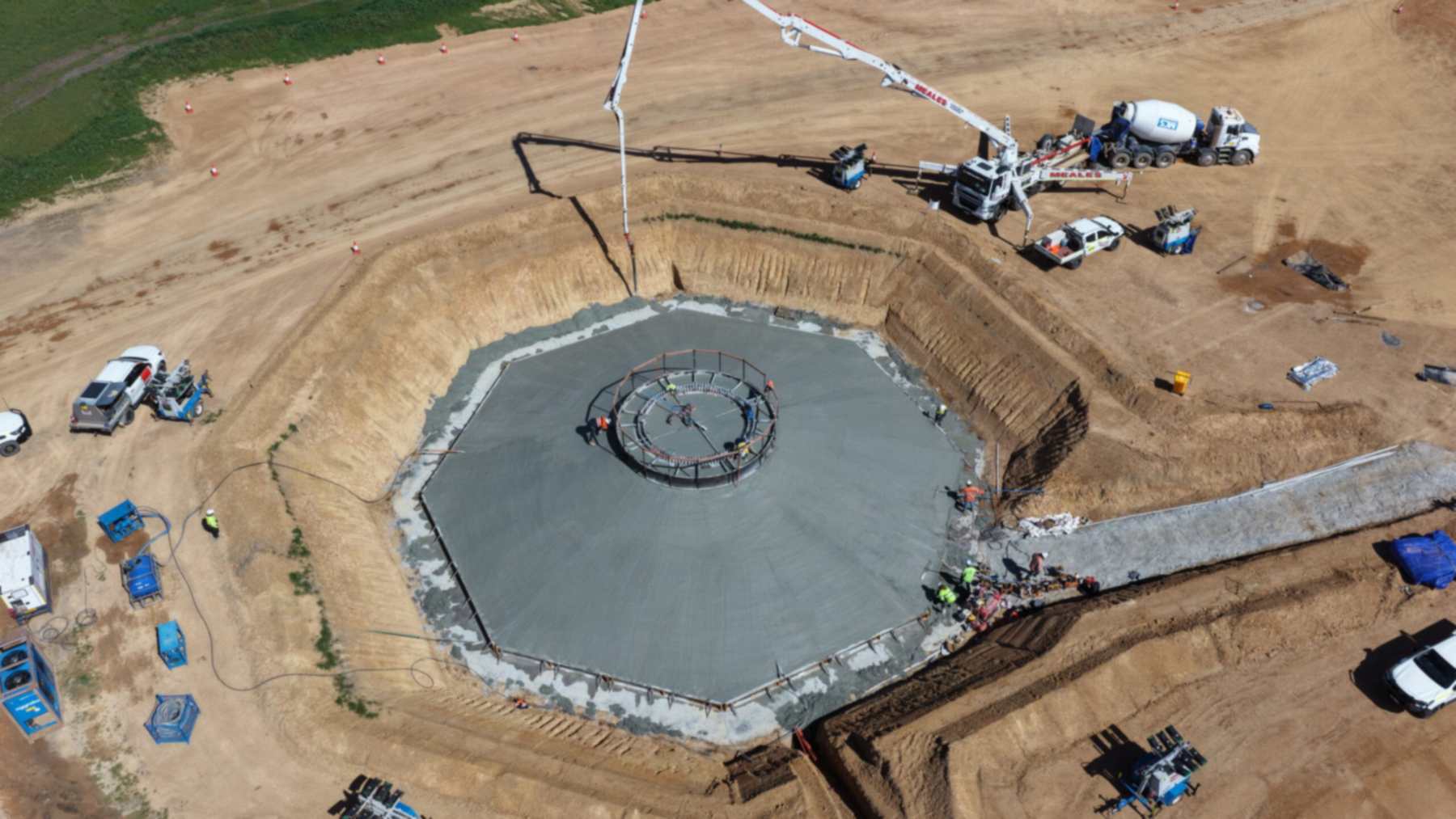
A Western Australia wind farm north of Perth has finished pouring the concrete bases for all 18 turbines. No tower has gone up yet. Developer Tilt Renewables gives the total in its November 2026 community newsletter: 13,860 tonnes, or about 15,300 U.S. tons.
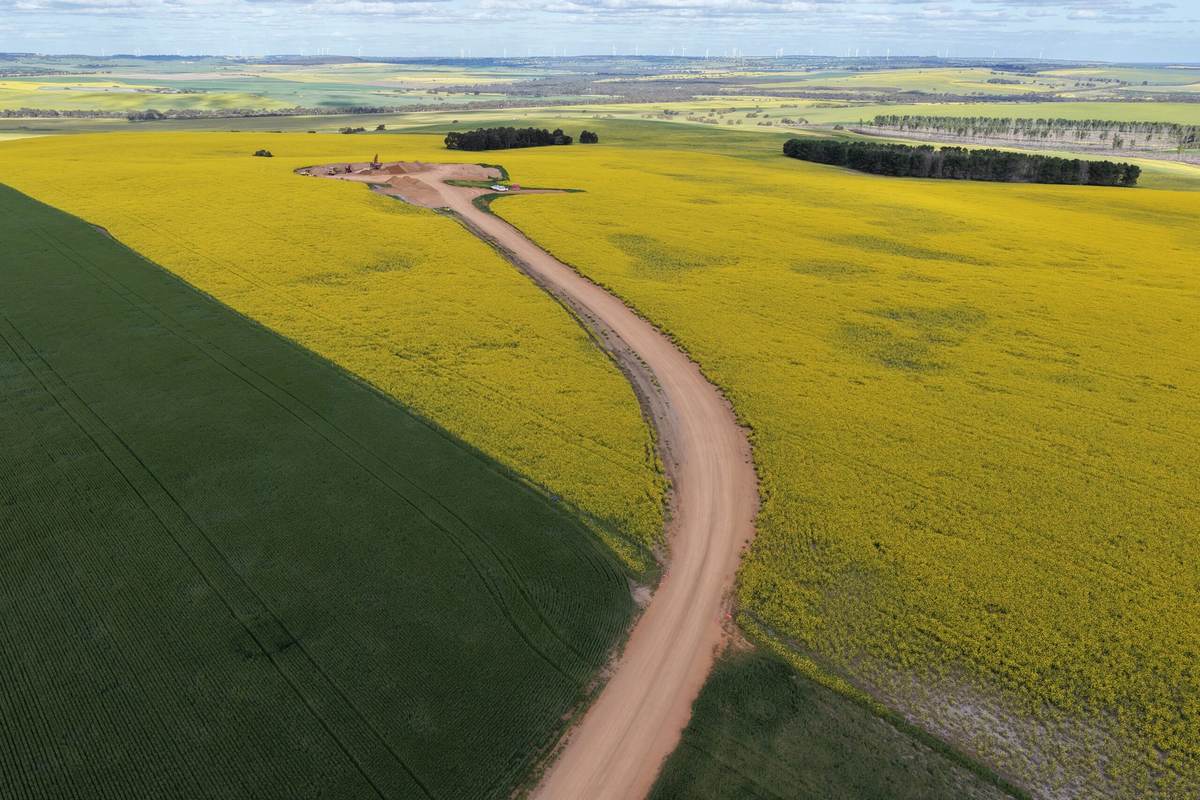
The Waddi Wind Farm lies about 93 miles (150 kilometers) from the state capital. Its site is cropland near the town of Dandaragan, in the Wheatbelt. Tilt says the finished 108 megawatts can power 68,000 homes.
Concrete mixed on site
According to the newsletter, all of that concrete came from a batch plant on the site. Workers also set 1,890 tonnes of steel reinforcement, about 2,080 U.S. tons. Split evenly, that means roughly 850 tons of concrete and 116 tons of steel per turbine.
Tilt’s construction factsheet describes foundations of this type as typically 66 feet (20 meters) wide. They go about 10 feet (3 meters) deep. A company photo shows an octagonal slab inside a broad excavated pit, with a steel ring at the center.
Beyond the pits, crews have built 16 miles (26 kilometers) of access tracks across working farmland. Three new masts now measure the wind. Network operator Western Power has begun a 4.7-mile (7.5-kilometer) overhead line to reach the existing grid.
From 57 turbines down to 18
Back in January 2012, the Shire of Dandaragan approved a very different layout. That version allowed up to 57 turbines, each 591 feet (180 meters) tall. Its indicative capacity was also 108 megawatts.
The project overview from July 2025 reaches that output with 18 Vestas V162-6.0 EnVentus machines. Each one is rated at 6 megawatts. Tilt’s May 2026 newsletter counts the smaller turbine total among its steps to protect a local bird.
Extra room for a cockatoo
Carnaby’s black cockatoo is listed as endangered under Australian federal law. Tilt’s biodiversity factsheet says the project puts its foraging, breeding and roosting habitat at risk. Turbine collisions are another possible threat.
In the approved design, the lowest blade tip rose from 59 feet (18 meters) to 190 feet (58 meters). The overview says the extra height was meant “to enhance ground clearance and create a larger buffer” for the birds.
Elsewhere, wind farms have tried red stripes painted on blades to reduce bird deaths. In England, turbine-mounted cameras tracked seabirds at an offshore site.
Other commitments stay closer to the ground. Tilt plans to revegetate 42 acres (17 hectares) of foraging habitat and install seven nest boxes. Its factsheet counts 124 potential nesting trees retained, or 98 percent.
Blades due in early 2027
Civil works should end in late 2026, when Vestas arrives to prepare for turbine installation. Blades and other components are scheduled to reach the site in early 2027. Tilt expects the first turbine then and the last by mid to late 2027.
Each finished machine will stand 676 feet (206 meters) at the blade tip. That is well short of the tallest wind turbine in Germany. Tilt’s August 2026 announcement put the whole build at about two years.
Chief executive Anthony Fowler credited the federal Capacity Investment Scheme at that event. He said it “helped provide the long-term certainty we needed to make such a large investment.” The company also holds a 15-year supply contract with AGL and targets commercial operation in 2028.
Some of the money has already reached nearby towns. The November newsletter reports A$93,000 spent on community projects and sponsorships, plus A$32,000 on First Nations benefit sharing and sponsorships. A May update lists an A$48,000 solar system and backup generator for the Dandaragan Community Resource Centre, where frequent outages had disrupted the community.
Tilt’s December 2025 announcement promised more than A$3.9 million in community funding over the project’s life. Operations should support six permanent jobs once the construction crews leave.
Collie’s closing date looms
Waddi will feed the South West Interconnected System, a grid whose state-owned coal plants were slated for retirement. A 2022 state government plan set Collie Power Station’s closure for late 2027. Muja D was to follow in late 2029.
Tilt estimates that Waddi will avoid 286,000 tonnes of carbon emissions a year, about 315,000 U.S. tons. The company compares that with taking 120,000 cars off the road. Both figures are the developer’s own projections.
Final blade clearance goes unstated
Planning approval allows a tip height of up to 722 feet (220 meters), but Tilt now lists 676 feet. The 190-foot clearance belongs to the taller approved design. Tilt’s published documents do not say what clearance the shorter machines will have.
Workforce numbers vary as well. August’s announcement cited more than 150 workers mobilized, while November’s newsletter records a daily peak of 75 on site. Neither document explains the difference.
None of the documents reviewed gives a carbon figure for the concrete and steel, so the payback time remains unknown. Evidence on the cockatoos will have to wait for spinning turbines. The factsheet names a collision monitoring program for that stage.
Photo: Tilt Renewables