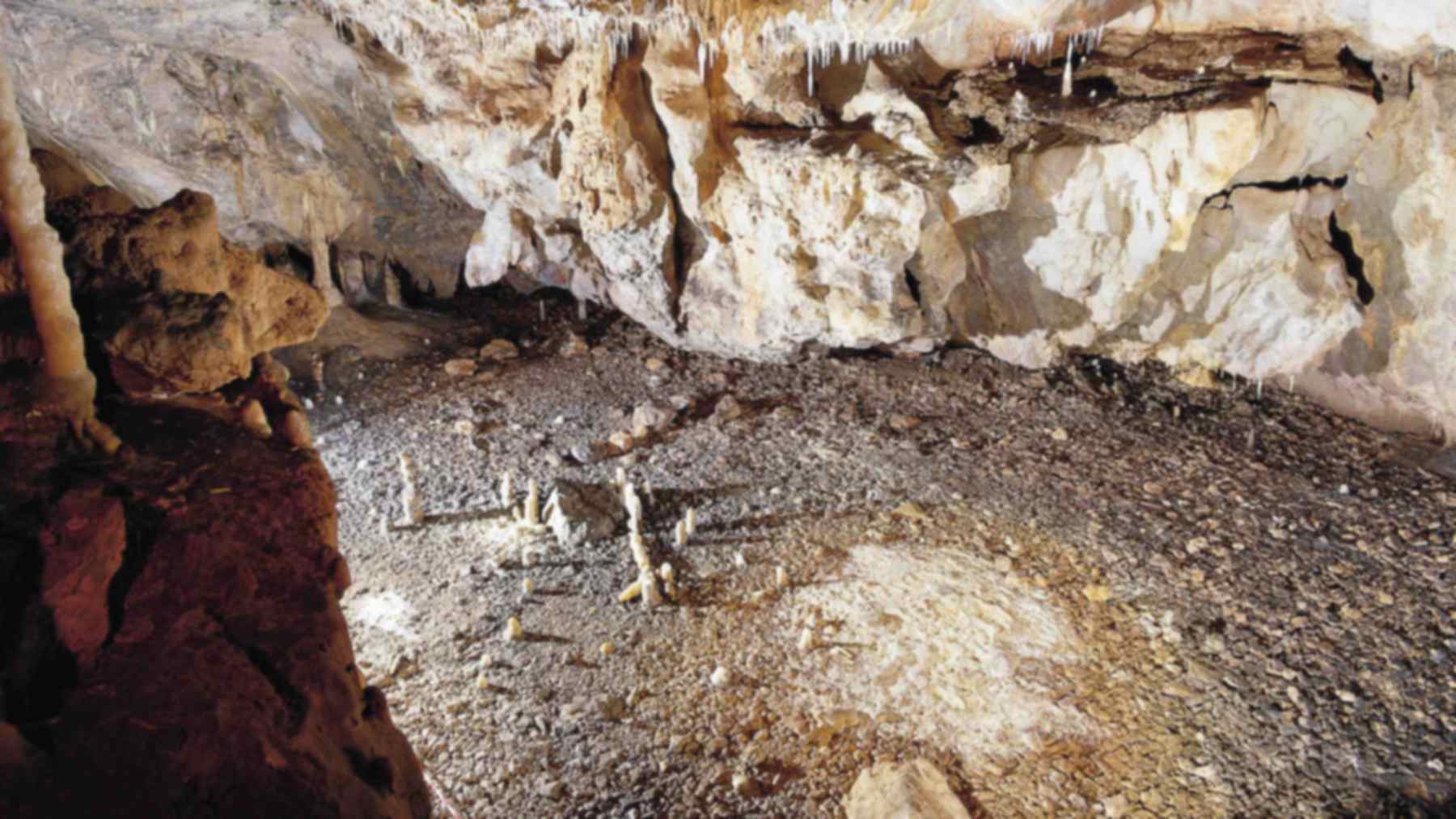
A cave in Spain called La Garma holds a Stone Age home built about 16,800 years ago. A rockfall blocked the cave’s entrance during the last Ice Age, and researchers discovered the site in 1995. The University of Cantabria ranks the hut among the best-preserved Paleolithic dwellings in the world.
Researchers have logged 4,614 objects there, from deer bones to needles and pendants. Prehistorian Pablo Arias of the University of Cantabria leads the project with Roberto Ontañón, director of Cantabria’s Museum of Prehistory and Archaeology. Both have run it since 1996.
When the entrance collapsed
La Garma lies near the Bay of Santander, in the northern Spanish town of Omoño. Its Lower Gallery runs 984 feet (300 meters). According to the team’s published paper, the original entrance closed “in about 14,500 cal BC,” roughly 16,500 years ago.
The Government of Cantabria calls the gallery a prehistoric “time capsule.” Its statement says the remains can be seen without any digging. They lie as the last occupants left them about 16,700 years ago.
That is a very different job from most Ice Age sites. At a 13,800-year-old base camp in Alaska, archaeologists had to recover more than 80,000 objects from the ground.
Sticks, hides and one fire
The hut stands about 131 feet (40 meters) from the old entrance. Stone blocks and stalagmites trace an oval of about 54 square feet (5 square meters). The university says those stones pinned down a frame of sticks and animal skins.
That frame leaned against a nearby ledge of the cave wall. The paper puts the overhanging roof at 5.2 to 5.6 feet (1.6 to 1.7 meters). A small hearth sat at the center of the shelter.
Debris around that fire records a working household. Its occupants belonged to the Magdalenian, a late Ice Age hunter-gatherer culture. They shaped tools from stone, antler and bone, processed game and worked hides.
Organic walls rarely last this long, and the sticks and skins here are gone too. The stones that held them still mark the outline. Far older wood has survived elsewhere in Spain, as with the Neanderthal wooden structures from Barcelona.
An aurochs bone with a face
Most of the 4,614 items are bones of deer, horses and bison. The inventory also lists 600 flint pieces, projectile points, needles and an early harpoon. Shells of sea mollusks turned up as well.
Several pendants and decorated bones show a less practical side of life. One perforated toe bone came from an aurochs, the huge wild ancestor of cattle. Someone engraved it with an aurochs and a human face.
The university calls that piece unique in the European Paleolithic. La Garma also has Paleolithic paintings and engravings on its walls, like the cave a boy and his dog found in 1940.
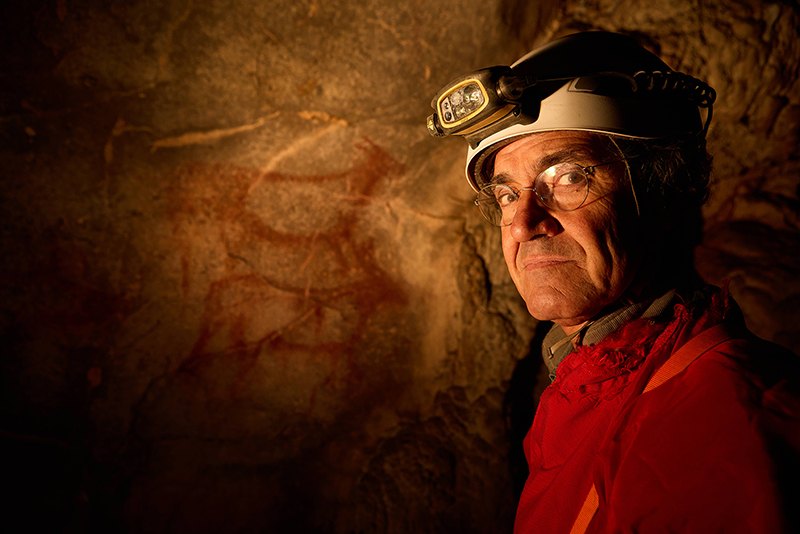
The site’s record reaches far beyond one household. Its layers span the last 400,000 years, and it sits on the UNESCO World Heritage List. On September 18, 2026, the university put the site’s inventory at more than 213,000 pieces.
A padded walkway over the floor
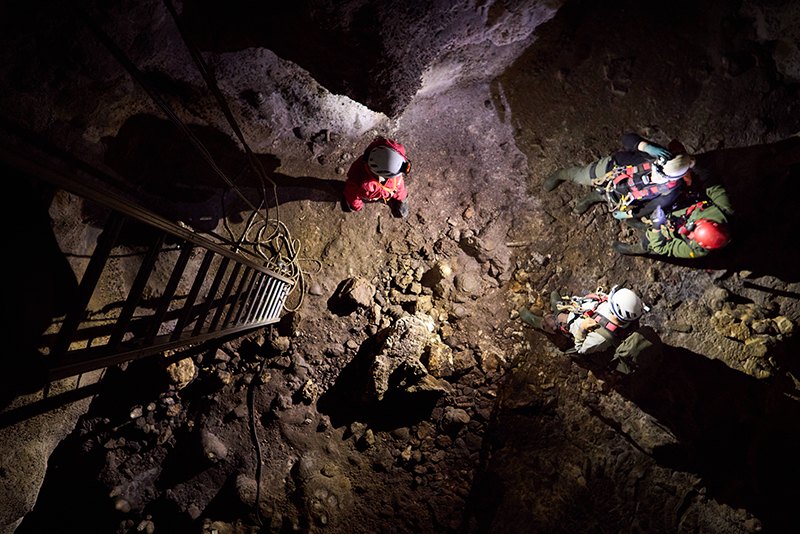
Before stepping into the study area, team members change their footwear and put on nitrile gloves. They reach the objects on a retractable aluminum walkway, 14 inches (35 centimeters) wide. Its padded feet protect the ground and the remains.
Under the cave’s environmental rules, the team can work only four continuous hours at a time, three days a week. Objects get photographed, studied and returned to their original spots.
To make those hours count, the group built what Arias calls a “paperless,” fully digital excavation. A network named Garmanet links the cave to the field lab. Researchers record finds on tablets, and barcode labels cut transcription errors.
“We are integrating everything into a single workflow, where we can access the data and work off-site,” said Carlos García-Noriega, the paper’s first author, in remarks the university released in Spanish. He said that approach respects the fragility of the site.
The team has also made more than 500 photogrammetric models, 3D reconstructions built from overlapping photographs. Specialists can examine fragile finds on them without going back underground. Broken flints can even be refitted digitally or as 3D prints.
How long anyone stayed there
Neither the official statements nor the paper say how many people slept in the hut. They also leave open how long the group stayed and in what season. The paper describes a way of recording evidence, not a reconstruction of daily life.
The numbers shift a little from one document to another. The 2023 announcement credits the hut with 4,614 objects after two years of work. The paper reports over 4,600 remains after 18 months, spread across the hut and a separate painted chamber of about 118 square feet (11 square meters).
The authors accept that studying everything in place “implies a slower process.” The full study was published in Advances in Archaeological Practice.
According to the university’s latest statement, the group has since applied its methods in Portugal, France, Argentina and Tanzania. Elsewhere, researchers are getting more from cave surfaces too, including ancient human DNA from cave walls in Portugal and Spain.
Photo: Proyecto La Garma / Gobierno de Cantabria