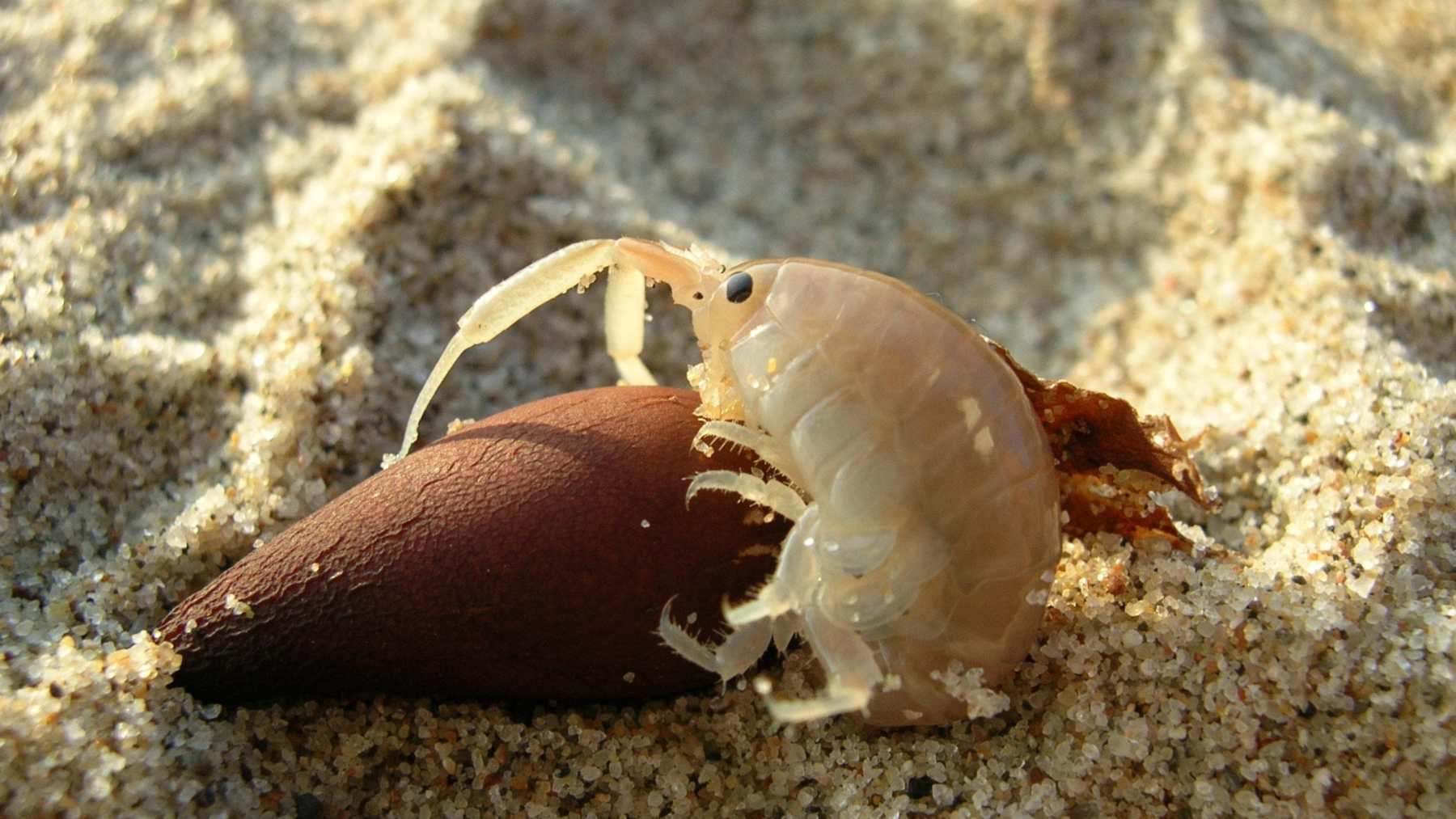
Sand hoppers about an inch long can excavate up to 110 pounds (50 kilograms) of sand per meter of California shoreline each day. A team from UC Santa Barbara and the University of Oxford reported that rate from plots at Isla Vista Beach.
Their results appeared in September in the Journal of Geophysical Research: Earth Surface. The authors rank the daily rate per unit of area among the highest mounding rates ever recorded.
These crustaceans belong to the genus Megalorchestia and feed on washed-up kelp after dark. “They have one of the highest rates of bioturbation of anything on the planet,” marine scientist David Hubbard told UC Santa Barbara’s news office. Bioturbation is the displacement of sediment by living things.
Metal frames at Isla Vista
Tim Baxter, a physical geographer now at Oxford, took up the question during postdoctoral work at UCSB. Marine scientists Hubbard, Kyle Emery and Jenny Dugan shared his curiosity, the university says.
Their test site was Isla Vista Beach, a bluff-backed stretch of shore next to the campus. After high tide on a summer night, the team set metal frames in the hoppers’ burrowing zone. The layout covered 21 sampling plots.
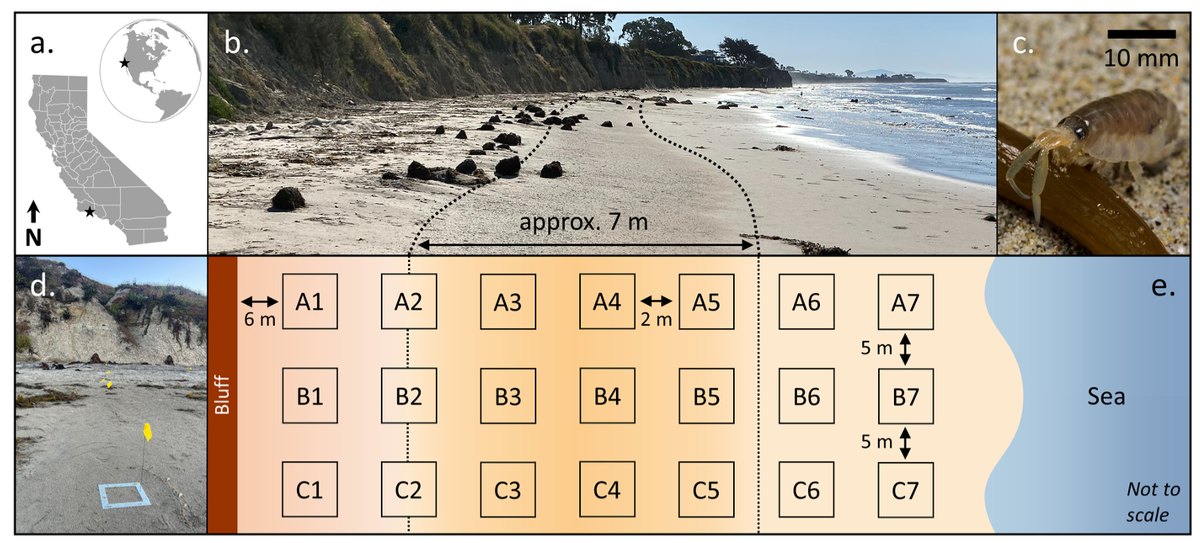
Overnight, the mounds swallowed part of the experiment. “When we came back in the morning, we couldn’t even see some of the frames,” Hubbard said, and the team was glad to have planted flags beside them.
Back at the plots, the researchers collected and weighed the excavated sand. The paper puts the top rate at 10.38 kilograms of dry sand per square meter per day. That equals about 2.1 pounds per square foot.
“It was quite impressive and we weren’t really expecting that,” Baxter said of the result.
A new burrow every night
Many burrowing animals dig one home and reuse it, but UCSB reports that sand hoppers make a fresh burrow every day. They reach 4 to 12 inches (10 to 30 centimeters) below the surface.
Moisture decides where each one digs, according to Hubbard. Burrows collapse at once in saturated sand. The animals also avoid the powdery dry sand above the high tide line, which leaves them a damp band in between.
According to the American Geophysical Union’s release, around 21,450 hoppers share that work on each meter of coastline. Each one digs up more than ten times its own body weight for every burrow.
310 tons along 15.5 miles
Across 15.5 miles (25 kilometers) of coast near Isla Vista, the hoppers would move around 310 tons of dry sand per day, the union says. The paper compares that amount with the suspended sediment of major rivers in the region.
Applying the peak rate to every meter of that coast would give about 1,250 metric tons. The 110-pound figure therefore marks the upper end of what the team measured.
For a yearly estimate, the authors added eight years of biomass records from the same beach. They arrived at about 2.79 million kilograms per hectare per year, or roughly 1,245 U.S. tons per acre per year.
Animals may be reshaping sediment elsewhere too. Off Queensland, scientists mapped 300 seabed holes around a shipwreck and suspect that fish dug them. In France, two strips of sand turned the island of Giens into a peninsula.
Buried kelp and looser dunes
When kelp or carrion lands on the beach, the digging buries it for a different group of organisms, Hubbard explained. The burrows also bring oxygen into the sand for microbes. Shorebirds and fish, in turn, eat the hoppers.
Wind or water can carry loosened sand away more easily, Baxter said. He added that the mounds may roughen the beach surface, which could affect how coastal dunes form.
California’s dunes already face other pressures, among them iceplant from South Africa crowding out native species. Baxter argues that “these activities and interactions are operating on a lot larger scale and that their impacts are really worth highlighting.”
Tractors over the burrows
Beach grooming threatens this activity, according to the union’s release. Tractors rake the sand to smooth it and remove seaweed, tearing up hoppers and their burrows.
Hubbard, a co-author, says that raking leaves “kind of a desert,” according to the release.
One beach, one summer night
The mounding rates come from plots on a single beach, so the regional figures depend on extrapolation. The supporting dataset at Oxford holds Isla Vista biomass estimates from 2013 to 2020. It adds one survey of the 25 kilometers, carried out on August 22 to 24, 2017.
Comparisons with other animals remain open as well. The union calls a South African sand prawn the only known rival among studied burrowing animals. The team weighed only the sand that reached the surface, so any mixing underground is not counted.
Blood worms and sand crabs work closer to the water and leave no easy mounds to measure, and Hubbard plans to study how their work interacts with the hoppers’ burrowing. Gemma Harvey, a Queen Mary University of London geographer outside the study, told the union that animals actively shape landscapes rather than just live in them.
The full study was published in Journal of Geophysical Research: Earth Surface.
The National Science Foundation, the UC Office of the President Climate Action Fund and the California Ocean Protection Council supported the research.
Photo: courtesy of UC Santa Barbara