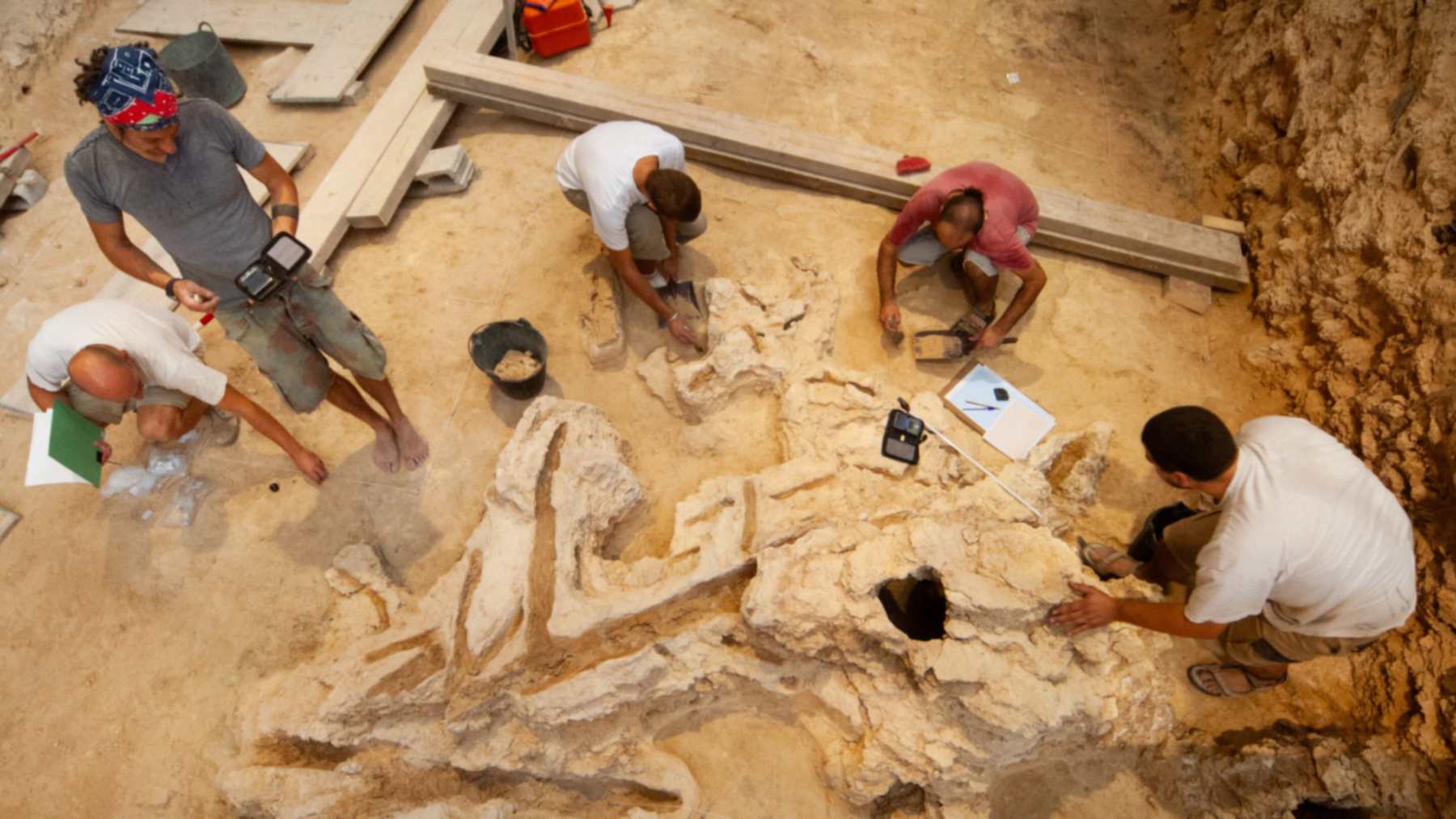
Neanderthals at Abric Romaní, a rock shelter in Capellades, Barcelona, made spears, a club-like tool, bark trays and wooden structures between about 62,000 and 40,000 years ago, according to a study of 597 wooden remains and imprints from 16 archaeological levels. One spear is about 8 feet (2.45 meters) long, and the club has no clear known parallels, says the Catalan Institute of Human Paleoecology and Social Evolution (IPHES-CERCA).
The work, published in Science Advances, was led by Palmira Saladié, a researcher at IPHES-CERCA and associate professor at Universitat Rovira i Virgili, who now directs the excavation with M. Gema Chacón and Josep Vallverdú. Of the 597 specimens, the team identified 13 wooden elements that Neanderthals made or used.
“Wood allows us to recover a fundamental part of the Neanderthal world that is usually invisible in the archaeological record,” Vallverdú said in the IPHES-CERCA statement.
A home with places to sleep and to work
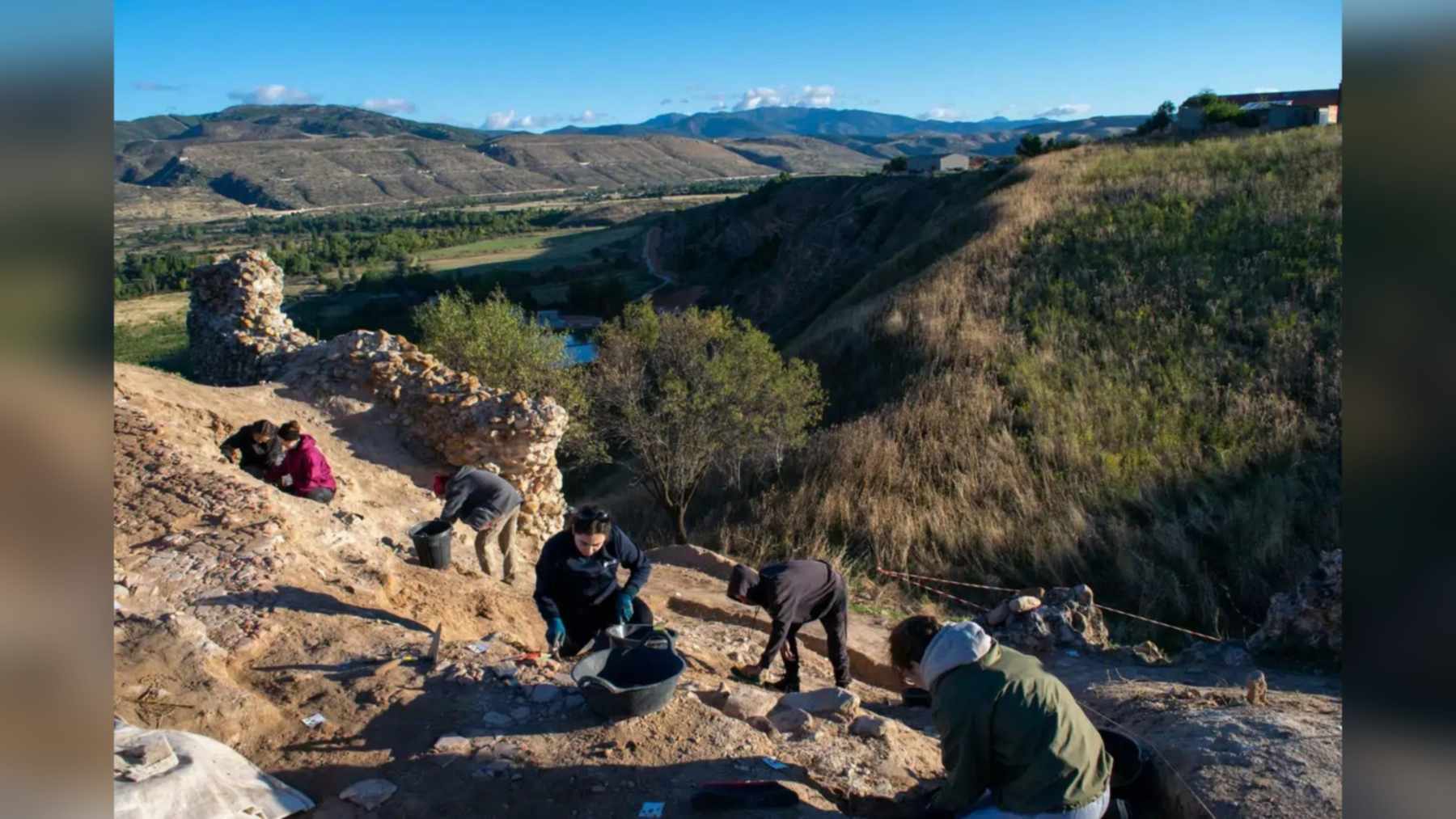
Systematic excavations at Abric Romaní began in 1983, and the shelter covers about 3,230 square feet (300 square meters), according to the paper. Some groups stayed there “for several weeks or even one or two seasons, engaging in all the activities typical of their daily lives,” the authors write.
The wood itself is long gone. Calcium carbonate built up around it, and when the organic material decayed it left natural molds in the travertine, a form of limestone. What remained were “hollow cavities that replicate the original shape of the wood,” the authors write, and some are sharp enough to show “anatomical features such as tracheids and cross-field pits,” microscopic structures inside the wood.
“What is extraordinary about Abric Romaní is that we can see things that usually disappear,” Saladié said in the statement. “We have the hearths, the stone tools, the animals they processed, and also the wood.”
Two long points from level R
The 8-foot spear came from level R, the last layer excavated to date. “The spear exhibits a slight curvature in its proximal portion, likely reflecting the natural shape of the tree trunk from which it was crafted,” the authors write, and its overall shape “can be consistent with its interpretation as a thrusting spear.” The pointed end is, in the paper’s words, “unfortunately, the most poorly preserved,” and the fracture at the other end is read as having occurred “during the manufacturing process rather than during use.”
A second pointed piece from the same level gets described in two ways. The IPHES-CERCA statement calls it a spear preserved to 6.5 feet (1.99 meters), with “clear evidence that the wood was intentionally worked,” while the paper’s text describes “a fragmented pointed implement, preserved in three sections.” A figure caption in the paper calls it a spear.
It was lying with other sticks, branches and a pinecone. That suggests “the artifact may have been discarded after breakage,” the authors write.
The red deer bones in that level carry no marks from a spear. In the paper’s words, such evidence on bones “is rare and often difficult to detect.”
A short club with scrape marks
Level P gave up the piece the paper calls “perhaps the most exceptional wooden object identified in the assemblage to date.” It is made from a single piece of wood, with a 6.3-inch (16-centimeter) handle and a pointed head 5.6 inches (14.2 centimeters) high.
Where handle meets head there is a sharp right-angle step. The authors think it “may have functioned as a stop element, either to reduce slippage or to protect the hand during use.”
Parallel striations run along the head, “indicating scraping during shaping,” according to the paper, and its shape is “more consistent with a percussive implement” than with a digging tool. The IPHES-CERCA statement says its function “remains open to interpretation.”
The only other possible wooden club from the Paleolithic was reported at Kalambo Falls in Zambia and is about 400,000 years old.
Bark trays, a raised frame and a long pole
Four concave pieces of charred bark from levels H and O are 12 to 22 inches (30 to 55 centimeters) long. They sat near hearths. At least one is juniper, while pine dominates both the firewood and most of the worked wooden objects at the site.
In level I, three straight sticks lay over a thick hearth, two of them crossed on the ground. The longest is about 5.6 feet (170 centimeters), and the team thinks they were part of a raised structure, “conceivably related to food processing.”
Level N had a 16.7-foot (5.1-meter) pole with no branches left on it, beside five hearths in what earlier work read as a sleeping area. It “most likely formed part of a more complex architectural arrangement composed of perishable materials that have not been preserved,” according to the study.
What the molds cannot show
The authors are open about the limits of their evidence. “The travertine molds encasing the wooden objects and tools/weapons from Abric Romaní have made analyzing the processes by which they were manufactured challenging,” they write.
The bark trays are a case in point. The paper acknowledges “the difficulties involved in distinguishing intentionally modified bark containers from bark fragments detached naturally,” and points to their size, their regular shapes, their position next to hearths and the use of juniper bark as reasons to read them as tools.
Wood chips under 2.4 inches (6 centimeters) were found in levels I, J, K, L, M, O, Q and R. Use-wear studies of the stone tools could not confirm that they came from woodworking, since a white patina and water erosion have altered their surfaces, and the authors write that “It is important to note the limitations of functional studies at Abric Romaní.”
Wood in a story long told through stone
For Vallverdú, the finds widen the picture. “What we see at Abric Romaní is that this material was part of many aspects of their everyday lives and that Neanderthal technology therefore extended far beyond stone,” he said.
The paper sets the finds next to wooden tools from Schöningen in Germany, Poggetti Vecchi in Italy and Aranbaltza III in Spain, and to Marathousa 1 in Greece, where a 430,000-year-old piece of wood carried cut marks. A sealed chamber in Gibraltar has shown Neanderthals as coastal hunters and glue makers, and genetics is filling in the picture as well, with ancient DNA from 27 late Neanderthals in Belgium and France.
The full study was published in Science Advances. Excavations at the shelter continue under a four-year project, Territoris Prehistòrics a la Conca de l’Anoia (2026-2029), approved by the Government of Catalonia’s Department of Culture.
Photo: Gerard Campeny / IPHES-CERCA