Astronomers at the University of Warwick have identified what they describe as the first known green star in the Galaxy. It is a white dwarf called WD J1330+6435, a dead star of about 7,200°F (roughly 4,000°C). The university says no other star has been credibly reported as green.
Mark Hollands, a Warwick Prize Fellow in astronomy and astrophysics, led the work. His coauthors are Boris Gänsicke and Pier-Emmanuel Tremblay of Warwick and Detlev Koester of Germany’s University of Kiel. Nobody has seen this star glow green through a telescope, since the color comes from calculations based on its light.
Water-thick air around dead stars
For most stars, color works as a thermometer. Warwick’s researchers note that cooler stars look orange and the hottest ones pale blue. Stars like our Sun look white.
White dwarfs are the dense remnants left when Sun-like stars reach the end of their lives, and they were thought to follow the same rule. Their atmospheres changed that assumption. The coolest ones can reach about 1 gram per cubic centimeter, close to the density of water.
At those densities, traces of carbon, calcium and sodium absorb a much wider range of colors than usual. “It turns out these incredibly dense stars can produce colours nobody expected, and some of them genuinely surprised me,” Hollands said.
Sodium strips out the orange
According to the university, WD J1330+6435 has pulled in rocky material from its own planetary system. That material left calcium, lithium and sodium in its atmosphere. The study says sodium absorbs orange wavelengths and calcium absorbs violet ones, so the star’s light peaks near 500 nanometers.
“The traces of sodium in the atmosphere of this white dwarf absorb the orange part of the spectrum, leaving behind a ghostly green glow,” Hollands said. He added, “Imagine standing on a planet and looking up at a green star.”
Of the 36 metal-rich white dwarfs the team examined closely, this one is the most vivid green. Two others, WD J0851+1543 and WD J1351+2645, also come out green. The paper describes both as much paler.
Color calculated from starlight
No white dwarf sits close enough for anyone to see its color directly, so the team worked from spectra, which record how much light a star gives off at each wavelength, and similar light measurements help astronomers study distant atmospheres. Here, each spectrum went through a model of human color vision.
The green disk in Warwick’s artwork is an illustration by the artist Mark Garlick, and it is not a photograph. In the team’s simulated image, WD J1330+6435 is most vivid at the center. Its color fades toward the edge, where the outermost pixels turn orange.
Pink, cyan and salmon stars
Applied across the sky, the method sorted white dwarfs into color families tied to their chemistry. Carbon-rich stars typically come out pink or purple. Those enriched with debris from shattered asteroids and comets lean yellow.
Cooler stars with mixed hydrogen and helium atmospheres often turn cyan or pale blue. Warwick attributes that tinge to hydrogen molecules colliding with helium atoms.
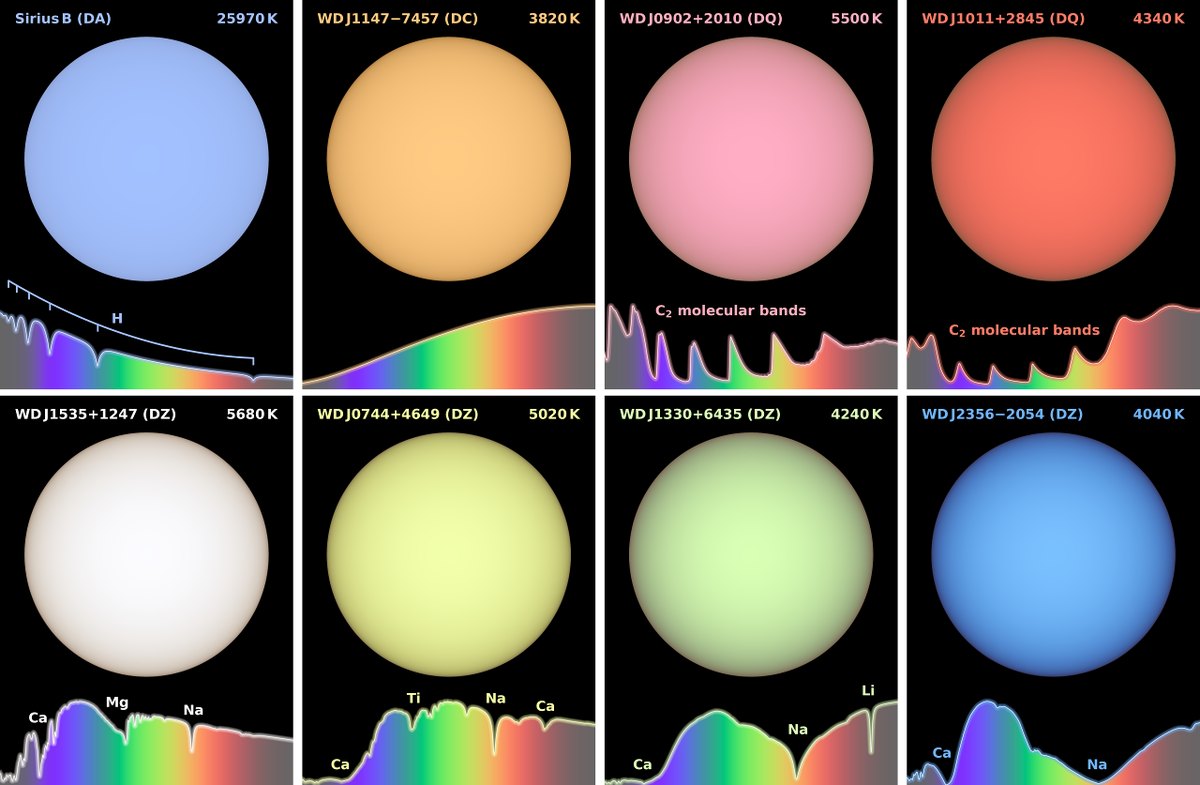
At the other extreme sits WD J1011+2845, just 48 light-years from Earth and possibly the reddest star on record. Warwick says convection has lifted carbon from its core to its surface. The resulting molecules push almost all of its light beyond 600 nanometers, for a deep salmon-pink glow.
Carbon molecules also explain WD J0902+2010, another pink star in the study. They absorb strongly across blue, green and yellow light.
One oddball in every thirty
To measure how common these colors are, the team turned to roughly 150 white dwarfs within 65 light-years of Earth. Five showed unusual coloring, two yellow and three pink. That suggests about one white dwarf in thirty has an unusual color.
Boris Gänsicke, a professor in Warwick’s Department of Physics, put that share in perspective. “One in thirty might not sound like a huge fraction, but across the entire population of white dwarfs in the Universe, that is still a lot of oddly coloured stars out there,” he said.
The rest of the sample had a median color temperature near 6,800 Kelvin, which people perceive as white. Light bulbs are labeled on the same scale. White dwarfs are often assumed to be blue, but hotter ones are brighter and show up more often in surveys.
A noisy spectrum behind the green
The green label rests on a model and on imperfect data. The authors acknowledge a somewhat noisy spectrum for WD J1330+6435 and say its real color may differ slightly. An older model of the same star produced a similar hue.
Warwick also limits its claim of a first to what its researchers are aware of. The simulated portraits cannot show true brightness either, because these stars would be many millions of times brighter than a screen can display.
The full study was published in RAS Techniques and Instruments, and a preprint of the paper is openly available.
Image: Mark A. Garlick / University of Warwick