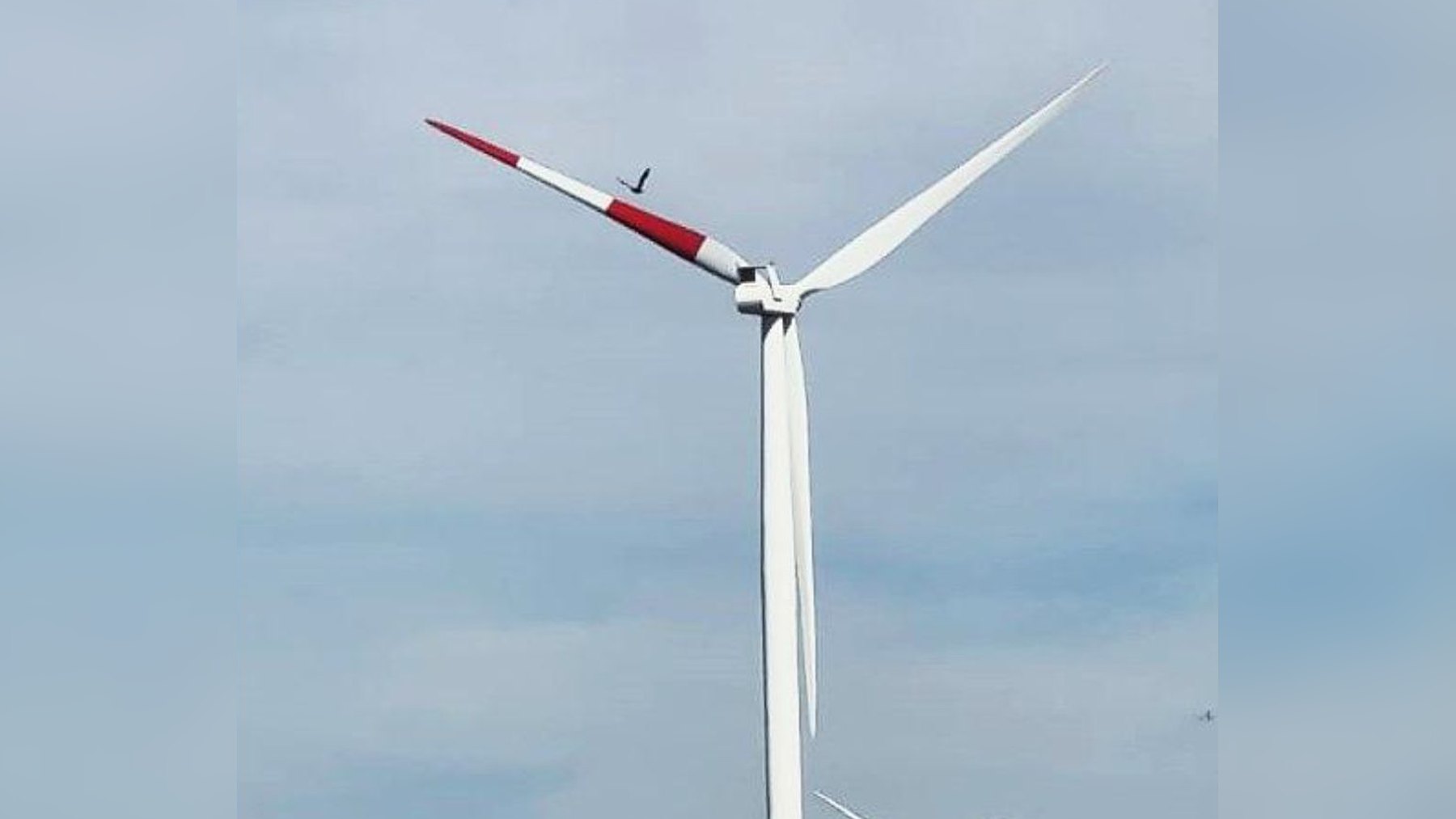
In October 2023 someone at the Umoya Energy Wind Farm near Hopefield, South Africa, took a photo of an adult Jackal Buzzard swerving away from a turbine. One of its white blades had two red stripes painted across it. That photo is now in a preprint which estimates that bird deaths at four turbines with two red stripes fell by a median 83 percent.
“Two broad ‘signal red’ stripes were applied to a single blade at four high-fatality turbines, in 2023 by Umoya Energy,” the authors write. In the 32 months that followed, searchers found 25 birds killed by blades at the 20 turbines they checked. Twenty-three were under the 16 turbines left white. Two were under the four striped ones. The groups differ in size, so those totals are not a like-for-like comparison. Per turbine, they work out to about 0.5 dead birds at each striped machine and about 1.4 at each white one.
The paper was posted on bioRxiv on May 7, 2026. It is a preprint, and the server marks it as “not certified by peer review.” It has not yet appeared in a peer-reviewed journal.
The work was led by Robert Simmons of the FitzPatrick Institute of African Ornithology at the University of Cape Town. His co-authors are Marlei Martins of Birds & Bats Unlimited and Francisco Cervantes of the Pyrenean Institute of Ecology in Spain.
An eagle that did not swerve
Simmons and Martins have seen a blade hit a bird. On July 27, 2016, at the Jeffreys Bay wind farm in the Eastern Cape, they watched two Jackal Buzzards chase a young Martial Eagle, Africa’s largest raptor. Not long after, a blade tip moving at about 89 mph (144 km/h) struck her on the right flank.
“Despite eagles’ high acuity vision, this individual took no evasive action to avoid the white blade travelling perpendicularly towards her,” they wrote in the journal Ostrich in 2024.
“Birds do not see black and white contrasts as well as we do,” Simmons told AFP in a report the Saturday Star ran in October 2025. “They, therefore, do not see a white blade spinning against a cloudy sky. This is very likely why they do not avoid it.”
The new paper says the same about raptors. Birds die “due to their apparent inability to detect moving blades and avoid them, and paradoxically this is especially so for raptorial birds despite, their legendary vision,” it reads. Our earlier story on a blind spot in the vision of golden eagles looked at another part of the problem.
Black was not allowed
The first field test was on Norway’s Smøla island, where researchers painted one blade black on four turbines after white-tailed eagles kept dying at Smøla’s turbines. “Fatality rates dropped by 72% for all birds,” the Hopefield preprint says of that work.
The team would have preferred black. “Red was used in preference to black due to constraints imposed by South African civil aviation authorities on the use of black on tall structures,” the authors write. A 2023 briefing note he co-wrote puts it more bluntly: “Theoretically, black is the best colour (see section 3 below), but SA CAA rejected this.”
The aviation authority approved red stripes on four turbines in August 2022. “Wind turbines are finely balanced machines,” Ryan Hammond, CEO of EIMS Africa and the Umoya Energy Wind Farm, said in a February 2023 statement shared by the South African Wind Energy Association. “Adding any additional weight to wind turbine blades can affect their performance and so the blade painting process required various testing procedures and approvals.”
Weekly walks under the turbines
Umoya has 37 Vestas turbines. Their hubs sit 312 feet (95 meters) up and the blades are 164 feet (50 meters) long. Two year-long surveys before painting, the second in 2020 and 2021, found 75 dead birds of 23 species. About a third were raptors.
“For conservation purposes, we chose four of the nine turbines that had previously killed the most birds or red data species, for treatment,” the authors write. “Blade painting was undertaken over 3 months (January to March 2023), in situ from a raised platform, and two coats applied.”
Searches started again in April 2023. “Throughout, we followed the same methods of carcass searching, within an 80m radius of the tower, walked by two observers 6 m apart,” the paper says. That covers the ground within about 262 feet of each tower, every week.
Some birds were left out. “Evidence from all years suggested that Cape Spurfowl Pternistis capensis were tower-collisions, not blade strikes, because they were found within a few metres of the towers and showed no traumatic injuries,” the authors write. Without them, the four painted turbines went from 13 deaths in 24 months to two in 32 months.
A wide range around 83 percent
The team used a Before-After-Control-Impact design. It compares how deaths changed at painted turbines with how they changed at unpainted ones over the same time. A Bayesian model gave a median 83 percent reduction against the four nearest neighbors and the same against all 16 controls.
The 95 percent credible intervals are 14 to 98 percent and 30 to 97 percent. “This means that there is a high degree of uncertainty associated with these median values,” the authors write. They add that they “found strong statistical evidence for an effect.”
Raptors and the black harrier
The four chosen turbines killed seven raptors of six species before painting. One was an Endangered Black Harrier. After painting, “only one raptor (a young, Yellow-billed Kite Milvus parasitus) was killed in the 32 months following the treatment at the patterned turbines,” the paper says. The 16 control turbines killed eight raptors in that time.
“If we were to kill an extra three to five adult black harriers per year through wind farms, the population will go extinct within 75 to 100 years,” Simmons told AFP. “It’s one of the first species in South Africa, possibly even in Africa, for which we know that wind farms can have a direct effect on the potential extinction.”
Three pairs of black harriers bred inside the Hopefield facility in 2024 and 2025. “The most vulnerable of those to population instability, the Endangered Black Harriers, suffered no further deaths at the patterned blades,” the authors write.
Why red might work
“We inadvertently tested the use of an alternative colour (Signal Red) at Hopefield,” the authors write. They think the color may matter. “The strong effect of red stripes may arise from both the high contrast it provides and the possible warning effect that red may elicit,” the abstract says. Many butterflies, beetles and amphibians use red and orange as warning colors.
Black blades have had mixed results. A team led by Roel May of the Norwegian Institute for Nature Research reported in Ecology and Evolution in September 2026 a 74 percent drop in bird deaths at the El Ruedo wind farm in Cádiz, Spain, though the effect was weaker for birds of prey. At Eemshaven in the Netherlands, seven black-bladed turbines showed no significant reduction.
May argues the bigger fix comes earlier, in choosing where turbines go. “If you’re painting blades black or doing curtailment that means you know you have a problem,” he told Yale Environment 360 in 2025. In Wyoming, one wind farm uses AI-powered cameras that slow turbines when eagles approach.
What the trial cannot answer yet
“We must also acknowledge that choosing high fatality turbines, rather than selecting turbines randomly for treatment may skew our results,” the authors write.
“These results are based on un-corrected carcass searches,” they add. Earlier work at the site suggested searchers found only about 52.6 percent of dead birds. The bias should affect painted and control turbines the same way.
Light is another gap. The authors note that red on white likely gives less contrast than black on white. Hopefield gets about 110 foggy days a year, but “effectiveness at dawn, dusk and at night remain unexplored,” the paper says. Verreaux’s Eagles and Cape Vultures, two threatened species often killed at South African wind farms, do not occur at the site.
Once the paint is on there are no further costs, the authors argue, and “the blades can be ordered pre-patterned from the factory as necessary.” A 2023 briefing note from the South African Wind Energy Association and BirdLife South Africa warned that “no one measure will completely eliminate fatalities in every situation.”
The full study was published as a preprint on bioRxiv. The El Ruedo study is in Ecology and Evolution.
“We cannot continue burning fossil fuels,” Simmons told AFP. “Some species, like the black harrier, will not survive climate change. But we also cannot sacrifice numerous birds on the altar of renewable energy.”
Photo: Simmons, Martins and Cervantes, bioRxiv