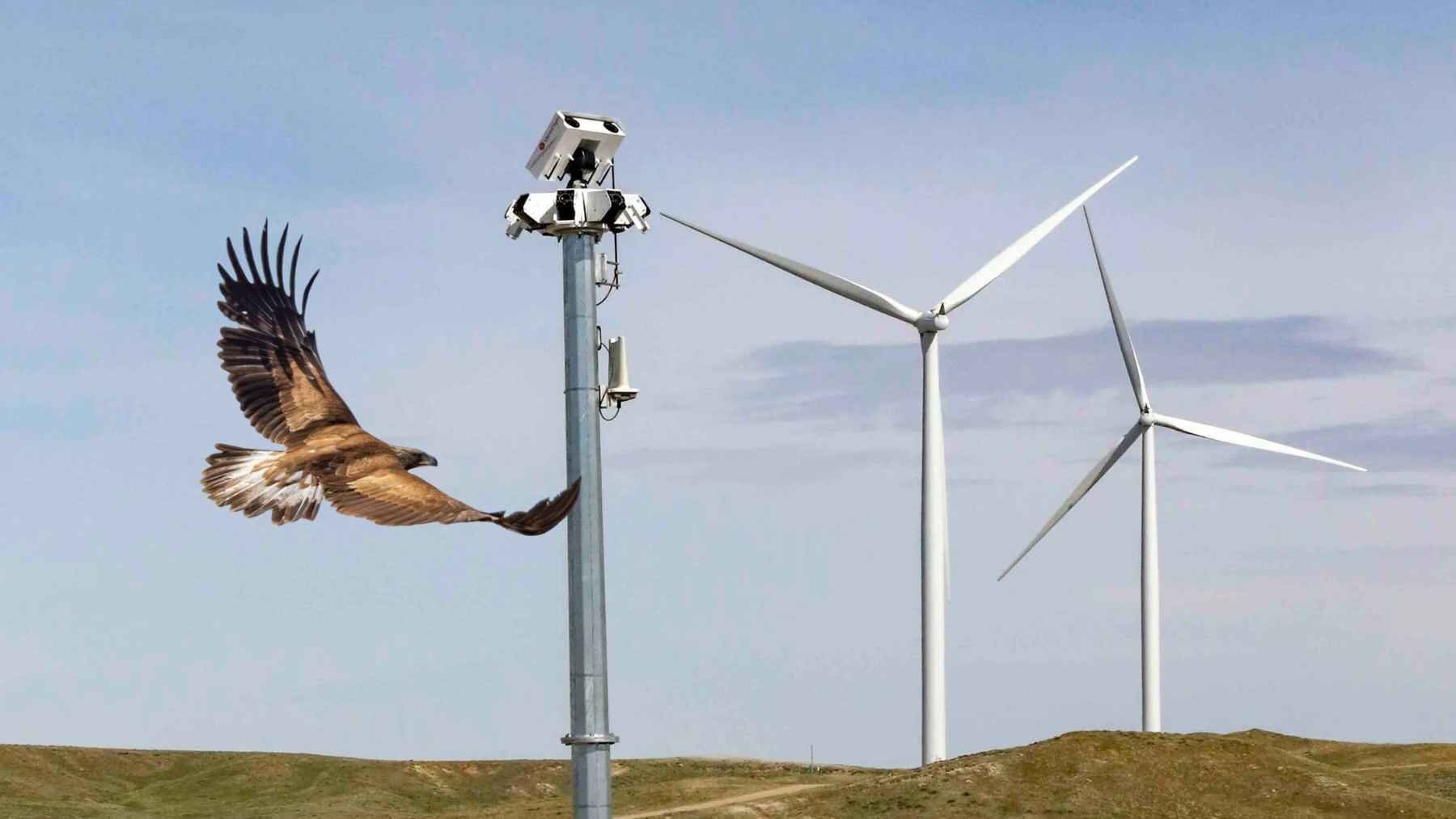
A golden eagle hunting over Wyoming’s sagebrush may spend much of its flight scanning the ground for rabbits and other prey. Research on eagle vision suggests that this posture can leave a broad blind area above the head, making even a large turbine harder to notice directly ahead.
At Top of the World, a 200 MW wind farm in Converse County,47 camera stations now watch a site containing 110 turbines and order short, targeted shutdowns when an eagle approaches. The original field study estimated an 82% reduction in eagle fatalities relative to a nearby control site, but later debate shows why that number should be treated as strong site-specific evidence, not a guarantee.
Why eagles miss the danger
Why would a bird with famously sharp eyesight fly toward a turbine? Golden eagles can spot prey at a great distance, but when they tilt their heads to scan below, a blind zone can hide objects ahead and above them.
Tim Hayes, then environmental director at Duke Energy’s renewable business, compared them to “teenagers on their cell phones,” a blunt image for birds whose attention is fixed on dinner rather than moving machinery.
Seven people across 17,500 acres
Before the automated network, the site relied on seven full-time employees with binoculars to watch 17,500 acres of grassland, scrub, and ranchland. When someone spotted an eagle, the observer radioed an operator to stop a string of turbines.
Those shutdowns could last up to an hour because a person at ground level could not always tell which rotor posed the real risk. In practical terms, protecting one bird could mean idling far more equipment, for far longer, than necessary.
How the 47 camera towokers work
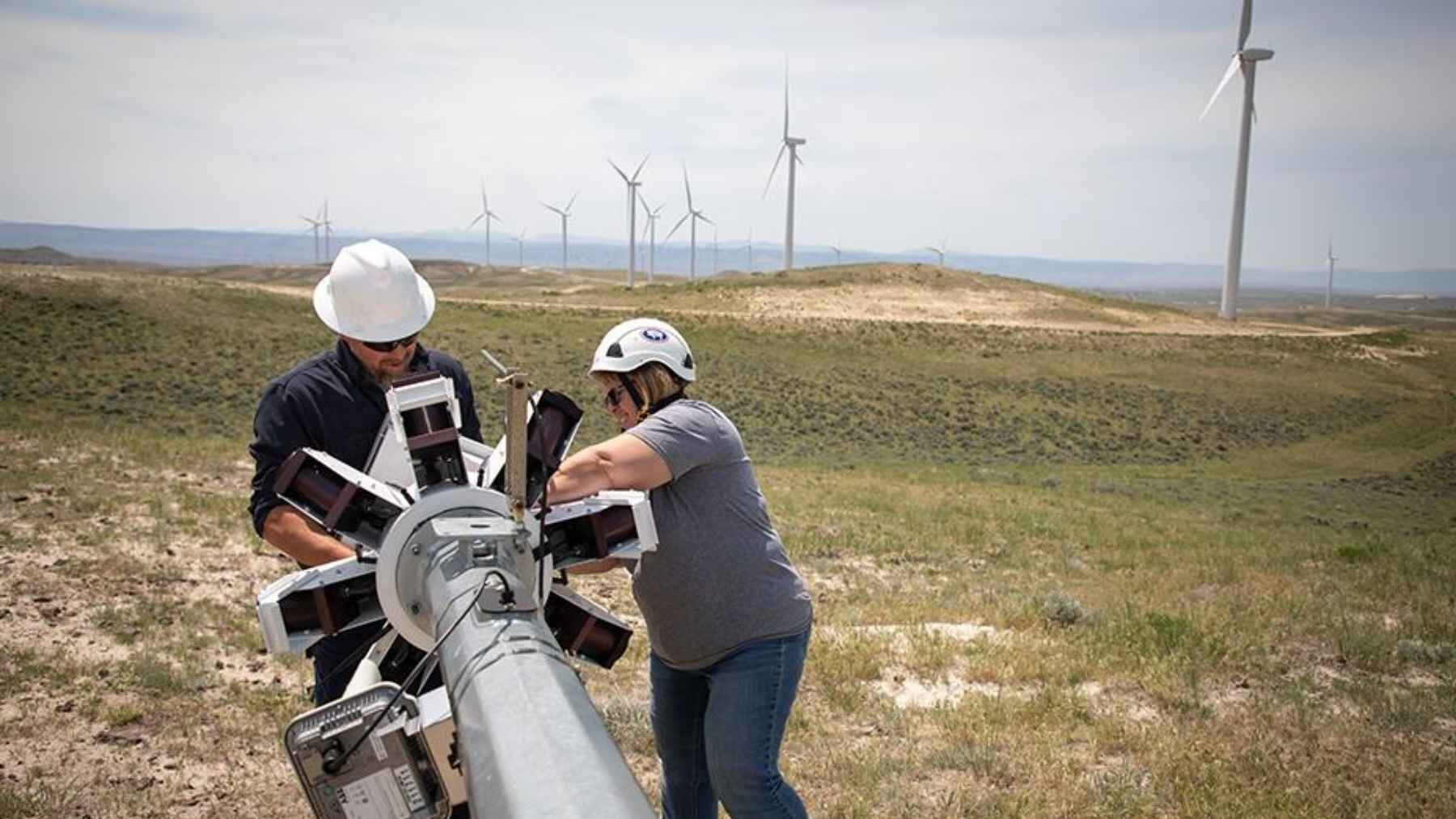
Each unit sits on a roughly 30 ft. pole and combines eight wide-angle cameras with a robotic tracking camera. The software detects motion, estimates an object’s position and flight path, and decides within seconds whether it is looking at an eagle.
IdentiFlight says its current system can detect birds up to 1 Km away and make a classification decision in under two seconds. At Top of the World, a risk alert typically stops one or two turbines and keeps them idle for about three minutes after the eagle leaves.
The 82% result
The 2021 peer-reviewed study used a before-after-control-impact design, comparing Top of the World with the nearby Campbell Hill facility, which did not use automated curtailment. After correcting for carcass detection and scaling results to turbine-years, the authors estimated a 63% drop at the camera-equipped site and a 113% increase at the control site.
Taken together, that produced the headline estimate of an 82% reduction in the fatality rate relative to the control. The researchers also stressed that fatalities were not eliminated and called the technology one part of a broader mitigation plan.
A later update strengthened the case
In 2022, the same team added more data and revised its analysis after receiving methodological suggestions. The updated estimate was an 85% reduction, with a 97% probability that the fatality rate fell at the treatment site relative to the control.
However, the uncertainty band was wide, running from 12% to 100%, and the authors warned that the result was specific to this site, these species, and this curtailment setup. That is a promising signal, not a universal performance label.
Why scientists still disagree
A separate 2023 reanalysis argued that the original effect was overstated because the comparison had only one treatment site, one control site, limited post-treatment data, and disputed choices about carcass inclusion. The original study was also partly funded by IdentiFlight International, although its authors said publication approval was not a condition of that funding.
The critique’s alternative estimate was 50%, with uncertainty broad enough to include no benefit or even an increase, while the original authors replied that the reanalysis mishandled control data and carcass criteria. On balance, the Wyoming evidence favors a real reduction, while the exact size remains contested.
The system still has blind spots
Automation also brings its own errors. At a California wind project, a 2023 PLOS ONE study found that IdentiFlight correctly identified 77% of eagles and 85% of non-eagles, while non-eagles, mostly ravens, triggered six times as many virtual shutdown orders as eagles.
Nor does an eagle-focused camera network solve bat mortality, which often requires different nighttime curtailment or deterrent strategies. At the end of the day, a wind farm needs a toolbox, not one silver bullet.
A more precise compromise
Top of the World is now listed in Deriva Energy’s portfolio, but its camera program began under Duke Energy and remains a useful case study. It shows that renewable power is not impact-free, yet faster detection and turbine-specific shutdowns can make the conflict with wildlife smaller.
The updated study was published in Ecological Solutions and Evidence.