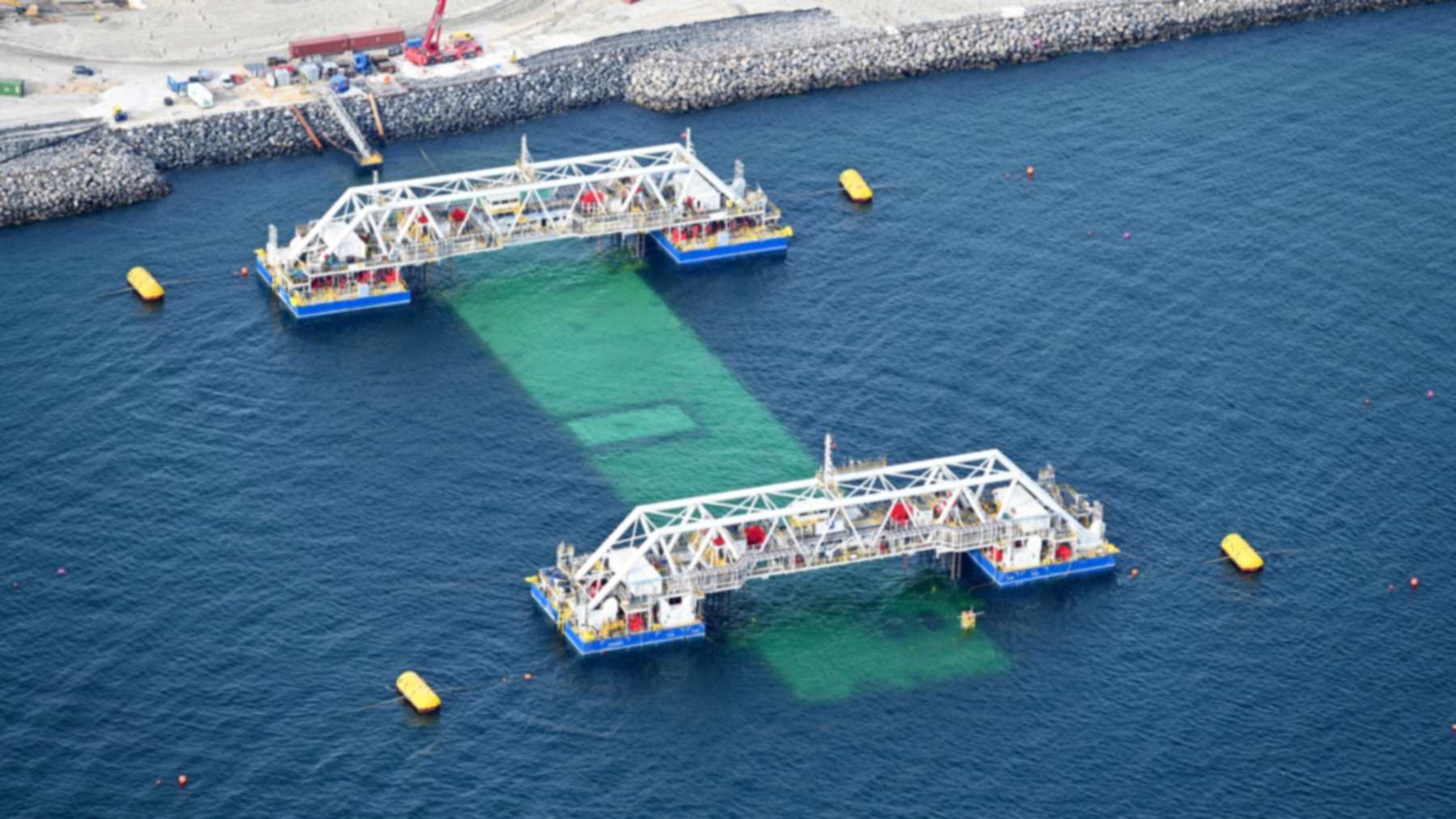
The Fehmarnbelt tunnel between Denmark and Germany now has nearly 2,950 feet (900 meters) of structure on the seabed. Owner Sund & Bælt said on Sept. 28, 2026 that a fourth concrete element had reached the trench off Lolland.
Each of those standard elements runs 712 feet (217 meters) and weighs more than 81,000 tons (73,500 metric tons). When finished, the link will stretch about 11 miles (18 kilometers) from Denmark’s Lolland island to Germany’s Fehmarn. The company says no immersed tunnel in the world will be longer.
Engineers build this type of tunnel in sections on land, float them out and sink them into a dredged trench. Brazil plans the same method for its first immersed tunnel, between Santos and Guarujá. With four of 89 elements placed here, 85 are still waiting.
Four placements since May
Tugboats pulled the first element out of the factory harbor at Rødbyhavn late on May 4. Immersion started around noon on May 6, and roughly 14 hours later the block sat in front of the Danish tunnel portal.
According to Sund & Bælt, the second element reached the seabed on the morning of June 27. The third was connected on August 1, about 1,640 feet (500 meters) from the Lolland coast. Five tugboats handled both tows, and crews then packed stone and gravel along each element’s sides.
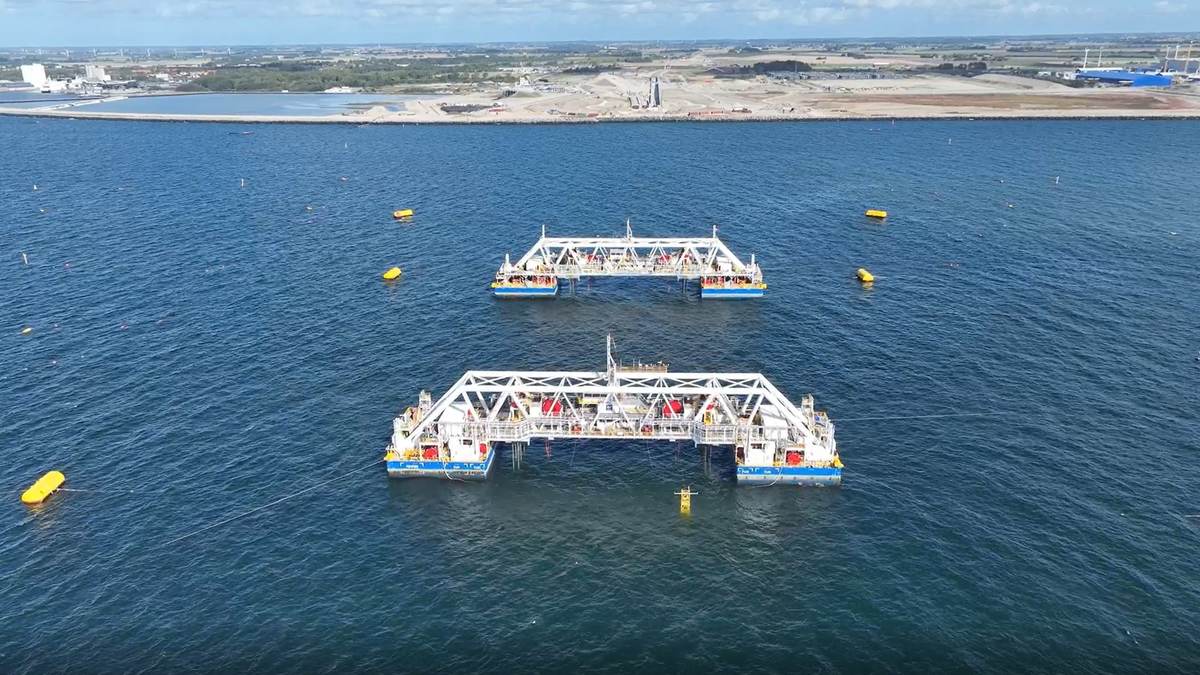
Those operations came five to eight weeks apart, a rhythm the owner hopes to shorten. “As the contractor gains more experience with the process and the equipment, we expect to increase the pace of the work,” Lasse Vester of Sund & Bælt said in June.
A load test with water bags
Up next is the first of 10 special elements, which sit about 1.2 miles (2 kilometers) apart along the route. Sund & Bælt gives its size as 128 feet long, 154 feet wide and 43 feet high (39 by 47 by 13 meters). The company expects to immerse it this fall more than 66 feet (20 meters) down.
Basements in these pieces will hold the tunnel’s technical installations. At road level, each one includes a lay-by where a service vehicle can stop without blocking motorway traffic.
That extra level makes the element ride higher in the water during transport. Buoyancy drops and the load rises on IVY, the two-part vessel that lowers the concrete.
To simulate that, crews put 1,600 metric tons (about 1,760 tons) of extra weight on the fourth element for the September load test. Water bags and internal tanks held the weight.
IVY passed. “We now know that IVY can handle the additional load and immerse the special element safely and precisely on the seabed,” said Vester, the company’s deputy contract director.
Nineteen blocks cast at Rødbyhavn
Production has run ahead of installation, with 16 standard and three special elements cast so far at the Lolland factory. A standard element is made of nine segments. The August 2026 fact sheet counted around 2,000 workers on the Danish site, which covers more than 1,235 acres (500 hectares).
Dredging the route produced 15 million cubic meters (about 20 million cubic yards) of material. The trench averages 39 feet (12 meters) deep and 328 feet (100 meters) wide. Most of the spoil is being reused for around 740 acres (300 hectares) of new nature and recreation areas off Lolland.
Every element also gets a name from a city on the European Scan-Med transport corridor. So far the list includes Lund in Sweden, Heiligenhafen in Germany and, for the fourth, Nykøbing Falster, the largest town on Lolland and Falster.
Seven minutes under the strait
Inside, five tubes will carry the motorway in two directions, two electrified rail tracks and the technical installations. The fact sheet puts the crossing at 10 minutes by car and seven by train, at 68 mph (110 km/h) and 124 mph (200 km/h). Today’s ferry takes 45 minutes before waiting and loading.
Rail travelers between Hamburg and Copenhagen would see their trip drop from about five hours to two and a half. Tolls and rail charges are meant to repay loans backed by Danish state guarantees. The European Commission has awarded about €1.3 billion in construction funding.
Other long crossings sit much further back. The Agua Negra tunnel between Argentina and Chile has been stuck since 2017, while a submerged tunnel under the Strait of Magellan remains a proposal.
No opening year yet
Sund & Bælt no longer works to the 2029 opening once planned. In July 2025 Germany’s transport ministry said the German rail facilities on land could not be ready that year.
Lengthy approvals were the main reason. Problems with IVY have also set the Danish side back about two years.
Under the revised plan, road traffic will start first and trains will follow once the German facilities exist. “It is unfortunate for the green transition and for rail passengers that the railway cannot open at the same time as the road connection,” CEO Mikkel Hemmingsen said in May.
German permit conditions add more uncertainty, with strict limits on underwater noise and on where and when crews can work. The company says those rules make lost time hard to recover and may cause further delays.
For now the public has no opening year and no updated budget. Sund & Bælt says it will prepare a new timetable after five standard elements and one special element are down. That leaves two more placements before the first real forecast.
Photo: Femern A/S