By August 7, 2026, the Cristo Redentor pass between Mendoza and Santiago had been closed by snow for 24 days, with more than 1,500 trucks waiting in Mendoza for the road to clear, NoticiasNQN reported. “We wonder where all the investment that was made years ago went,” said APROCAM, the Mendoza truck owners’ association, which warned that about 4,000 trucks could head for the pass the day a reopening was announced. Winters like that one are a big reason the Agua Negra tunnel, farther north, keeps coming back onto the agenda.
For decades, people in San Juan province have pointed to it as the answer, twin 8.6-mile (13.9-kilometer) tubes under the Andes that would connect Argentina’s San Juan with Chile’s Coquimbo region in every season. In September 2026, the newspaper Clarín reported that the plan calls for a tunnel boring machine “custom-developed by specialized international firms” (translated from Spanish, like the other Spanish-language quotes in this story).
Nobody has started digging. The Inter-American Development Bank (IDB) approved a $1.5 billion credit line on October 18, 2017, and the first $280 million loan under it is listed as “Closed” in the bank’s records.
A pass that shuts for months
“Agua Negra was always a pass used by the neighboring regions on both slopes of the cordillera,” EBITAN, the binational agency in charge of the project, writes in its history of the route. “In the 19th century it was a route for important cattle drives toward Chile and a way in for various manufactured goods arriving at the port of Coquimbo.”
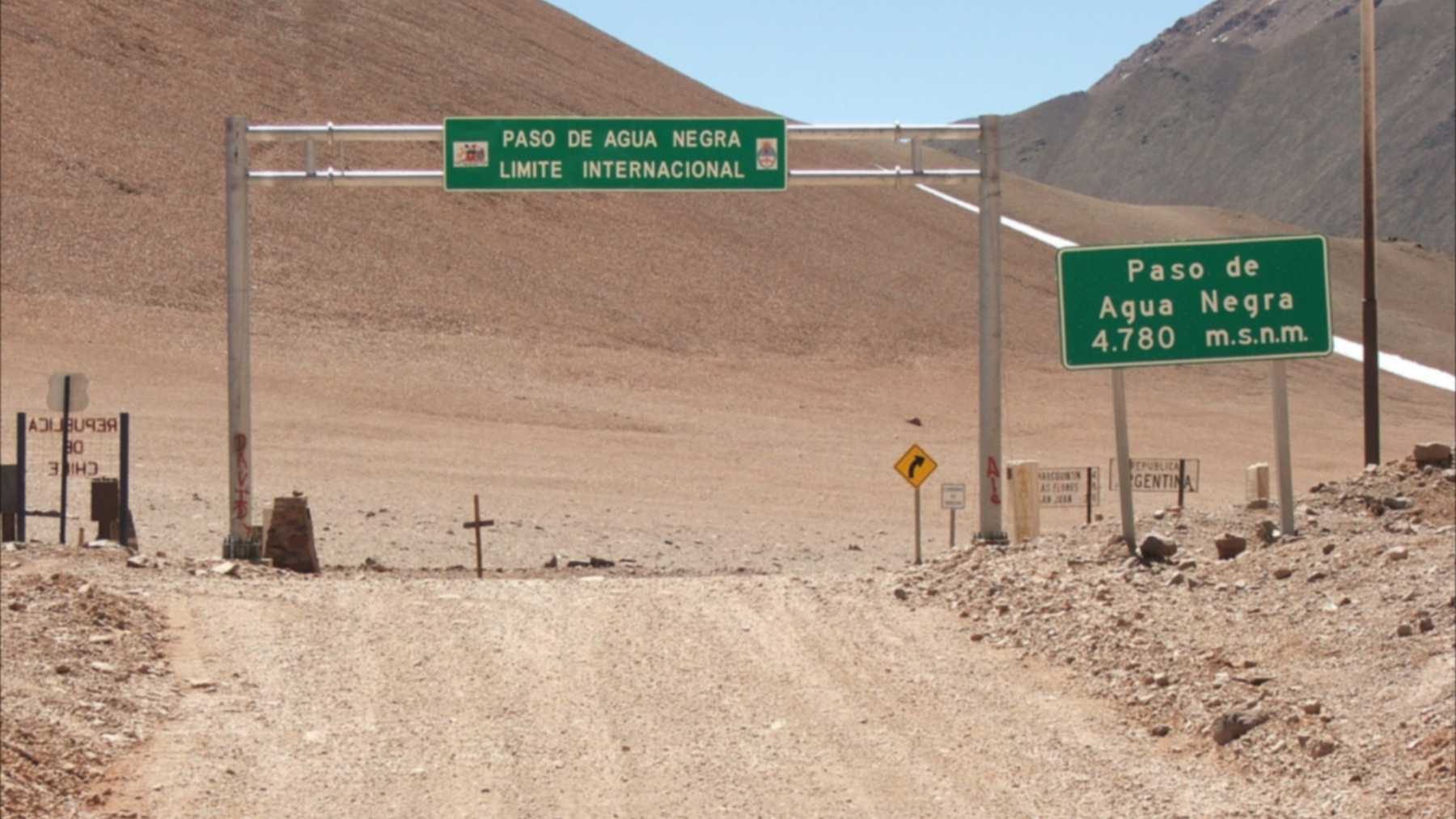
The road that cars use now opened in 1965 and tops out at 15,682 feet (4,780 meters), the highest crossing on the border. In 2017 the IDB wrote that it “remains closed at least six months a year due to its climatic and topographic conditions.”
When the 2025-2026 season opened on November 26, Governor Marcelo Orrego called the pass “a common effort and a shared dream” and said it “boosts the possibility of a future commercial route,” MDZ reported. By May 24, 2026, Tiempo de San Juan counted more than 72,000 people who had crossed during six straight months without a closure.
Big rigs are another story. The road is mostly used by tourists and “only admits light vehicles or minibuses,” the paper wrote. One idea discussed in April 2026 was to keep cars on the road in the morning and let trucks go up after 4 p.m. behind a guide pickup.
“What is a priority today is to guarantee that the route is functional and safe,” Javier Sandoval, then the regional public works secretary in Coquimbo, told El Día in November 2024. “In parallel, alternatives are being studied to decide whether a tunnel should be built, snow sheds put in, or other solutions chosen that give the pass permanence.”
Two tubes so no one passes a truck underground
The design published by EBITAN calls for “two parallel tunnels, one for each direction of traffic,” each 13.9 kilometers long, with the Argentine portal at 13,402 feet (4,085 meters) and the Chilean one at 11,877 feet (3,620 meters).
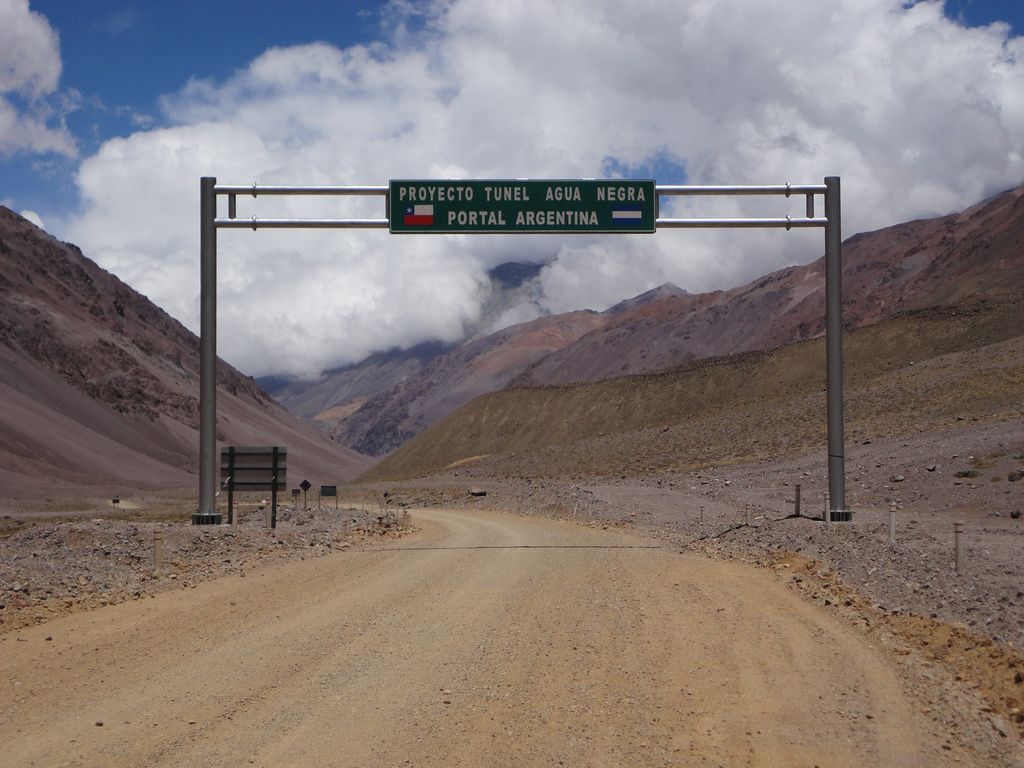
The agency’s case for two tubes reads almost like advice to drivers. One bore would mean “14 km of underground driving with traffic coming the other way, where the temptation to break the no-passing rule could arise when driving behind loaded trucks that move slowly,” EBITAN writes. Head-on crashes, it adds, are “the great risk in bidirectional tunnels.”
On weather, EBITAN notes that “at Agua Negra, despite its greater altitude, snowfall is statistically three times lower than at Cristo Redentor.” On earthquakes, it argues that “underground structures are less prone to earthquake damage than those resting on the ground surface.”
A boring machine instead of explosives
A tunnel boring machine, or TBM, is a giant rotating drill that lines the tunnel walls as it goes, like the one that dug a 2.5-mile water tunnel beneath the Hudson River between 2018 and 2019.
Clarín says the plan relies on one “because of the geological complexity of the Andes,” in a method that “replaces the traditional forms of drilling and blasting with explosives, so that operational safety is prioritized.” It also “seeks to reduce execution times in an area characterized by extreme tectonic pressures and formations of high hardness.”
Chile’s undersecretary of public works, Nicolás Balmaceda, called the tunnel “a very challenging project, which involves reaching 4,500 meters of altitude and building a tunnel of great length,” in remarks to El Día in March 2026. Clarín’s report does not name a manufacturer or a contract, and neither government has announced buying a machine.
The bank put up the money in 2017
When IDB president Luis Alberto Moreno visited San Juan in May 2016, he said the bank was ready “to finance whatever the final cost is,” Diario de Cuyo recalled the following year.
The first loans came in October 2017, $130 million for Argentina and $150 million for Chile, to pay for the first tunnel segments, temporary access roads and the portals. The bank expected the tunnel to cut about 25 miles (40 kilometers) from the route and take at least 10 percent of the traffic from Cristo Redentor, which was carrying 2,100 vehicles a day.
“The Agua Negra tunnel project reflects the IDB’s commitment to support these two nations’ efforts to forge closer ties with regional and global economies,” said José Luis Lupo, then head of the bank’s Southern Cone Country Department, who added that “both countries deserve applause for the decision to carry out a project of this magnitude.”
Julio Ortiz Andino, San Juan’s infrastructure minister at the time, told Diario de Cuyo the governments wanted the money in stages “because it makes no sense to have all the money for a project whose construction will take 9 years.” By then, 10 consortia representing 26 construction companies had applied to prequalify.
Politics and costs kept it on paper
El Día says the project was postponed with no clear date during Sebastián Piñera’s second term in Chile. Tiempo de San Juan puts it down to technical and budget disagreements under Piñera and Argentina’s Mauricio Macri.
“It is not among our priorities,” Chile’s previous public works minister, Jessica López, told El Día, adding that the priority was “to give our region, at least, a project that makes it easier to cross the border.”
Balmaceda, who serves in the current government, said the tunnel “must be analyzed in depth” and that “the possibility of completing the road network without a tunnel has been analyzed, which could be an alternative to lower costs and allow the initiative to go ahead.” That option is under study, he said.
San Juan Governor Marcelo Orrego told El Día in 2024 that “it is a very mature project, studied by both countries. However, due at times to political and economic issues, we have not been able to move forward as we would like.” Mario Schiavone, Chile’s consul in San Juan, told the outlet Diario Huarpe in September 2025 that the tunnel “was never lost as a goal.”
Copper has revived the debate
“Today we know there is significant mining production in Argentina, whose concentrates could go out through the ports of the region, so all of this requires a double perspective,” Balmaceda said.
San Juan is home to the Vicuña copper district on the Argentina-Chile border. The Argentine site Más Energía reported in June 2026 that Vicuña, owned by BHP and Lundin Mining, has a preliminary total investment estimate of $18 billion and expects about 395,000 metric tons of copper a year over its first 25 years.
“The current situation is different from 2018. Today San Juan has a clear interest in reaching the Pacific coast. The mining boom in that province can drive this connectivity and allow private players to collaborate as well,” Pedro Valencia, a regional councilor in Coquimbo, told the site.
“This scenario was only a matter of time, considering the logistics needs facing the more than 30 mining projects planned in San Juan,” said Carlos Ruiz Benítez of the business group CORPAN.
What is still missing
There is no construction contract, no machine on order and no start date. The $1.5 billion price comes from 2017, and officials expected about nine years of construction once work began.
For comparison, the longest tunnel in Latin America took more than 10 years to build, and other big crossings in the far south, like the submerged tunnel proposed under the Strait of Magellan, are still at the study stage.
The boring machine plan was reported by Clarín on September 16, 2026, and the project’s technical design is published by EBITAN.
Until something is signed, the crossing between San Juan and Coquimbo will keep opening and closing with the seasons, as it has since 1965.
Photo: Joe Merlo / Wikimedia Commons (CC BY-SA 4.0)