A machine weighing about 1,350 tons helped carve a new water tunnel beneath the Hudson River, but finishing the tunnel did not finish the job. The bypass still needs connections before it can carry drinking water around a leaking section of New York City’s Delaware Aqueduct.
The aqueduct normally supplies about half the city’s drinking water. But the Department of Environmental Protection (DEP) now anticipates another shutdown around 2031 or 2032 to finish the connections, according to August 2026 public meeting minutes.
A leak measured in billions of gallons
The 85-mile Delaware Aqueduct uses gravity to bring water from upstate reservoirs toward New York City. Two leaking areas, near Newburgh and in Wawarsing, have been monitored since the early 1990s.
How much water escapes? DEP has published estimates of approximately 20 million gallons daily, with about 95 percent leaking near Newburgh, while its May 2025 announcement said losses can reach upwards of 35 million gallons. Those figures should not be presented as a single, fixed daily measurement.
At a steady 20 million gallons a day, the calculated annual loss would be 7.3 billion gallons. At 35 million, it would approach 12.8 billion gallons, water diverted from the supply before it reaches anyone’s kitchen faucet.
Meet Nora, the machine behind the bypass
The $30 million tunnel-boring machine arrived in Newburgh in 2017 in 22 pieces, requiring four months of assembly. It was named Nora in honor of pioneering civil engineer and suffragist Nora Stanton Blatch Deforest Barney.
With its trailing equipment, Nora stretched more than 470 feet and weighed upwards of 2.7 million pounds, roughly 1,350 U.S. tons. Its cutting head measured 21.6 feet across, and the machine was designed to withstand water pressure exceeding 30 bar.
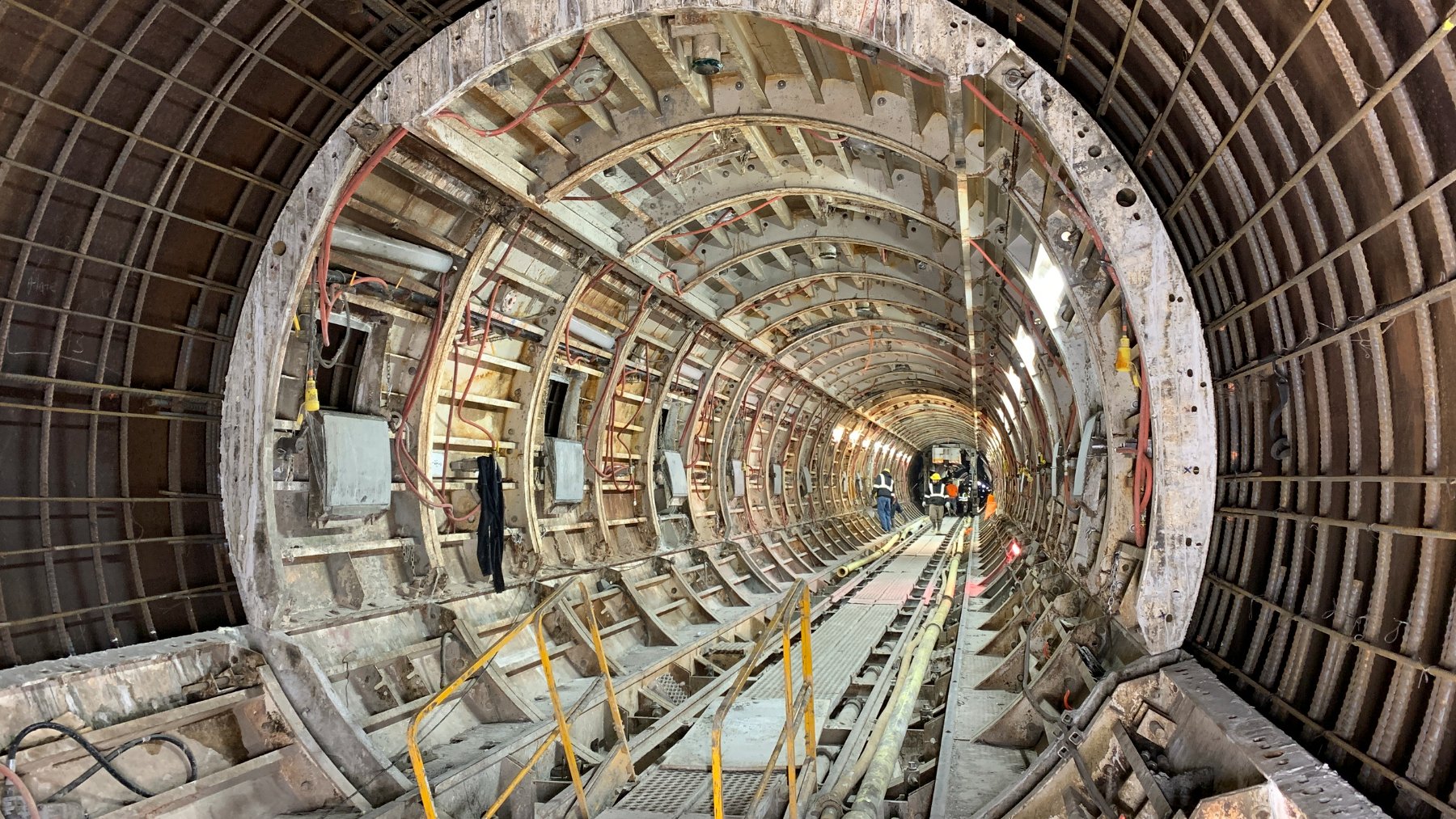
Beginning in January 2018, Nora excavated 12,448 feet over 582 days, completing its drive in August 2019. That work helped create a 2.5-mile bypass roughly 600 feet beneath the Hudson, running between Newburgh and Wappinger.
A finished tunnel is not a working repair
Excavation was only part of the job. Construction manager Parsons says crews installed a one-inch-thick steel liner between reinforced concrete layers, completing the final lining in November 2021. Access chambers and supporting systems followed in December 2022.
To make the bypass useful, workers must drain the existing aqueduct, connect the new tunnel to sound sections on both sides of the damaged stretch, and permanently isolate the leaking section. The smaller Wawarsing leaks are to be sealed during the same shutdown, making this much more involved than turning off a valve under the sink.
Why keeping the worksite dry became a problem
Tests in 2023 revealed that groundwater entered the partially drained aqueduct faster than expected. DEP delayed the connection work to install additional pumping and drainage equipment, citing the safety of crews working about 700 feet underground.
Parsons describes plans for two additional pumps, each capable of moving 15 million gallons daily, and larger drainage pipes. In practical terms, draining the tunnel once is not enough because incoming groundwater must also be controlled throughout construction.
DEP’s May 2025 plan called for an eight-month shutdown beginning in October, when the system approaches its lower-demand winter season. Other water sources must cover the gap while the Delaware route is unavailable.
Drought stopped the work and reset the timetable
The shutdown began in October 2024, but the city suspended the repair that November as drought depleted its water supplies. The existing aqueduct returned to service in December, restoring access to water that officials were unwilling to keep offline.
The interruption also ended the existing construction contract. “A new contract must take every contingency into account,” then-DEP Commissioner Rohit T. Aggarwala said in May 2025, when the agency announced that completion was not expected until after 2027.
The August 6, 2026, council minutes provide a newer outlook. DEP anticipates bidding around 2029, after other Ashokan Reservoir and Catskill Aqueduct work, followed by a shutdown around 2031 or 2032 lasting approximately six to nine months. These remain planning estimates, not a guaranteed opening date.
Saving water requires more than another tunnel
Regional planners are also examining additional storage, including a possible expansion of Cannonsville Reservoir. That is a feasibility question, not an approved construction project, and potential environmental and community impacts remain part of the assessment.
The lesson is that a completed tunnel and a dependable water-saving repair are different milestones. New York must connect the bypass without jeopardizing the supply people already rely on.
The official meeting record was published on the Upper Delaware Council website.