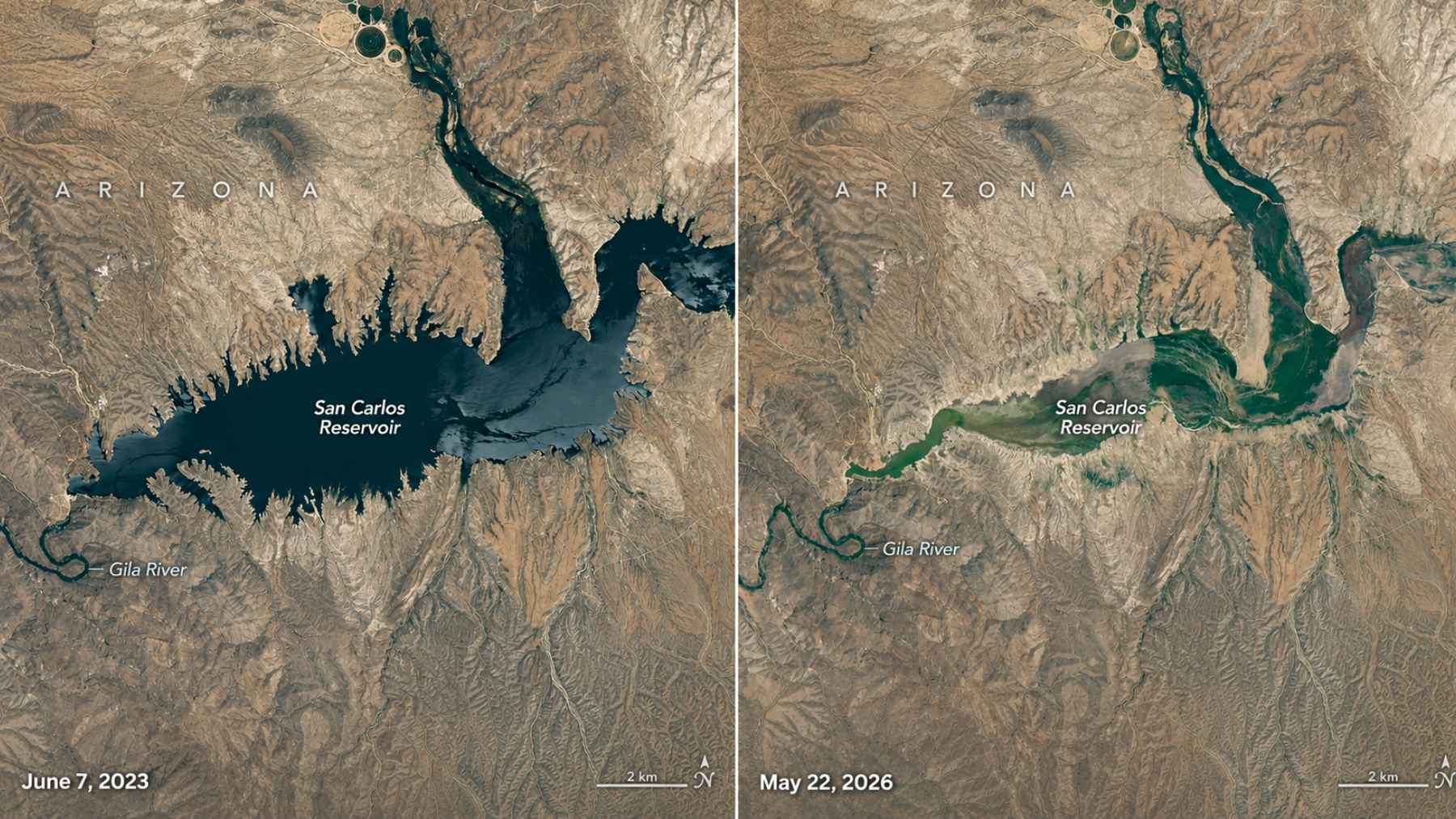
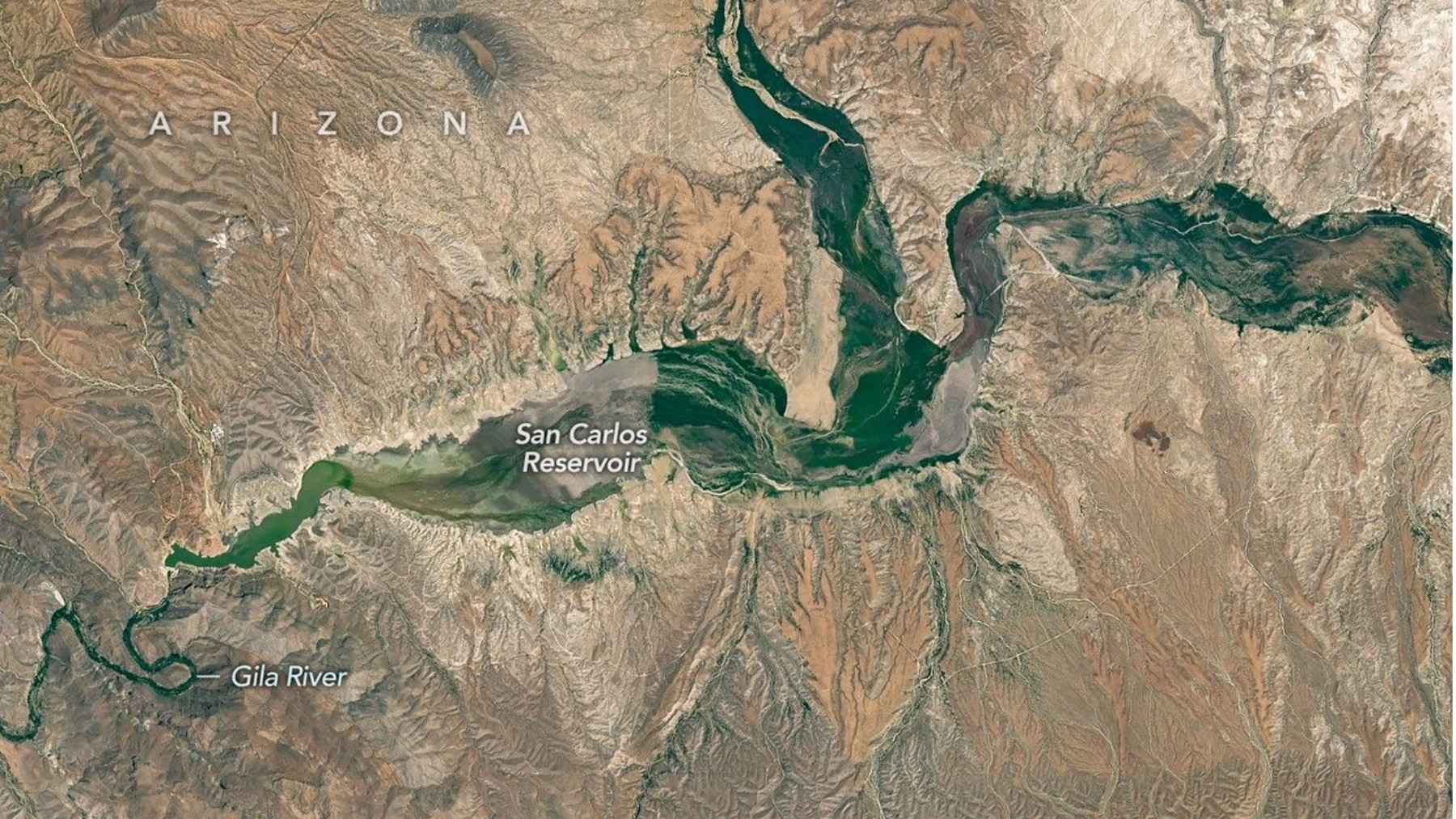
San Carlos Reservoir in Arizona has become a stark snapshot of what drought can do when snowpack fails, water demand continues, and summer heat closes in. New NASA Earth Observatory images show the reservoir nearly empty in May 2026, with only 389 acre-feet of water left, which is about 127 million gallons and less than 1% of its capacity.
The result was not just a smaller lake. Officials closed the reservoir indefinitely on June 5, 2026, after low water helped create hypoxia, a dangerous drop in oxygen that killed virtually all of the fish living there. For anglers, nearby communities, and wildlife, the lake’s collapse is the kind of event that turns a dry spell into an ecological emergency.
A river under pressure
The Gila River is one of the Southwest’s important water routes, carrying water from snow-fed mountains in southwestern New Mexico toward the desert lowlands of Arizona. In good years, snowmelt from the Mogollon Mountains and Black Range helps refill San Carlos Reservoir, which is formed by Coolidge Dam.
However, 2026 was not a good year. NASA reported that snowpack in the Gila River watershed was only 2% of the 1991 to 2020 March median, and April streamflow reached just 39% of normal. That is a thin margin for a reservoir expected to support farms, people, and wildlife.
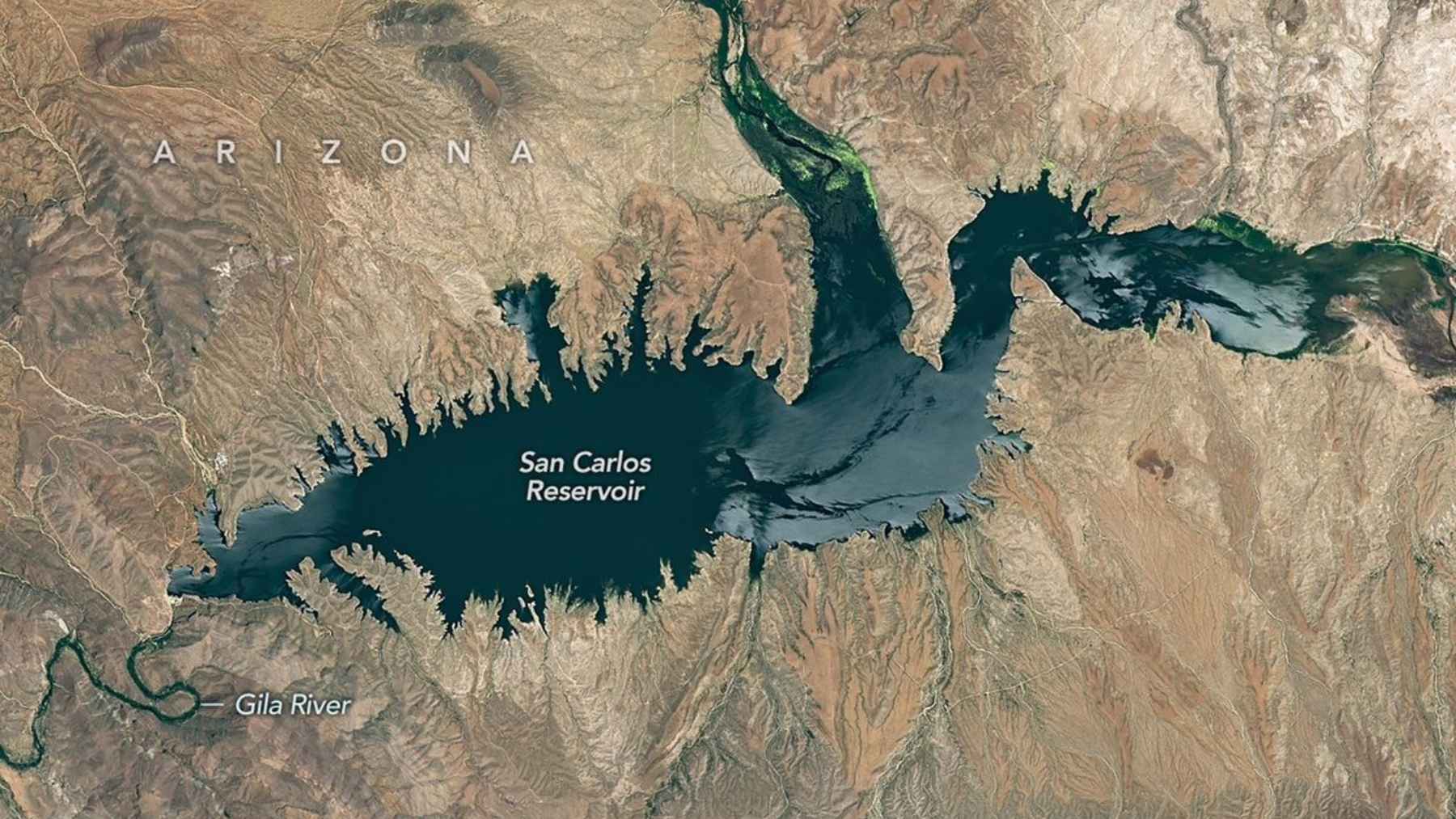
By June, after mandatory water releases for downstream agriculture, less than 400 acre-feet remained. This means a reservoir that looked broad and blue in June 2023 had been reduced to exposed river channels, scattered green vegetation, and warm shallow water by May 2026.
NASA’s two-frame warning
The contrast NASA published is easy to understand, even for someone who has never visited the lake. A Landsat image from June 7, 2023, shows San Carlos Reservoir at about 60% full, still looking like one of Arizona’s largest bodies of water.
A second Landsat image, captured on May 22, 2026, tells a very different story. The reservoir was nearly empty, and the Gila River’s natural channel had become visible again. Along the exposed edges, NASA identified plants such as tamarisk, willow, cottonwood, sedges, and grasses.
It is a simple before-and-after scene, but the message is not small. When a reservoir shrinks this far, it stops acting like a stable lake and starts behaving more like a stressed, overheated basin where oxygen can disappear fast.
Why the fish died
Fish need dissolved oxygen in the water. When water levels fall sharply, the remaining water can warm more quickly, become stagnant, and lose the conditions many fish need to survive.
That is where hypoxia comes in. NASA said declining water levels contributed to low oxygen conditions that killed virtually all fish in the reservoir, including largemouth bass, black crappie, bluegill, channel catfish, flathead catfish, brown trout, and rainbow trout.
For people who fish, that list is more than biology. It is weekend trips, family routines, quiet mornings on the water, and local recreation suddenly cut off. The San Carlos Recreation and Wildlife Department warned that decomposing fish could pose health risks to people trying to boat or fish, which is why the closure remains in place.
Not the first collapse
San Carlos Reservoir has seen this kind of stress before. According to NASA, news reports indicate the reservoir has run out of water at least 20 times since it was filled in 1930.
There is even an old line from humorist Will Rogers that captures the problem with painful clarity. Looking at grass growing in the dry reservoir bottom, he reportedly told President Calvin Coolidge, “If that was my lake, I’d mow it.”
Major fish kills have happened in other years too, including 1976 and 2018. After more than 5 million fish died in a similar 1976 event, the Gila Herald reported that it took five years for the lake’s ecosystem to rebound, according to NASA. Recovery, when it comes, may not be quick.
Drought is the bigger story
The reservoir’s decline is part of a wider dry pattern across the region. NASA said much of the Gila River’s headwaters in New Mexico have been in severe drought, based on U.S. Drought Monitor data.
That matters because reservoirs do not refill by wishful thinking. They need snowpack, runoff, and rain, and when one piece fails badly, the whole system feels it. Farmers still need irrigation, wildlife still needs habitat, and towns still need reliable water.
This is the tough part of Western water in everyday terms. The same system that supports crops and local economies can also leave a lake gasping when drought tightens its grip.
Could summer rain help?
There is one possible opening. NASA noted that the Gila River’s flow can vary widely, and heavy rains during the wet season could help the reservoir recover. NOAA’s May 2026 Arizona monsoon outlook projected a 33% to 50% chance of above-average precipitation in the region that summer.
Still, experts warn that a wetter monsoon does not erase long-term drought impacts overnight. A June 2026 drought update from the National Integrated Drought Information System said above-average rainfall could improve short-term drought conditions in the Southwest, but long-term effects from record-low winter snowpack would remain.
So the hope is real, but limited. A strong monsoon could bring relief, reduce immediate stress, and put water back into the system, but rebuilding an ecosystem after a near-total fish kill is a slower job.
What to watch now
For now, San Carlos Reservoir stands as a visible warning from space. It shows how quickly a major water body can shrink when snowpack collapses, drought lingers, and releases continue downstream.
The next chapter depends on rainfall, water management, and how the lake responds once water returns. Will the reservoir refill enough to recover, or will this become another entry in its long history of boom-and-bust water levels?
That question matters far beyond one Arizona lake. Across the Southwest, reservoirs are more than scenic places to fish. They are part of a fragile water network, and when one falls this hard, the whole region gets a reminder.
The official article was published on NASA Earth Observatory.