Thirteen-year-old Roy Kim built a prototype chamber that pulls moisture straight out of thin air and waters plants automatically when soil turns dry. The Whitford Middle School student from Beaverton, Oregon, has earned a spot as one of 10 national finalists in the 2026 3M Young Scientist Challenge
Could a school project like this eventually ease pressure on wells and rivers? Perhaps, but not yet, because Kim’s reported prototype produced only 0.35 fl oz. in two hours while irrigation accounted for 47% of U.S. freshwater withdrawals between 2010 and 2020.
A young inventor takes on an old problem
Kim calls the project the “Sustainable Water Generating Chamber for Farms.” Instead of drawing directly from a well, river, or reservoir, the device is designed to capture water vapor already present in the air and deliver the condensed liquid to plants.
“Do what you can do tomorrow, today,” Kim says in his official profile. He entered the contest to “showcase my invention to people around the world,” and that goal has already placed his early stage idea on a national platform.
How the chamber works
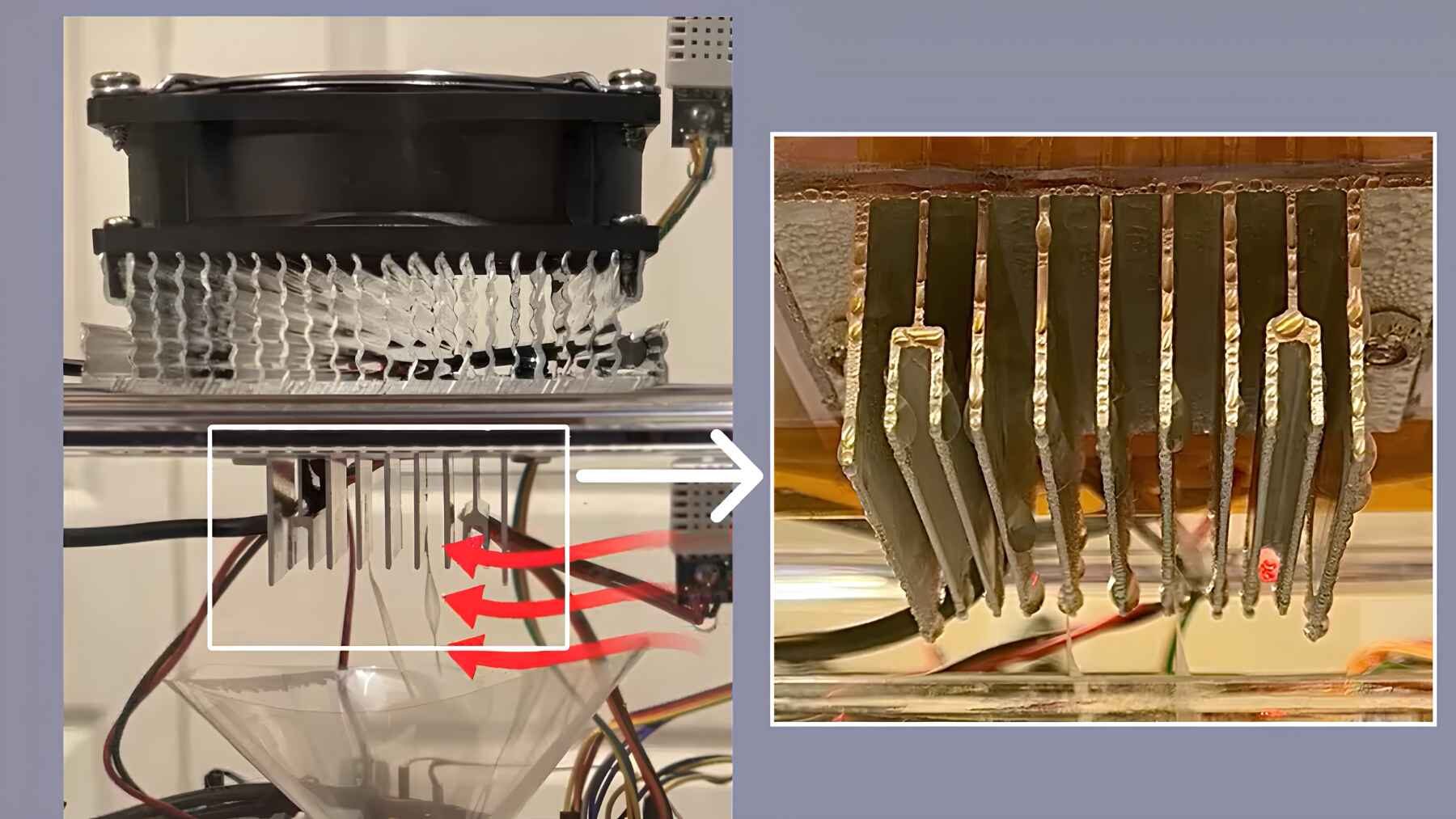
At the heart of the system is a thermoelectric cooler commonly called a Peltier module. Passing an electric current through this type of component creates localized cooling, and water can condense when humid air meets a surface chilled below the dew point.
According to Kim’s project description, air is warmed and pushed by a fan toward the colder side of the chamber. The droplets fall into a funnel, then a valve directs the collected water toward the plants.
Sensors keep the soil in charge
A soil-moisture sensor determines when irrigation is needed, while temperature and humidity sensors watch the surrounding conditions. The design can adjust airflow when the environment becomes less favorable for water production.
By integrating sensors directly with the condenser, the chamber combines water generation and irrigation into a single automated loop. That matters when a tiny supply must reach roots at the right moment instead of landing on soil that is already damp.
The numbers reveal the challenge
Kim reported collecting 0.35 fl oz. in two hours, roughly two teaspoons, with a peak efficiency of 4.80 oz./KWh. At that reported peak, producing one liter would require about 7.4 kWh, so cutting energy use and raising output will be central to any scale-up.
The source material identifies the device as a prototype and does not describe commercial farm trials. That distinction matters because the USDA counted 212,714 irrigated farms applying 81 million acre-feet of water in 2023.
Humidity can make or break output
Air is not an equally rich water source everywhere. A separate 2026 study of a solar-powered Peltier system reached 0.80 fl oz. per hour at 86°F and 80% relative humidity, with output rising strongly as humidity increased.
The researchers concluded that compact thermoelectric systems currently fit small, decentralized uses better than bulk water production. For Kim’s chamber, that suggests greenhouse seedlings, targeted irrigation, or emergency plant care may be more realistic early tests than watering an entire field.
Why farms need more options
U.S. irrigated land accounts for less than 17% of harvested cropland, yet farms with irrigation produce more than half the value of national crop sales. That productivity makes reliable water essential, especially in western regions where dry conditions and groundwater depletion can squeeze supplies.
There is also the electric bill. Farmers spent $3.3 billion on energy for pumping well and surface water in 2023, so any atmospheric system must eventually prove that its power needs, maintenance, and water output make practical sense.
The science challenge comes next
3M and Discovery Education selected Kim alongside nine other students after judging short pitches for creativity, scientific knowledge, and communication. Each finalist receives summer mentoring before the final event at the 3M Innovation Center in St. Paul, Minnesota, on Oct. 12 and 13.
Kim’s mentor is Rodrigo Marmol, a global portfolio manager at 3M. The finalists will present their improved projects, answer questions from judges, and compete for $25,000 and the title of “America’s Top Young Scientist.”
A prototype worth watching
The smartest next step is not simply making the chamber bigger. Longer outdoor tests should track output across seasons while measuring water quality, durability, maintenance needs, cost, and performance under lower humidity.
Kim has already turned a huge environmental challenge into a measurable experiment that can be questioned and improved, which is where real engineering begins.
The official finalist profile was published on Young Scientist Lab’s website.