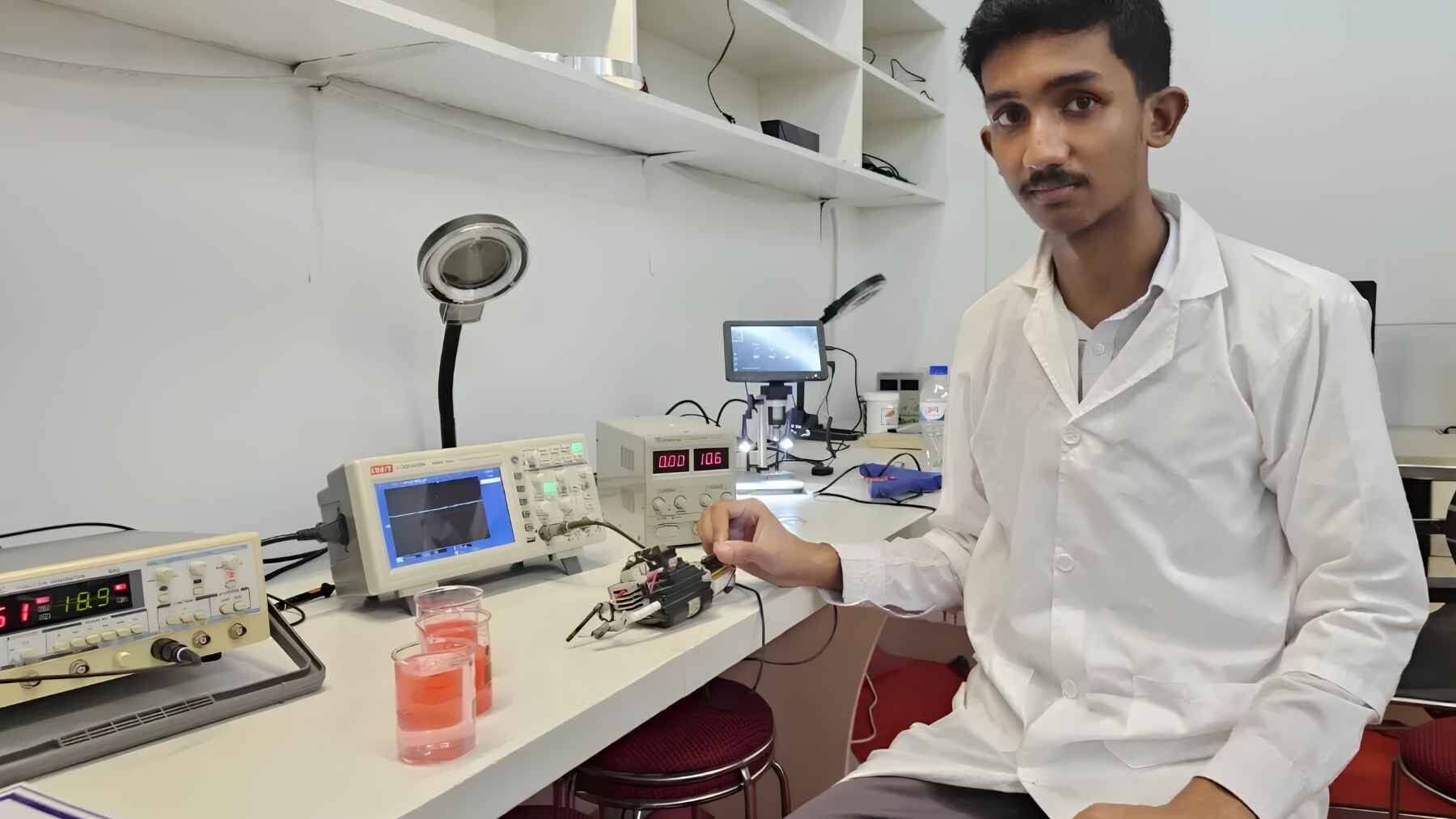
What can an old laptop battery, a damaged circuit board, and parts from a bulky tube television do after their useful lives are over? In Bangladesh, student Zabeer Zarif Akhter used discarded electronics to build a high-voltage plasma water purifier intended for places where floods contaminate water and electricity may disappear at the same time.
The prototype won the Bangladesh Stockholm Junior Water Prize in 2024 and took Akhter to the international competition during World Water Week in Stockholm. Its most compelling idea is the way it combines emergency water treatment, solar charging, and e-waste reuse, though the public evidence still describes a developing prototype rather than a finished household product.
How plasma attacks contamination
The name sounds futuristic, but the basic principle is fairly straightforward. A high-voltage electrical discharge creates non-thermal plasma at normal air pressure, producing reactive oxygen and nitrogen compounds, charged particles, and ultraviolet light. Together, these forces can damage bacterial membranes and genetic material without bringing the water to a boil.
Akhter’s simplified design reportedly uses two carbon electrodes and an electronic circuit assembled from discarded parts. Local reporting says the system was developed to target E. coli, total coliforms, and fecal coliforms.
Does that mean the device is ready for every muddy pond or flooded well? Not yet, and published laboratory tests show why. A 2026 study reported at least a six-log bacterial reduction, roughly 99.9999 percent, after eight minutes in Nile water samples holding only about 0.34 fluid ounces, while a separate study treated 3.4 fluid ounces for 15 minutes, evidence that flow rate, water chemistry, and scale matter.
Old electronics become the supply shelf
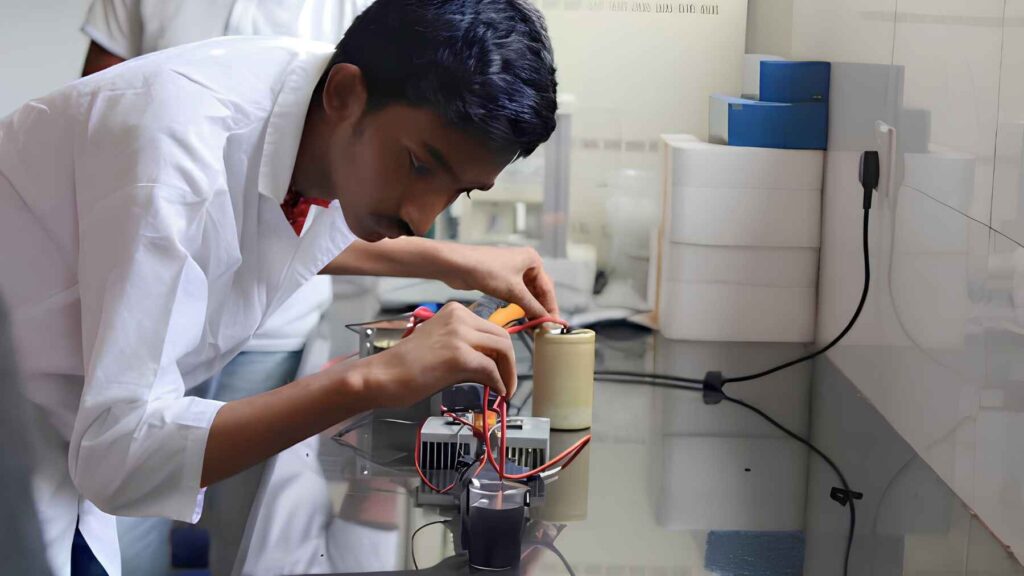
Instead of buying a specialized power system, Akhter says he recovered components from three-wheeler motor circuits, old cathode-ray tube televisions, abandoned laptops, and cell phone lithium batteries. He also says solar panels can recharge the unit, a practical feature when wall outlets are useless and the local grid is down.
That reuse angle is more than a clever science project flourish. The world generated about 68.3 million short tons of e-waste in 2022, and only 22.3% was documented as formally collected and recycled. In other words, the global pile of unwanted electronics is growing far faster than safe recycling systems can keep up.
However, scrap is not automatically sustainable. Reused batteries, high-voltage circuits, and parts from old televisions would need secure housings, electrical safeguards, and a responsible end-of-life plan, especially if a machine is expected to operate around children or in wet disaster zones.
Floods made the problem personal
Akhter told UNICEF that major floods pushed him toward the project because contaminated water can remain dangerous after the waterline drops. He wanted a fast emergency treatment option that would not depend on a large plant, expensive laboratory equipment, or a stable power network.
This need is hardly abstract in Bangladesh. UNICEF said the severe eastern floods of August 2024 affected 5.6 million people and placed more than 2 million children at risk, while families urgently needed safe drinking water and water purification supplies. When roads are submerged and the tap runs dirty, even a compact point-of-use device could matter.
Bangladesh also faces a wider water quality problem outside disaster periods. UNICEF reports that microbial contamination is detected in 84.9% of household drinking water samples, while safely managed drinking water coverage stands at 39.3 percent. That helps explain why Akhter is looking beyond one flood season.
An award opened the laboratory door
Akhter’s project, called “High Voltage Plasma Water Purifier from E-waste,” was named the national winner of the 2024 Bangladesh Stockholm Junior Water Prize. The wider competition drew 168 participants with 46 projects, and 11 papers reached the final stage.
Tanvir Ahmed, a civil engineering professor at the Bangladesh University of Engineering and Technology and a competition judge, said he had seen “positive results initially.” He also said the device was being supervised in a university laboratory to make it more functional and effective before the international competition.
The work did not stop with the first purifier. In 2025, Akhter won the national prize again with an artificial intelligence-based rapid water testing system, and UNICEF now describes him as a two-time winner. “Find something that you are good at and use it to solve a need,” he told the agency.
The promise and the missing proof
The science behind non-thermal plasma is credible, and controlled studies show that it can sharply reduce bacterial populations in water. Still, the public sources reviewed for this article do not include a peer-reviewed performance paper on Akhter’s purifier, its treatment capacity, energy use, chemical byproduct analysis, or long-term field results.
Those gaps matter. Before the device could be trusted in homes or shelters, independent teams would need to test it against different pathogens, muddy water, industrial chemicals, repeated battery cycles, and real flood conditions. A purifier also needs to show that treated water stays safe after it leaves the machine.
For the most part, this technology should be viewed as a promising point-of-use concept, not a replacement for municipal treatment plants or emergency water programs. At the end of the day, its strongest lesson may be that one young inventor looked at two growing problems, unsafe water and discarded electronics, and tried to make each part of the answer to the other.
The official article was published on the UNICEF Office of Innovation website.