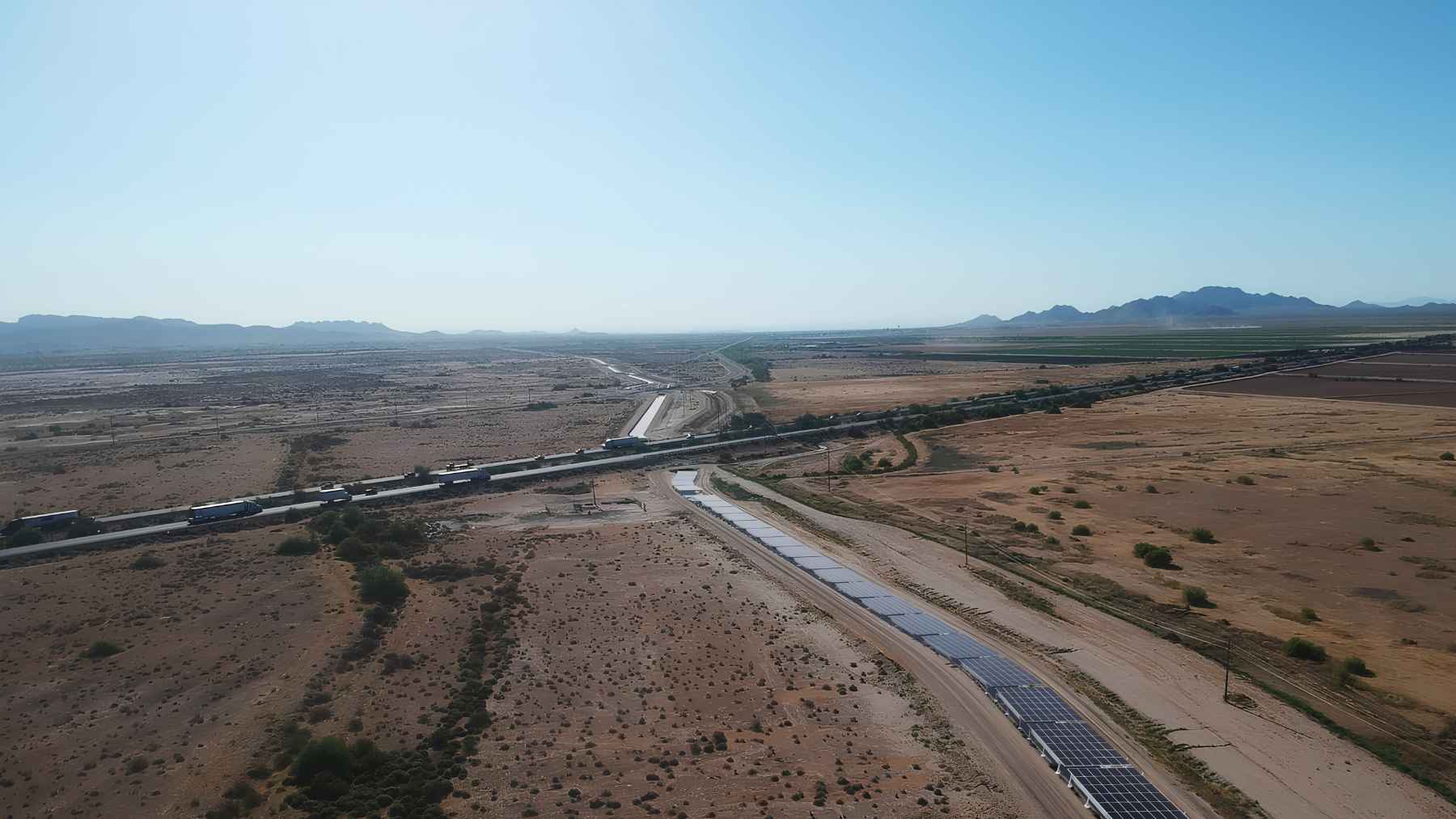
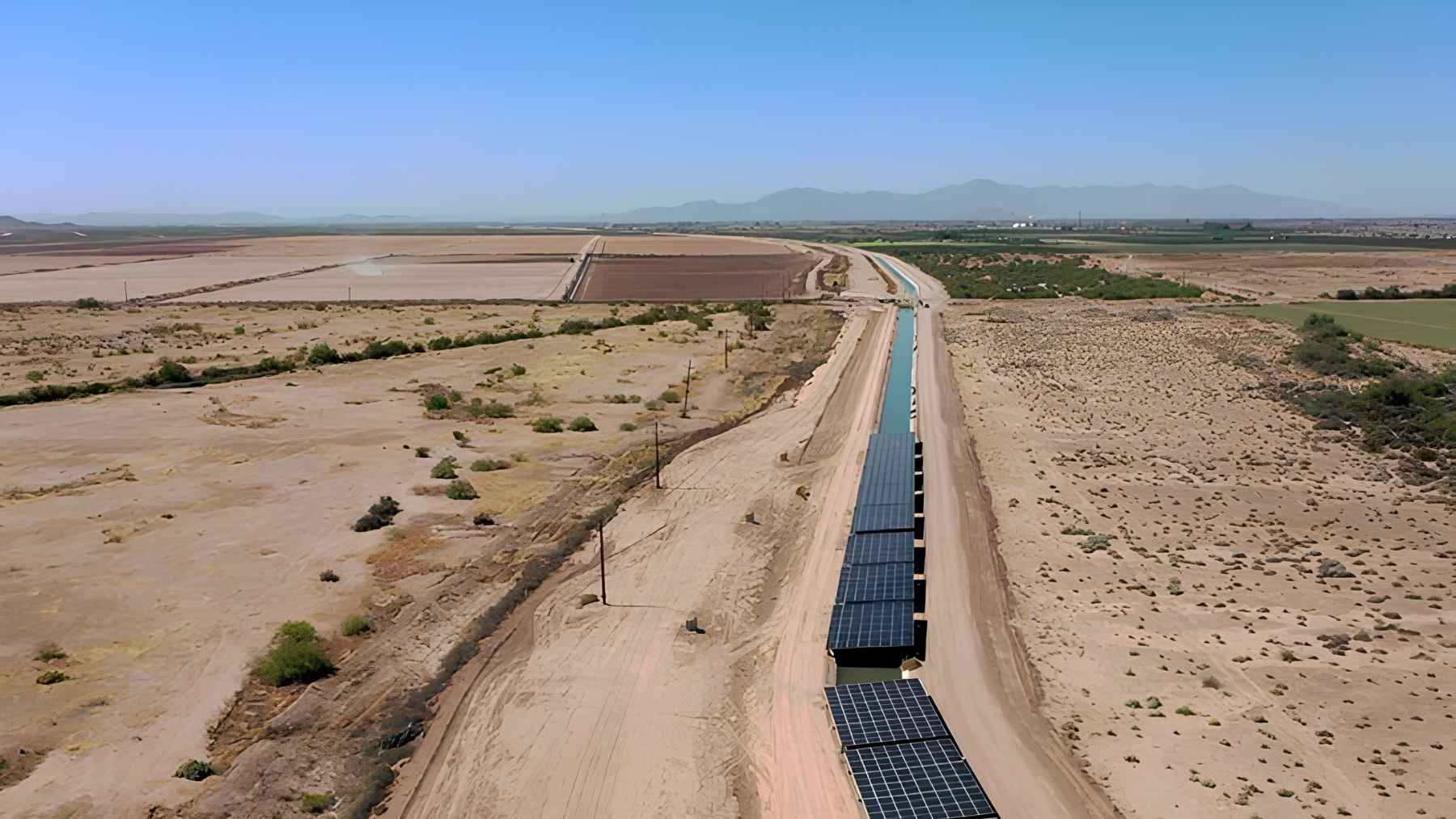
Many people would argue the deserts are a pure dead land, but in Arizona they turned a neat desert area into a working infrastructure. Near the area of Sacaton new 2,556 solar panels were installed stretching across an area of 2,872 feet, from the Casa Blanca Canal onwards to the Gila River Indian Community land, and are now producing electricity while also shading the irrigation water below. This is the first of its kind in the United States and its first power arrived on October 3, in the year of 2024.
The highly intelligent engineered setup avoids taking farmland while leaving the canal available for water delivery and maintenance, but here is a catch. The specialized steel structure that is used to support its foundations over the ground makes the canal solar roughly twice as expensive as placing comparable panels on the ground.
How the canal array works
The structure is clever. The panels sit on modular steel structures that cross the canal without touching the water, which prevents the formation of rust. That also keep the flow clear of impurities and gives crews access when repairs are needed. The shade can also reduce evaporation, while the cooler environment above the water may also give solar output a small boost.
The rated capacity of the whole structure is 1.31 megawatts and is expected to generate at least 2.26 million kilowatt-hours each year in practical terms. The local irrigation district uses only a fraction of all that energy, which corresponds to about 27 million kilowatt-hours annually, in tasks like pumping, moving or storing water. That means that this single installation could cover roughly eight percent of the whole electric bill.
The project that finished first
Even though the Casa Blanca was known as “phase II” it began producing power first. The “phase I” was a separate 1000-foot installation that had signed its agreement and began construction earlier, but its ribbon-cutting did not take place until December 11, 2025, 14 months after Casa Blanca had already switched on and began its operation.
The director of Pima-Maricopa Irrigation Project, David H. DeJong summed it up plainly with the phrase “It was scheduled to be the first in the Western Hemisphere, but our Phase II Casa Blanca Solar over canal project was actually completed first.”
The difference in prices was quite striking too. While Casa Blanca received the investment of 5.65 million dollars for its 1.31 megawatts production, which corresponds to about $4.31 million per megawatt, the Phase I was estimated to cost $6.7 million for one megawatt, a striking difference. Summing up the numbers we can gather that the difference between the projects is about 55 percent more expensive per megawatt, although it featured additional federal partnership and tribal contracting requirements.
The water benefit is still being measured
In a statement given by DeJong he said the estimates are that the half-mile array that constitutes the Casa Blanca each year may prevent 2.6 and 3.9 millions gallons of water from evaporating. At such a scale the project can also be viewed as a test for future similar efforts, showing not only how useful it is for nearby agriculture but also maybe helping with the Colorado River crisis even if not being enough to end it alone.
The claims that the project cuts evaporation by about half are still just claims that still need to be verified in order to analyze full-season results. The federal grant includes a five-year monitoring period, which is most likely time enough for more data to be gathered which in turn could provide a clearer answer on water saving and performance closer to the end of the decade.
The community has bigger plans though: their documents describe an estimate of a bigger plan with solar panels being constructed over more 18.5 miles of canal. The ambitious plan of covering 16 miles of Casa Blanca could help provide about 26 more megawatts and save roughly 117 million gallons each year, although those are still estimates.
The official project releases were published by the U.S. Bureau of Reclamation and the U.S. Army Corps of Engineers.