Under the ice of Antarctica lie the roots of Himalayan-style mountains, according to two geologists tied to the Australian National University (ANU), who reached that conclusion from 1,712 zircon crystals that glaciers had carried off the continent and dumped on the surrounding seafloor. The range is the younger of two “supermountains” that Ziyi Zhu, then a PhD candidate at ANU, described in February 2022, when she said “there’s nothing like these two supermountains today” and linked this one to the Cambrian explosion.
The new work was led by Bei Chen of the GFZ Helmholtz Centre for Geosciences in Potsdam, Germany, and ANU, together with Ian H. Campbell, an emeritus professor at the ANU Research School of Earth Sciences, who argue in Earth and Planetary Science Letters that the erosion of those mountains helped set the stage for the Cambrian explosion, the burst of animal diversity that began about 538 million years ago.
“Analyses of detrital zircons from Antarctica show that its tectonics were dominated by Himalayan-style mountains, the roots of which now underlie the ice sheet,” Chen and Campbell wrote in the first line of their abstract, using the geologists’ term for zircon grains that erosion has worn out of their parent rock and carried off in sediment.
Mud from the seafloor around Antarctica
Radar has mapped ancient landscapes preserved under the ice, but “ice covers 99.5% of Antarctica,” as Chen, Campbell and their ANU colleague Richard J. Arculus wrote on September 10, 2026, in a companion paper in Communications Earth & Environment, so the team went after the mud that glaciers had dumped on the seafloor around the continent.
Chen worked through 1,712 zircon grains from 12 sediment samples supplied by the International Ocean Discovery Program, grains that the companion paper says were “derived by glacial erosion of 90% of Antarctica,” and the biggest group of them turned out to be between 650 million and 450 million years old, from the time when the supercontinent Gondwana was being pieced together.
Antarctic zircons have drawn other geologists to the same era, and in 2017 Timothy Paulsen of the University of Wisconsin Oshkosh, whose team studied grains his university described as “some smaller than the width of an average human hair,” said he wanted to understand the swing “from a Snowball Earth state when it was completely frozen over to its hothouse state that characterized the Cambrian time period.”
Zircons that grew in mountain roots
Zircon is the same hardy mineral behind Earth’s oldest known terrestrial mineral grain, and in their 2022 study Zhu and Campbell tracked supermountains through time using zircon with low lutetium content, which ANU described as “a combination of mineral and rare earth element only found in the roots of high mountains where they form under intense pressure.”
Antarctica dominates the zircon record
When Chen and Campbell added the Antarctic grains to a global database of river zircons and weighted each sample by the ground it represents, about 46 percent of the grains from the base of the Cambrian to the end of the Cambrian explosion, along with 55 percent of the high-pressure grains, turned out to come from Antarctica.
Those figures describe a database of mineral grains rather than the size of the ancient ranges.
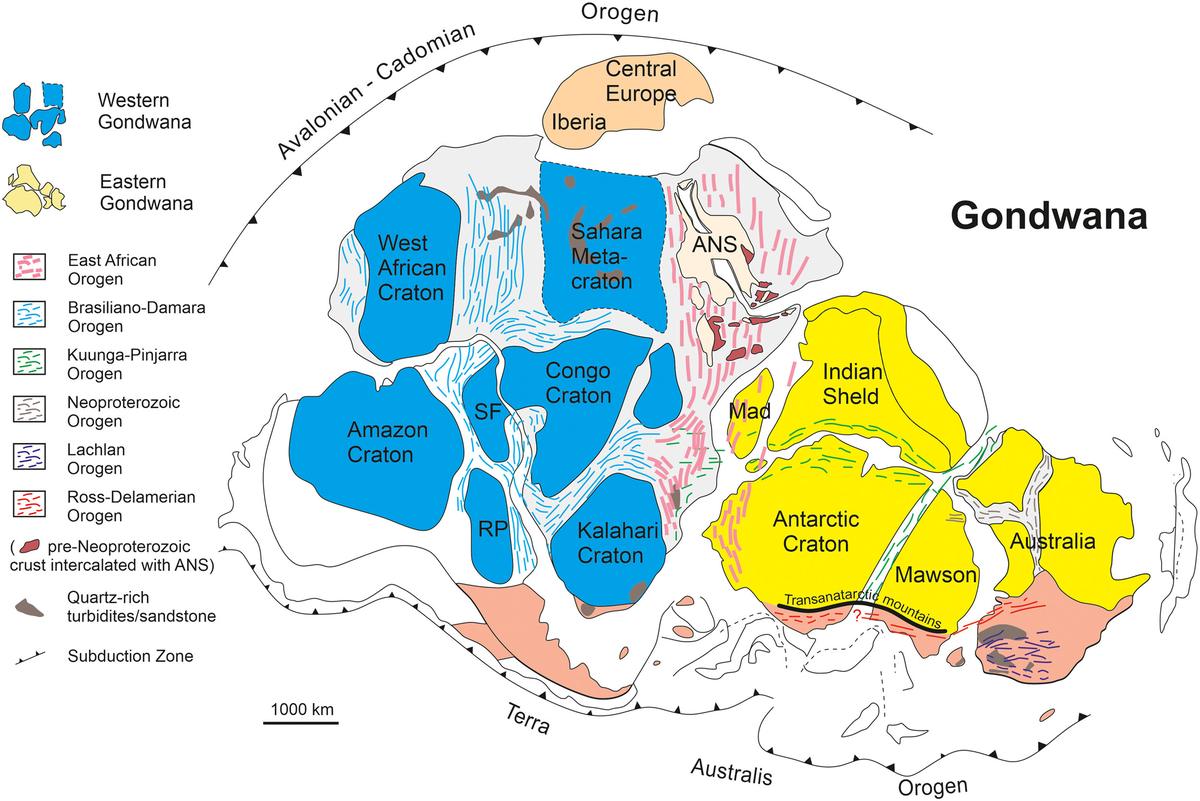
Gondwana joined what are now Africa, South America, Antarctica, India and Australia long before the supercontinent eventually broke apart, and the map in the new paper places the Antarctic block between the Indian shield, Africa’s Kalahari craton and Australia, hemmed in by belts of mountain building that geologists call orogens.
A buried fan bigger than Bengal
According to the ANU geologists, the rock stripped from those mountains piled up as “giant turbidite fans that extended across Antarctica to southeastern Australia,” the vast underwater aprons of sand and mud that heavy, sediment-choked currents spread across the deep seafloor.
The Australian tail of that system alone may hold as much sediment as the modern Bengal Fan, “which is 20 times larger than any other modern river fan,” the authors wrote.
Nutrients for the bottom of the food chain
Chen and Campbell argue that “nutrients shed during the erosion of the Gondwanan mountains fertilized the oceans.” In 2022, ANU described that kind of erosion as providing “essential nutrients like phosphorous and iron to the oceans, supercharging biological cycles and driving evolution to greater complexity.”
Campbell has also made the opposite case, about a planet without big mountains, saying in an ANU statement in February 2022 that “the time interval between 1,800 and 800 million years ago is known as the Boring Billion, because there was little or no advance in evolution,” which he linked to “the absence of supermountains during that period, reducing the supply of nutrients to the oceans.”
Buried carbon and a rise in oxygen
Extra algae make extra oxygen, although rotting algae use much of it up again unless their carbon is buried first, and the new paper says that burial “was responsible for a marked increase in atmospheric oxygen, which facilitated first the rise of animals and later the Cambrian explosion.”
“The early Earth’s atmosphere contained almost no oxygen,” Zhu said in the 2022 ANU statement, explaining that “atmospheric oxygen levels are thought to have increased in a series of steps, two of which coincide with the supermountains.”
Volcanoes are another suspect
What the study does not prove
Back in 2022, Zhu had already tied the Gondwana range to the rise of animals, saying that the Transgondwanan Supermountain “coincides with the appearance of the first large animals 575 million years ago and the Cambrian explosion 45 million years later, when most animal groups appeared in the fossil record,” and Professor Jochen Brocks, a co-author of that study, said that “what’s stunning is the entire record of mountain building through time is so clear.”
Chen and Campbell put their own bottom line this way: “It is unlikely to be a coincidence that Earth’s most dramatic period of evolution correlates with the planet’s most important period of mountain building: the formation and erosion of the Gondwana Supermountains.”
The full study was published in Earth and Planetary Science Letters.
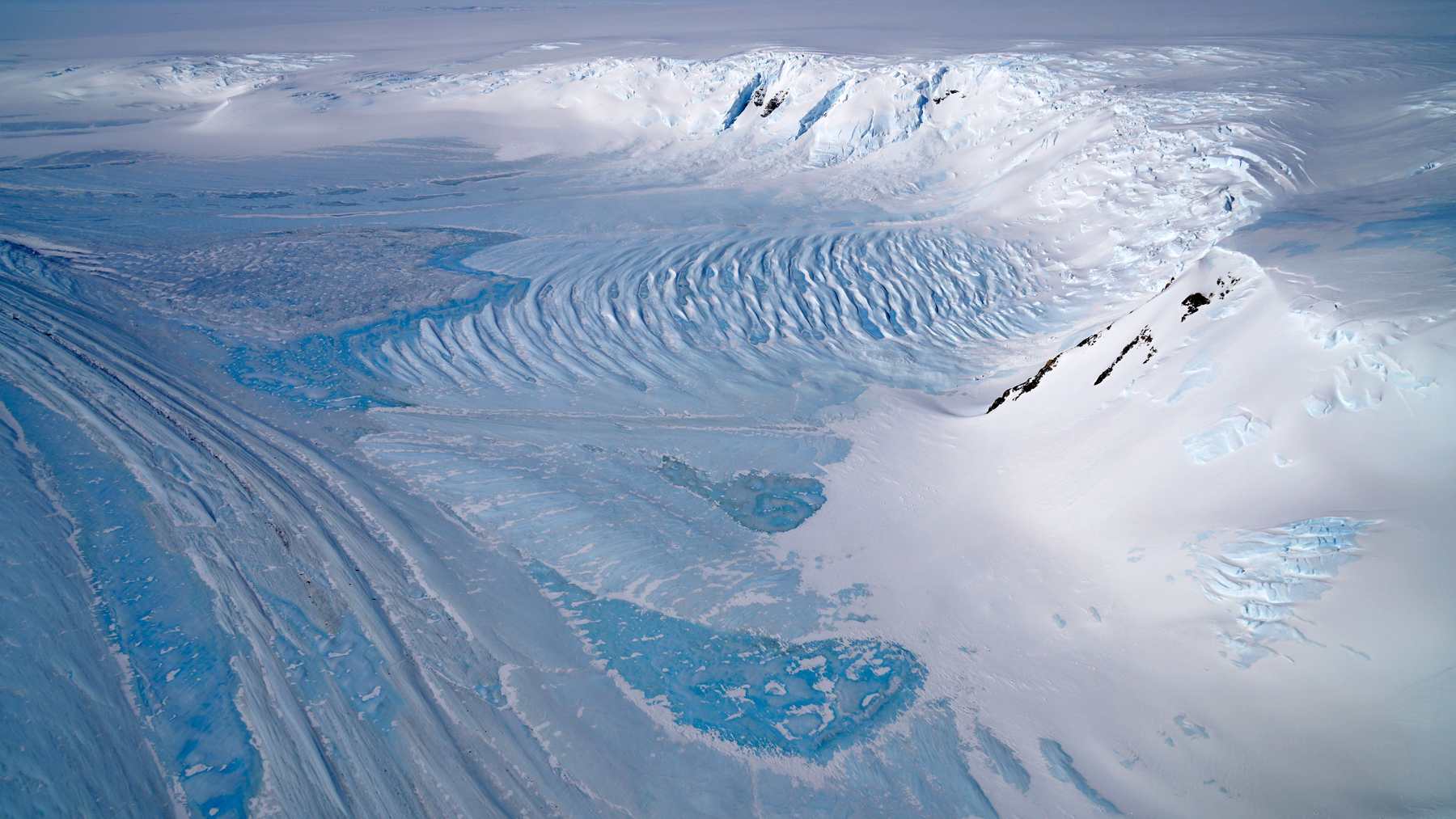
Photo: Chris Larsen / NASA Operation IceBridge