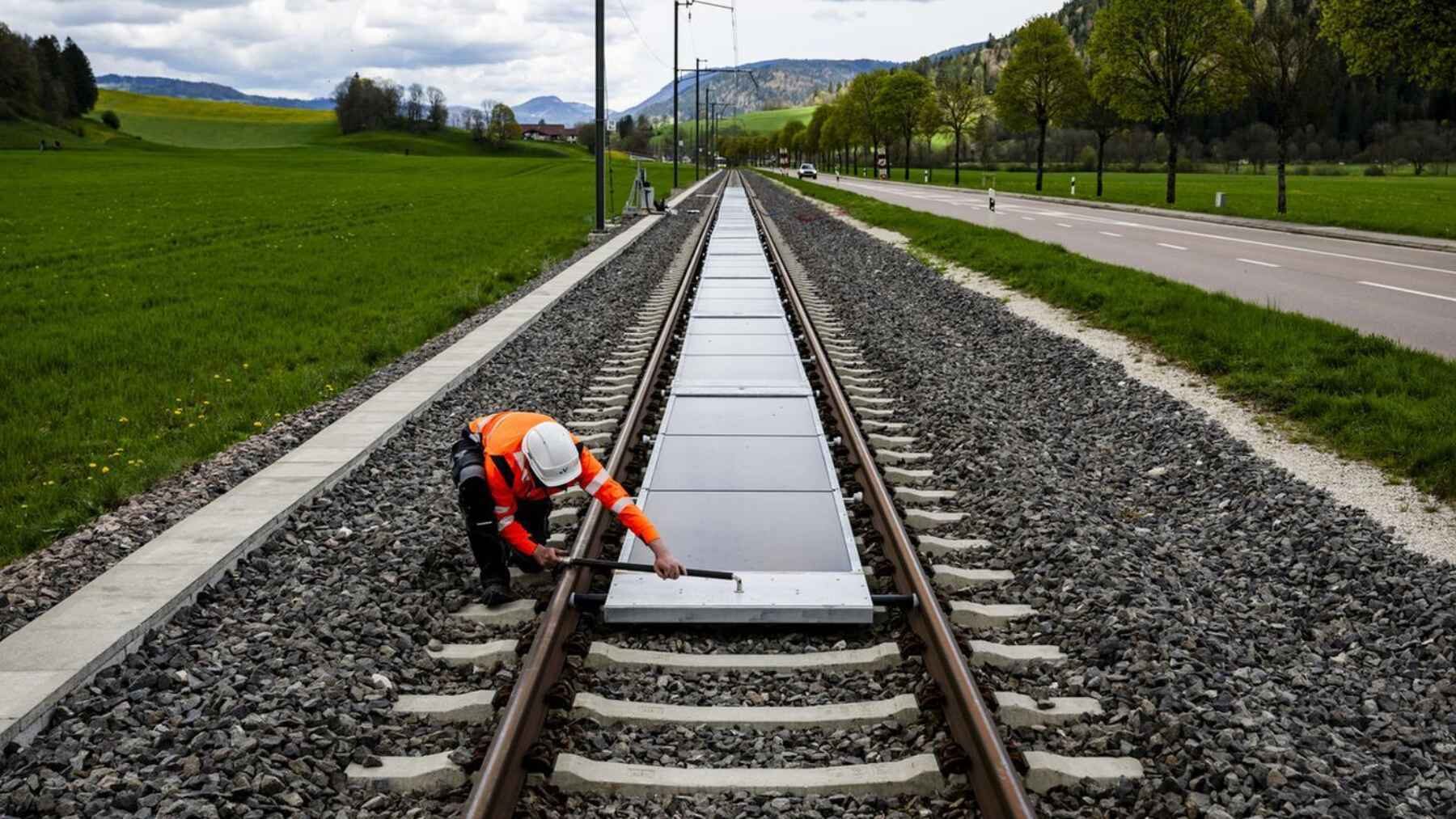
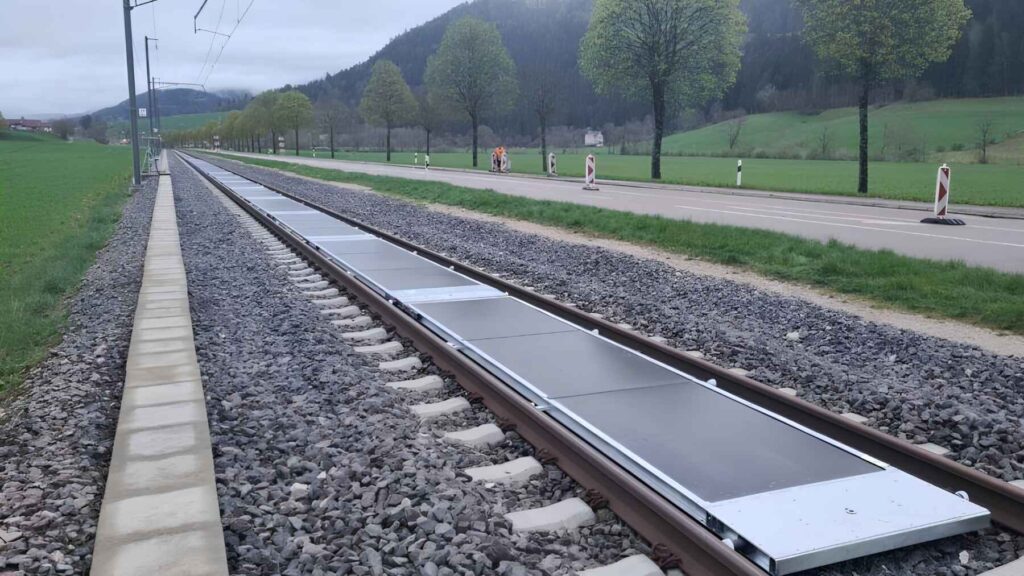
Switzerland’s strangest solar power plant is no longer just a clever idea on paper. On an active rail line near Buttes, in the canton of Neuchâtel, 48 removable solar panels now sit between the rails, and more than 11,000 trains have already passed over them without disrupting daily service. “We have achieved our objectives, both in terms of railway safety and electricity production,” Sun-Ways founder Joseph Scuderi told Swissinfo.
The installation is tiny by power-plant standards, but the point is much bigger. If panels can survive traffic, vibration, dust, snow, and maintenance work, the narrow strips of space already running through towns, farms, and forests could become a new clean-energy surface without taking over fields or mountain slopes. And that is where this Swiss test gets interesting.
A solar farm hiding in plain sight
The pilot covers about 330 feet of operating track and uses 48 panels rated at 380 watts each. Together, they provide 18 kilowatts peak of installed capacity and are expected to produce about 16,000 kilowatt-hours a year, according to Sun-Ways and the French National Railway Company (SNCF).
That is not enough to change Switzerland’s grid on its own. Still, for a short stretch of track, it is a practical proof of concept. Think of it less as a power plant and more as a question placed between two steel rails. Can this work every day?
Sun-Ways designed the panels to be removable, because railroad tracks are not empty land. They are critical infrastructure. Crews still need access for inspections, repairs, ballast work, and emergency operations, so a fixed solar carpet would be a nonstarter.
Why this matters now
Solar power keeps getting bigger. The International Energy Agency says solar PV additions rose almost 30% in 2024, reaching about 550 gigawatts, and global installed solar capacity hit roughly 2.2 terawatts. That growth is good news, but it brings a very down-to-earth problem. Where do all the panels go?
Switzerland has already felt that tension. In 2023, voters in the canton of Valais rejected a plan to speed up large solar parks in the Alps, with 53.94% voting against it. For many opponents, the issue was not solar itself. It was the thought of industrial-looking equipment spread across treasured mountain scenery.
That is why rail solar has a different kind of appeal. It uses land society has already changed. No one has to imagine a new energy site appearing outside the kitchen window or across a favorite hiking view.
A tough place for panels
At first glance, placing panels between rails sounds almost too obvious. Then a train rushes by. Suddenly, the environment looks less friendly.
The panels must deal with repeated air pressure, metal dust, grit, snow, frost, vibrations, and the sticky grime that builds up anywhere machines run every day. They also sit flat, which is usually less efficient than tilted rooftop panels facing the sun.
Sun-Ways says its system is modular and reversible, and its prototype is designed for trains passing at up to about 93 mph. The company also says a specialized rail machine could install about 10,800 square feet of panels per day. That kind of speed matters if the idea ever moves beyond a small pilot.
Safety is the hard part
The real test is not whether the panels can make electricity. They can. The real test is whether they can make electricity without creating headaches for rail operators, maintenance crews, or train drivers.
SNCF says the Buttes pilot, launched on April 24, 2025, is being used to evaluate installation, glare, track inspection, maintenance impacts, electricity output, and dirt buildup. The trial is scheduled to run until April 2028, with SNCF’s innovation teams and SNCF Réseau studying what the data means for rail operations.
So far, the early signs are encouraging. TransN, the public transport company operating the Buttes section, told Swissinfo there had been no conflicts with infrastructure, maintenance, or train traffic. The company also said it had received no reports of glare from staff.
Where the electricity goes
For now, the power from the panels is fed into the local grid. Swissinfo reported that the plant produced more than 16,000 kilowatt-hours since May 20, 2025, despite a shutdown of about a month linked to snow and planned technical work.
Effectively, that output is modest. It will not make trains “100% self-powered” anytime soon, no matter how tempting that phrase sounds. Trains use a lot of electricity, especially when they accelerate, climb, heat cars, or run through busy timetables.
Still, the long-term possibilities are useful. Rail corridors could help power nearby signals, switches, stations, low-voltage systems, or local distribution networks. For anyone watching the electric bill climb during that sticky summer heat we all know, even small local supplies can matter.
Could it scale?
Sun-Ways estimates that suitable stretches of Switzerland’s roughly 3,300-mile rail network could generate up to 1 billion kilowatt-hours a year. Swissinfo says that would equal the annual consumption of about 300,000 households, or around 2% of Switzerland’s electricity use.
The company also points to more than 621,000 miles of railroads worldwide as a huge potential surface. That number sounds dazzling, but it needs a cautious reading. Tunnels, shaded cuts, heavy snow zones, complex crossings, and high-maintenance tracks will not all be good candidates.
Even so, a small fraction of that network would be meaningful. Clean energy does not always need a dramatic new landscape. Sometimes it needs a better use for the narrow, overlooked spaces we already built.
What the Swiss experiment tells us
The biggest lesson from Buttes is not that railroads will replace solar farms. They will not. The lesson is that the next wave of renewable energy may depend, to a large extent, on fitting into daily life without adding new land fights.
That is a more human test than it sounds. People want cleaner power, quieter cities, less exhaust, and lower emissions. They also care about farms, forests, mountains, and the view from the places they call home.
For now, 48 panels in Switzerland are doing something humble but important. They are asking whether clean energy can hide in plain sight, under the trains we already ride.
The official statement was published on SNCF Group’s website.