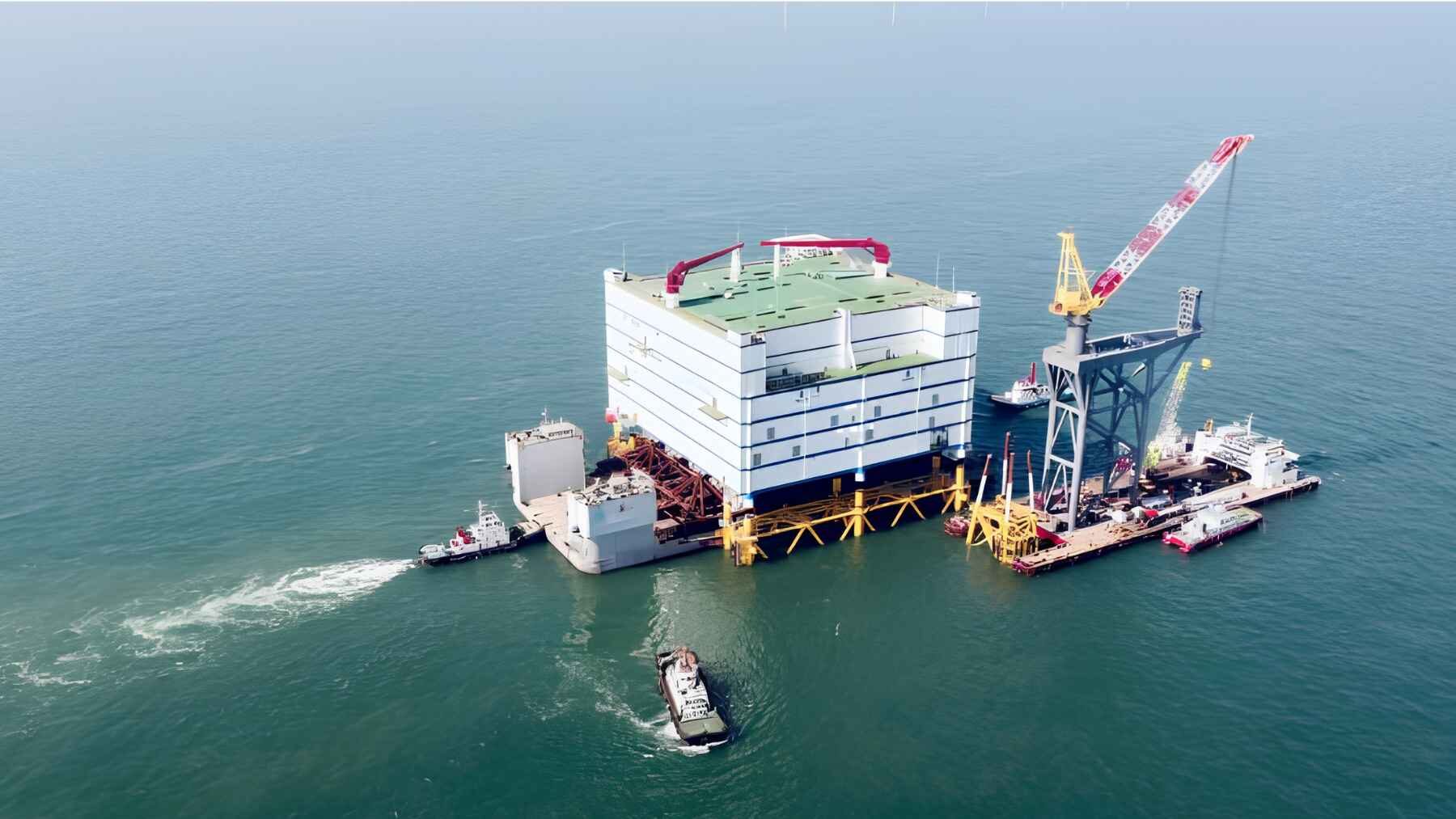
It does not have spinning blades. It does not look like the wind turbines most people picture when they think about clean power. Still, China’s Rudong offshore converter station may be one of the most important pieces of the country’s offshore wind buildout, because it helps move 1.1 gigawatts of electricity from three wind farms through undersea cables and toward the grid.
Built for the Jiangsu Rudong offshore wind project in the Yellow Sea, the platform gathers power from the H6, H8, and H10 wind farms, then converts that electricity so it can travel about 62 miles underwater with fewer losses. Project figures say the wider development can meet the annual electricity needs of roughly 1.36 million households. That is the kind of number that makes clean energy feel less abstract and a little closer to the electric bill at home.
The hidden machine at sea
The Rudong platform is not a power plant in the usual sense. The turbines do the generating, while the converter station acts more like a busy electrical traffic center, collecting, transforming, and sending power where it needs to go.
That role becomes more important as offshore wind farms move farther from shore. Stronger and steadier winds are often found out at sea, but distance creates a problem. The farther electricity travels, the more carefully it has to be managed.
Why direct current matters
Rudong uses high-voltage direct current technology, known as HVDC, to solve that problem, the station converts electricity from alternating current into direct current, which is better suited for long-distance submarine transmission.
China Three Gorges describes the Rudong project as China’s first ±400 kilovolt VSC-HVDC transmission offshore wind project. The company also says the project includes a VSC-HVDC cable with China’s highest transmission capacity and longest transmission distance for this kind of offshore wind system at the time.
Why should anyone outside the power industry care? Because offshore wind is only useful if it reaches homes, factories, and cities reliably. A turbine in strong ocean wind is impressive, but without the grid hardware behind it, much of that promise gets stuck offshore.
A 24,250-ton engineering problem
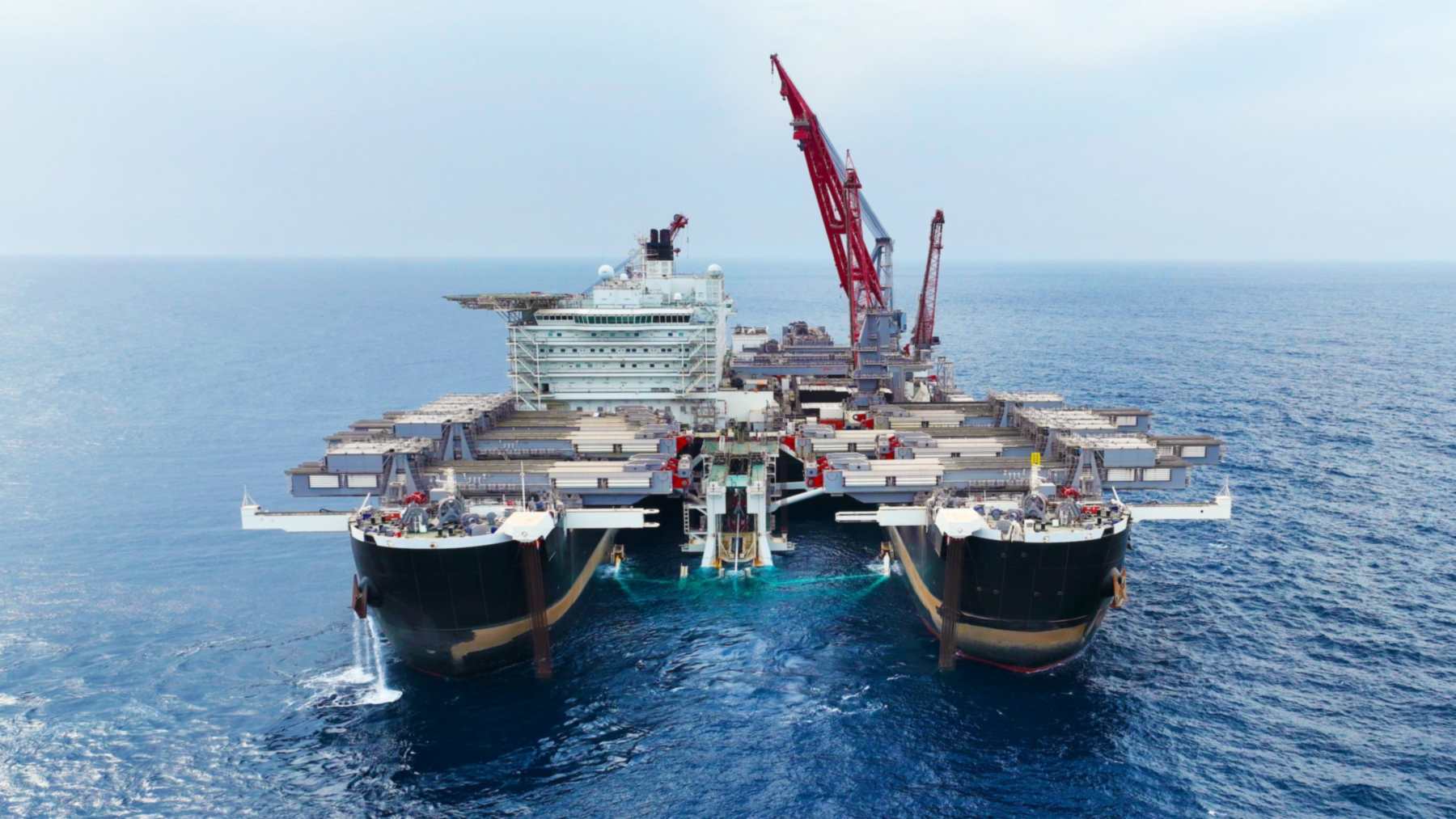
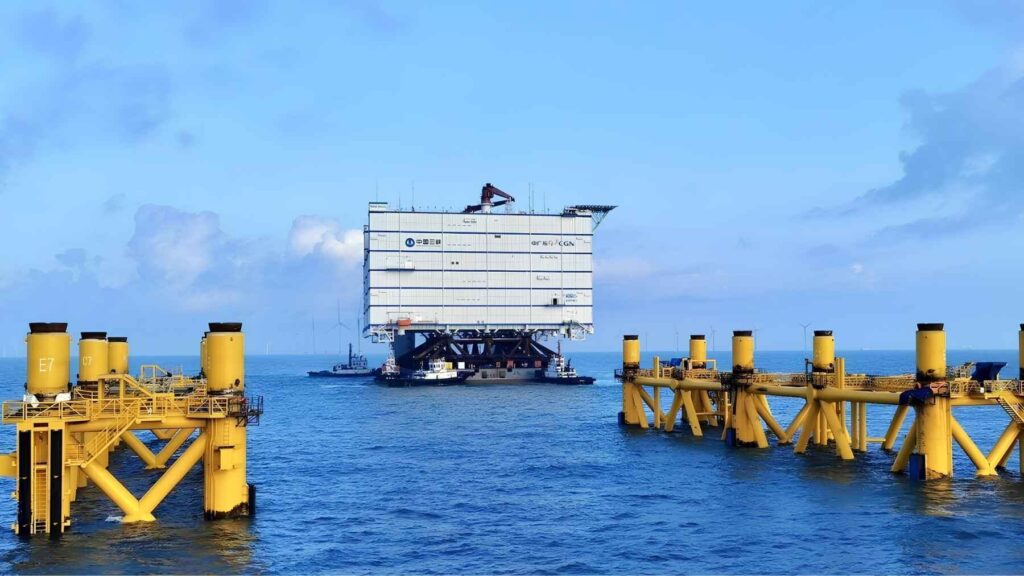
The scale of the Rudong converter station is hard to picture. The China Classification Society said the offshore station weighed about 22,000 metric tons, which is roughly 24,250 U.S. tons, and was installed in the Huangshayang waters off Rudong, Jiangsu.
That is not equipment you simply lift into place. Reports on the installation describe the use of a floating tow method, with ballast systems and natural tides helping position the structure over its foundation. Imagine using the rise and fall of the sea itself as part of the crane.
The platform was described at installation as the world’s largest and Asia’s first offshore converter station. That record-setting label matters, but so does the lesson behind it. Offshore wind is becoming a story about ships, cables, foundations, and precision engineering as much as it is about blades turning in the wind.
China’s offshore wind push
Rudong also reflects a broader shift in China’s energy planning. The project was built to handle output from three offshore wind areas with a combined capacity of 1.1 gigawatts, including 400 megawatts at H6, 400 megawatts at H10, and 300 megawatts at H8.
A later China Three Gorges project summary said Rudong was completed and put into operation at the end of 2021. It also described the project as a demonstration for large-capacity offshore wind and deep-sea development, with research, design, construction, installation, commissioning, and operation all tied to flexible direct-current transmission.
At the end of the day, that is what the project is trying to prove. Offshore wind does not scale by turbines alone. It scales when the grid can swallow huge bursts of clean electricity and send them inland without wasting too much along the way.
The record is already moving
There is one important update. Rudong was a landmark when it was installed, but China’s offshore wind hardware has already moved into an even larger generation.
In May 2026, China Three Gorges reported the shipment of “Sea Wind Heart,” a roughly 27,560-U.S.-ton offshore converter station for the Yangjiang Qingzhou V and VII offshore wind farms. The company described it as the world’s largest offshore converter station by scale and the first ±500 kilovolt, 2,000 megawatt flexible direct-current offshore converter station.
That does not make Rudong less important. If anything, it shows how fast the field is moving. Yesterday’s record becomes today’s blueprint.
A grid that reaches under the sea
The bigger picture is simple, but not easy. If countries want more renewable electricity, they need more than solar panels and wind turbines. They need transmission systems that can handle distance, storms, saltwater, corrosion, maintenance, and sudden changes in supply.
Europe is working through the same challenge as offshore wind expands in the North Sea and Baltic Sea. The European Commission says offshore grids and hybrid offshore infrastructure are now part of the region’s energy planning, because wind farms increasingly need to be connected at sea basin level instead of one project at a time.
Rudong’s lesson is that the clean-energy transition has a hidden layer. It is buried in cables, sealed inside converter halls, and mounted on steel islands far from shore. Not very glamorous, maybe, but essential.
The official project statement was published on China Three Gorges Corporation’s website.