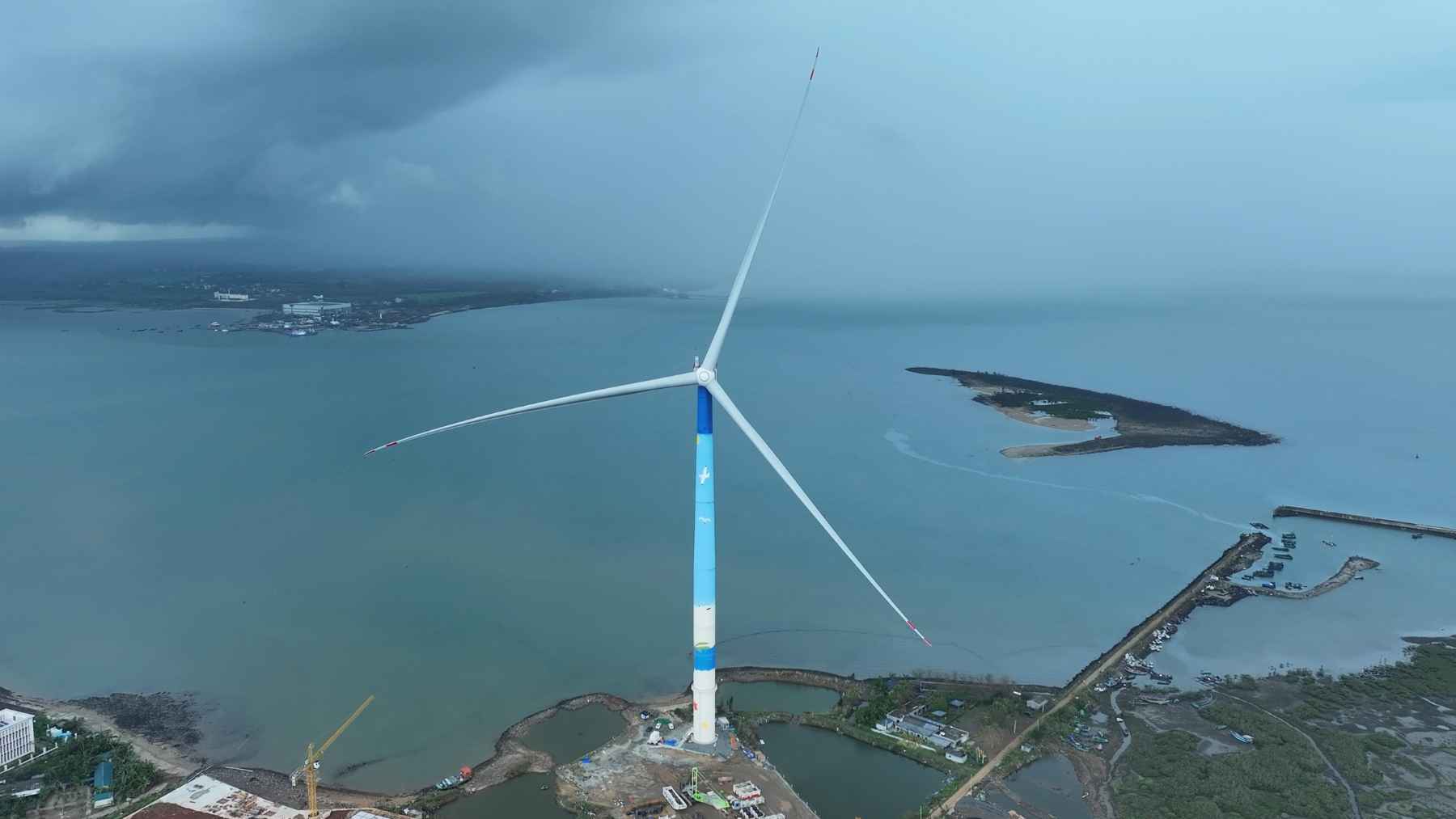
How big does a wind turbine have to be before people start talking about local weather? In China, that question is now attached to a 20-megawatt machine in Hainan, an offshore-class turbine so large that its blades sweep an area measured in soccer fields.
The main point is not that one turbine is changing the planet’s climate. It is more local than that. When giant blades pull energy from moving air, they leave behind a wake, and that wake can nudge wind speed, temperature, and moisture in the small area around it.
What China built
Mingyang Smart Energy’s MySE18.X-20MW turbine was hoisted in Hainan on August 28, 2024, and Chinese state science media reported that it was connected to the grid on September 26, 2024. The machine has a flexible 20-megawatt design, with a rotor that can span about 853 to 958 feet across.
One Hainan test setup used a MySE292 blade set, with blades about 469 feet long. That is the kind of size that changes how people think about wind power, not as a field of small machines, but as a few huge structures doing the work of many smaller ones.
Power for thousands
By the company’s estimates reported in China, the turbine could generate 80 million kilowatt-hours of electricity in a year under average wind conditions.
That is enough to meet the annual electricity use of about 96,000 households, while avoiding roughly 73,000 U.S. tons of carbon dioxide compared with fossil fuel generation.
In practical terms, one very large turbine can reduce the number of machines needed for the same output. Fewer turbines can mean fewer foundations, fewer cables, and less occupied sea space. But there is a tradeoff worth watching.
A record with a caveat
There is an important detail here. Offshore wind industry reporting later described the Hainan machine as a 20-megawatt prototype installed at an onshore test site, while a separate 20-megawatt turbine from China Three Gorges and Goldwind was installed more than 18 miles offshore in Fujian in January 2026.
That distinction matters because the open sea is a harsher proving ground. Waves, salt, maintenance limits, and typhoon winds all test a turbine differently than a coastal test base does. Even so, the Hainan machine remains a major signal of where wind energy is heading.
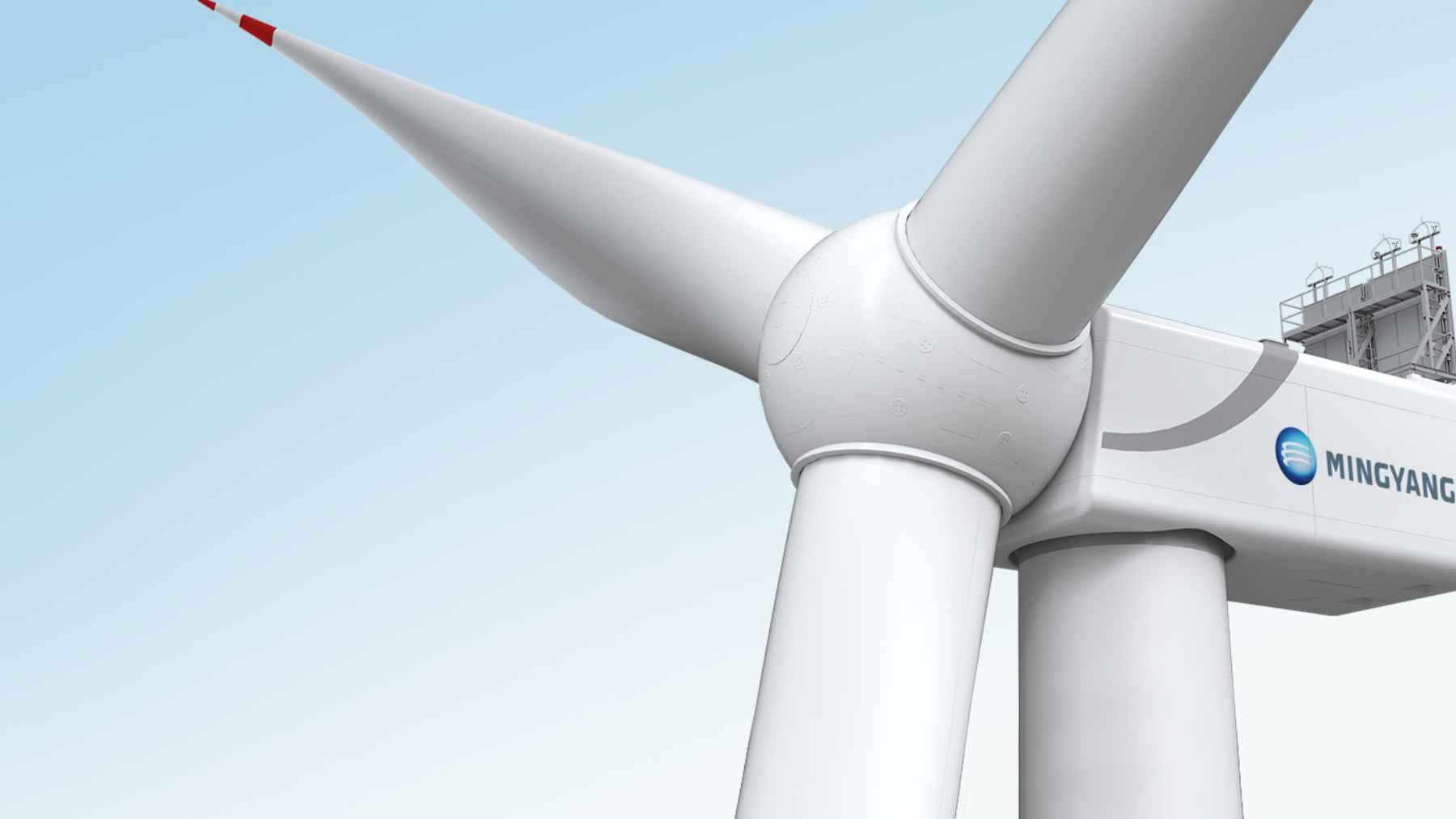
Mingyang’s massive 20MW turbine in Hainan highlights the growing scale of offshore wind energy projects in China.
Why the air changes
A wind turbine does not simply “catch” wind like a sail. It removes some of the wind’s energy and turns it into electricity, leaving slower and more turbulent air behind the blades. Scientists call that disturbed trail a wake.
Think of the rough air behind a truck on the highway, only spread across the sky and shaped by weather.
In 2018, Andreas Platis of the University of Tübingen and colleagues used aircraft measurements over offshore wind farms and confirmed that wakes can stretch for tens of miles under stable atmospheric conditions, with wind speed drops reaching as much as 40% in some cases.
The microclimate question
A microclimate is a small local climate pattern. It can be the cooler air under a tree, the extra heat over a parking lot, or the stirred-up air around a wind farm. With turbines this large, the question becomes simple. How far does that pocket of changed air reach?
A 2022 study led by Naveed Akhtar at Helmholtz-Zentrum Hereon found that large North Sea wind farms can reduce near-surface winds by about 2.2 miles per hour, warm the lowest air layers by less than half a degree Fahrenheit, and increase rainfall over wind farm areas by about 5%. These are not dramatic daily weather events, but they are measurable changes.
Why wildlife matters
Small shifts can still matter when they repeat over time. Birds moving along a coast, marine animals sensitive to currents, and coastal habitats all depend on wind, moisture, and water movement in ways that are easy to overlook from shore.
A 2026 study led by Nils Christiansen found that large offshore wind development can also affect coastal ocean dynamics, including current speeds and surface temperatures. That does not mean offshore wind should stop. It means planning has to include the air above the sea and the water below it.
Built for rough weather
China’s coastal wind projects also have to deal with typhoons, not just steady breezes. Mingyang’s official product information describes its large offshore turbine line as designed to withstand winds of about 178 miles per hour, a number that helps explain why these machines are being tested in places like Hainan.
That strength is part of the bigger story. The same scale that makes a turbine more productive also makes it more visible in the environment around it. Clean energy still has to be engineered carefully.
What comes next
The real test will be long-term monitoring. Researchers need local data on wind, temperature, humidity, bird movement, sea conditions, and marine life before and after these giant turbines operate at scale.
At the end of the day, the Hainan turbine is less a warning sign than a reminder. Renewable energy can cut pollution and still reshape local environments, so the smartest path is not to ignore those effects, but to measure them early and design around them.
The official product information has been published by Mingyang Smart Energy.