The United Kingdom has drilled five kilometers underground and found a real alternative to oil, bringing an old energy dream closer to the surface
· 4 min read

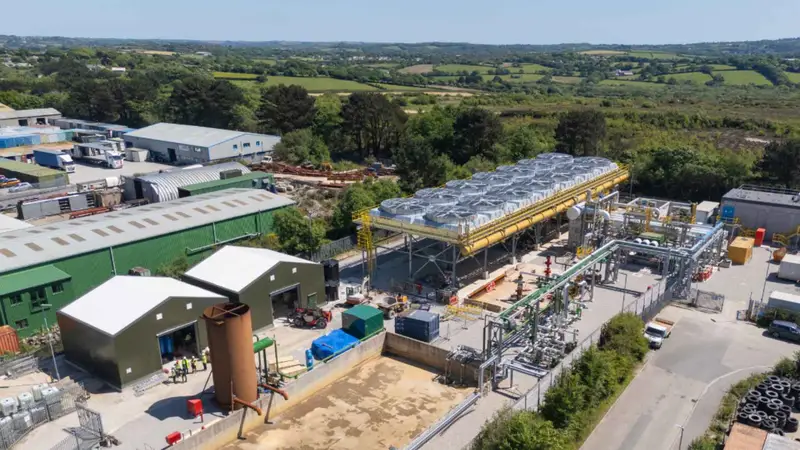
In southwest England, a project near Redruth, Cornwall, is doing something the U.K. has not done before at commercial scale. Geothermal Engineering Limited (GEL) says its United Downs site is now generating electricity from hot brine brought up from more than 3 miles underground, and it is also producing battery-grade lithium carbonate from that same fluid.
It lands at a moment when fossil fuel markets are once again showing how jumpy they can be. Reuters reported that on April 29, 2026, Brent crude climbed above $118 a barrel and U.S. West Texas Intermediate rose past $105 as investors weighed supply disruption risks tied to the Iran conflict. If your electric bill and the price at the pump feel connected, this is why.
Why a 3-mile well matters
Geothermal power is “always-on” renewable electricity, meaning it does not depend on sunshine or wind. That makes it less flashy than a new solar farm, but potentially more useful on the days when the grid is stretched thin and everyone is running the air conditioner.
For United Downs, the pitch is energy security with fewer surprises. Octopus Energy founder Greg Jackson put it bluntly when he said, “Bills are still too high, and the answer is more homegrown, renewable energy.”
Drilling into granite for 374°F heat
The basics sound almost too simple. You drill into hot granite, pull up mineral-rich water, harvest the heat, and send the cooled fluid back down again.
At United Downs, GEL says its deepest well reaches about 5,057 meters, roughly 3.14 miles, and temperatures can exceed 190°C, about 374°F. The wells are designed to intersect a fractured structure called the Porthtowan Fault Zone, which helps move fluid through the rock.

How the power plant turns heat into electricity
So why not just boil water into steam like a traditional plant? At these temperatures, many geothermal projects use a binary system that transfers heat into a secondary fluid that vaporizes more easily, spinning a turbine without venting the brine.
A technical project paper describing the Organic Rankine Cycle design says brine enters the system around 170°C, about 338°F, and is cooled to about 50°C, around 122°F, after its heat is captured. That lower temperature is not wasted, because it sets up the next step, mineral extraction.
The headline numbers for power and land use
Industry reporting describes United Downs as a 3 megawatt plant, with output expected to cover around 10,000 homes through a power purchase agreement with Octopus Energy. The same reporting described the proof-of-concept project as costing about $68 million.
The physical footprint is also limited compared with many energy projects. Reporting around the launch described the site as about 0.6 hectares, roughly 1.5 acres, which is closer to a small retail lot than a sprawling industrial zone.
GEL says geothermal projects can reach about 5 to 15 grams of CO2 per kilowatt-hour, roughly 0.01 to 0.03 pounds, though real-world values vary by design and geology.
Lithium without a new mine
The second output is what makes this project different. After power generation, the brine is processed for “direct lithium extraction,” producing lithium carbonate before the fluid is reinjected underground in a closed loop.
Hatch, which worked on the lithium facility, says the brine contains more than 340 parts per million of lithium. The Chemical Engineer reported expected production of about 100 metric tons of lithium carbonate equivalent per year, which is about 110 U.S. short tons, at the current scale.
Why lithium supply is becoming a climate issue
Electric vehicles and grid batteries are not just about cleaner air in traffic. They also require huge volumes of minerals, and lithium is one of the biggest pressure points in that supply chain.
The International Energy Agency expects lithium demand to grow about fivefold by 2040 under today’s stated policies. That does not mean every new project is automatically “green,” but it does help explain why governments are looking for lower-impact sources, including direct extraction from brines and more recycling.
The environmental questions to watch
Deep geothermal is low carbon for the most part, but it is not impact free. One of the main risks is induced seismicity, since injecting and withdrawing fluids in fractured rock can trigger small earthquakes, which is why project documentation emphasizes monitoring and safe operating limits during testing.
The lithium side has its own checklist. Direct lithium extraction can reduce land disturbance compared with some mining routes, but it still uses industrial equipment and chemicals, and it produces waste streams that need transparent reporting and careful handling.
What success would look like from here
GEL and industry coverage say the company is developing additional deep geothermal sites in Cornwall, aiming for about 10 more megawatts of geothermal power by 2030. Scaling beyond a single plant is where the real climate impact would show up, but it also depends on drilling costs and on finding rocks that can deliver reliable long-term flow.
The British Geological Survey notes that some U.K. granites can reach temperatures up to about 200°C, around 392°F, at 5 kilometers (about 3.1 miles) depth, which is hot enough for power generation.
For now, United Downs is a real world test of whether one set of wells can deliver clean electrons and critical minerals without trading one environmental problem for another.
The press release was published on GEL Energy.
Glossary for this story
- Geothermal energy
- Heat from inside the Earth used to make electricity or to heat and cool buildings.
- Fossil fuels
- Coal, oil and natural gas. They formed over millions of years from the remains of living things and release CO₂ when burned.
- Renewable energy
- Energy from sources that are naturally replenished, such as sunlight, wind, water and biomass.
- Megawatt
- One million watts. Used to measure the output of power plants and wind or solar farms.
- Kilowatt-hour
- The unit of energy on electric bills: what a 1,000-watt appliance uses in one hour.
- Electric vehicle
- A vehicle powered by one or more electric motors running on rechargeable batteries that are charged by plugging in.
ECOnews Newsroom
Writer at ECOnewsA team of journalists specializing in socio-environmental news, sustainability, climate change, the environment, responsible consumption, and innovation. At EcoNews, we provide clear, reliable, and relevant coverage of the environmental and social challenges shaping our era.
More from ECOnews NewsroomComments · 0
Rules ›No comments yet. Be the first to share your view.