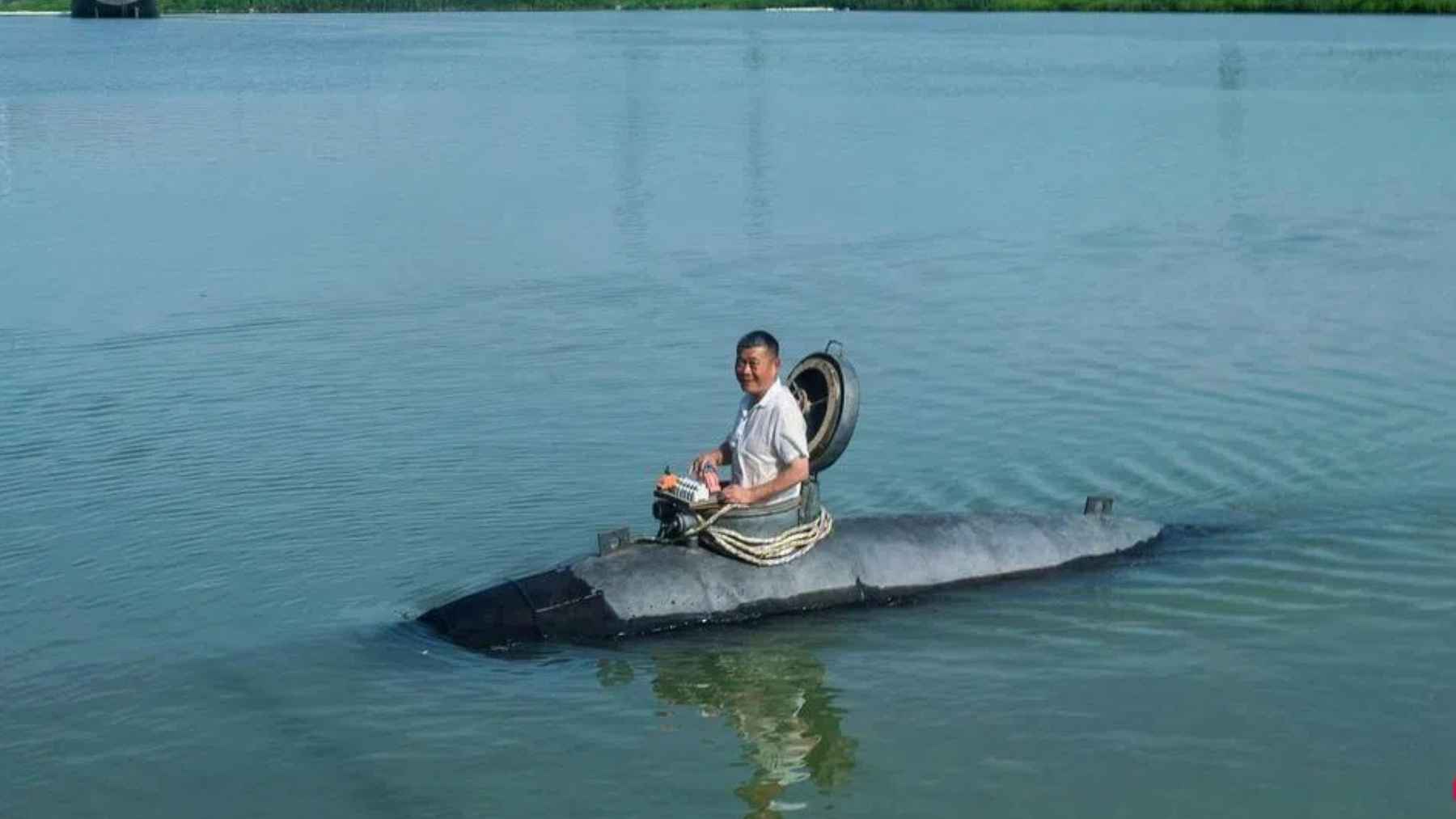
A 60-year-old farmer in eastern China has turned a dockside idea into a working homemade submarine. Zhang Shengwu, from Anhui Province, built a craft known as “Big Black Fish” that can carry two people and dive about 26 feet in a local river.
But the most interesting part is not just that it went underwater. The story is how a first attempt built with about $700 in parts eventually grew into a heavier, larger, and safer second version that cost more than $5,600 to develop. In practical terms, this is less a cheap stunt and more a long experiment in welding, balance, patience, and risk.
A dockside idea
Zhang had spent years around boats, cargo traffic, and a small riverside wharf. He had worked with his hands before, including carpentry and shipping, which gave him a practical feel for structure and propulsion.
Then, in 2014, a television program about homemade submarines lit the spark. “I’ve seen metal boats and wooden boats all my life,” he recalled, but he had never seen one that could go below the water.
What would most people do with that thought? Probably let it pass. Zhang did the opposite, turning the wharf into a workshop and sketching the design in his head.
The first submarine leaked
His first prototype was about 20 feet long, about 4 feet tall, and weighed roughly 2.2 U.S. tons. He bought steel plates, batteries, and an engine, then spent months turning those parts into a real vessel.
That first machine reached the water, but it was far from perfect. It leaked during the dive, a serious problem for any submersible, and Zhang later described the experience as both frightening and dreamlike.
Still, the failure did not end the project. The early craft earned him a Chinese utility model patent, which is a type of protection for a practical design, and gave him a starting point for the next version.
Big Black Fish
The upgraded submarine is much larger. “Big Black Fish” measures about 23 feet long and about 6 feet high, weighs around 5.5 U.S. tons, and has a displacement of about 7.7 U.S. tons.
It can carry two people, stay underwater for about 30 minutes, and move at a minimum speed of roughly 4.6 mph. During a July 2025 river trial, it completed basic movements such as acceleration, turning, and diving.
Zhang also strengthened the welds and improved the seals with silicone and glass adhesive. For a submarine, that detail matters because a tiny gap is not just messy. It can become a safety problem.
How it dives
The key device is the ballast tank. A ballast tank is a compartment that takes in water when the craft needs to sink and releases water when it needs to rise again.
Zhang added ballast tanks and poured about 2.2 U.S. tons of concrete into the bottom of the craft to help keep it stable. Think of it like adding weight low in a boat so it does not roll around too easily.
That balance is what makes the submarine more than a sealed metal tube with a motor. It needs to sink, stay steady, move forward, and then come back up without trapping its crew underwater.
Safety is the hard part
A 26-foot dive may sound shallow compared with ocean exploration, but water pressure builds quickly. The National Oceanic and Atmospheric Administration says pressure increases by about one atmosphere for every 33 feet of depth.
That is why homemade submarines remain risky, even when the builder is careful. Seals, welds, batteries, air supply, emergency surfacing, and hull strength all matter at the same time.
Professional manned submersibles are usually checked through design reviews, inspections, construction testing, and ongoing inspections. Classification group DNV describes those steps as part of meeting recognized safety and reliability standards.
Not a weekend project
Zhang’s success has been widely praised online, and it is easy to see why. There is something gripping about a farmer taking scrap-yard logic, river experience, and stubborn curiosity, then making a machine that actually dives.
Still, the story should not be read as a how-to guide. A homemade submarine is not like fixing a lawn mower or building a backyard shed, because a mistake underwater can turn dangerous very quickly.
Zhang has said he wants to build a larger submarine and keep improving depth, speed, and energy use. That next step would make safety even more important, not less.
What it really shows
“Big Black Fish” does not rewrite naval engineering. But it does show how hands-on knowledge can become a real, testable machine when someone keeps solving one problem after another.
The more human lesson is quieter. Dreams are easy to talk about, but Zhang’s story is about years of trying, leaking, repairing, adding weight, sealing gaps, and going back to the river.
At the end of the day, the hardest part of going underwater is not getting below the surface. It is coming back safely.
The main report has been published by CCTV News and carried by China Daily.