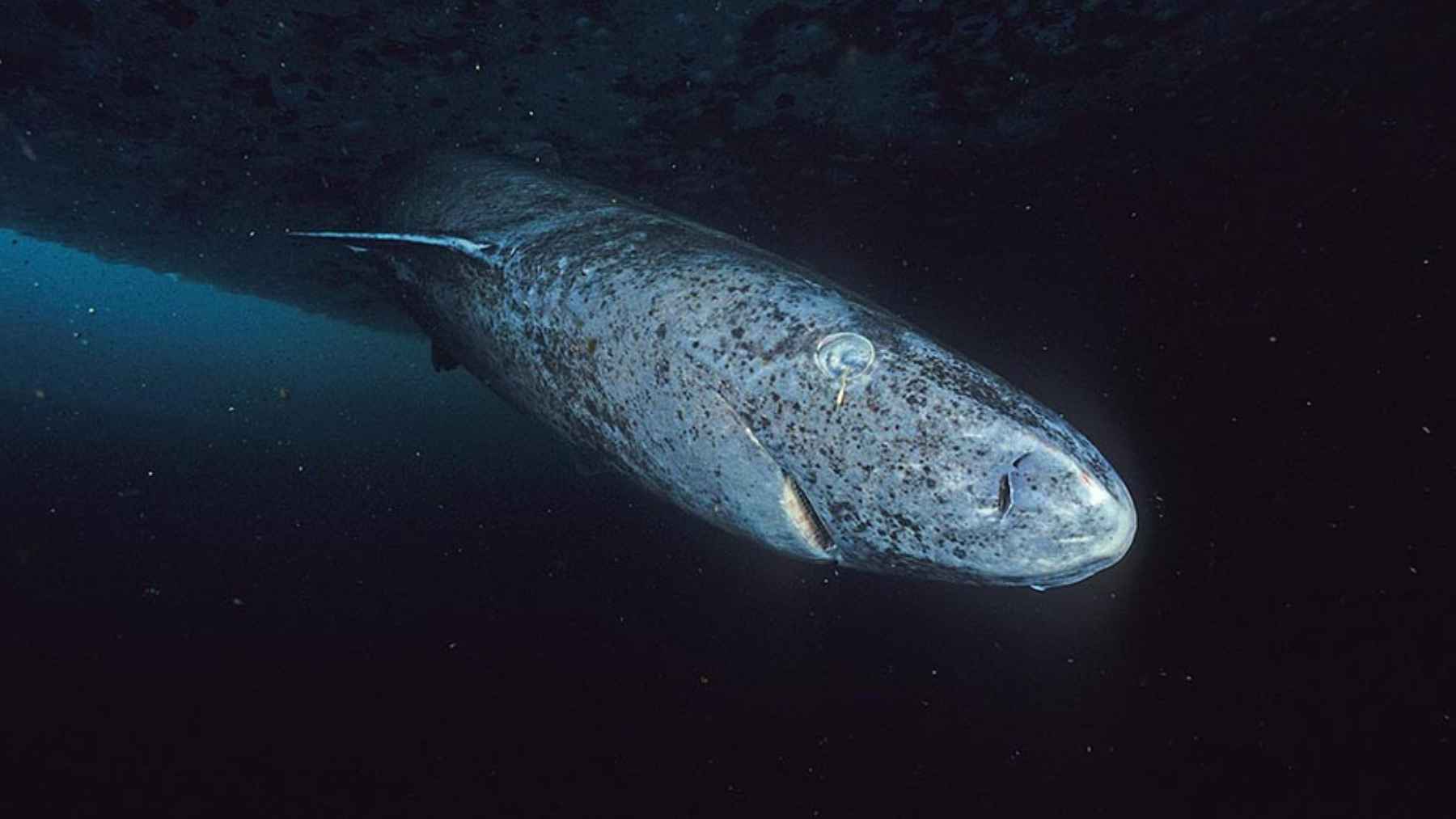
Deep in the cold waters of the North Atlantic and Arctic, one Greenland shark has pushed the limits of what scientists thought a vertebrate could survive. The animal was not given a neat birthday, of course, but research suggests the largest shark in a landmark study may have been close to 400 years old.
That is why some headlines say the shark was “born in 1627.” The real science is a little more careful, and much more interesting. Researchers estimated its age at about 392 years, with a wide uncertainty range, after studying 28 female Greenland sharks that had been accidentally caught by fishermen.
A shark from another century
Imagine a shark already alive before modern electricity, before cars, and before the United States even existed. That is the strange pull of this discovery. It makes the Greenland shark feel less like a fish and more like a living archive.
The largest animal in the study measured about 16.5 feet long. Based on radiocarbon dating, researchers estimated it was 392 years old, give or take 120 years, which means the “399-year-old shark” figure should be treated as a rough popular shorthand rather than an exact age.
How scientists dated it
Aging a Greenland shark is not like counting rings on a tree. Many sharks can be aged by studying growth bands in hard tissues, but Greenland sharks have soft vertebrae and no fin spines that work well for that method.
So scientists looked into the eyes. Proteins in the eye lens form before birth and do not degrade as the shark gets older, which means they can preserve a chemical timestamp.
By measuring radiocarbon in those lenses, researchers could compare the signal with known carbon levels from the past, including the “bomb pulse” left by nuclear testing in the early 1960s.
Slow life in cold water
Greenland sharks do almost everything slowly. NOAA notes that they grow less than 0.4 inches per year, can reach more than 20 feet in length, and may dive as deep as about 7,200 feet. Their top speed is under 1.8 miles per hour, which is slower than a relaxed walk through the grocery store.
That slow pace matters. In icy water, a low metabolism may help explain why these sharks age so gradually. It is not a magic trick, but the cold, dark, stable world they inhabit seems to favor a life stretched across centuries.
Late to grow up
The study also estimated that Greenland sharks may not reach sexual maturity until around 156 years old. That is hard to wrap your head around. A shark could spend more than a century in the ocean before it is old enough to reproduce.
In practical terms, that makes every adult shark especially valuable. If a mature Greenland shark is lost to fishing gear, the population cannot simply replace it in a few seasons. The recovery clock runs in decades, and maybe centuries.
Not just an old fish
These sharks are not passive relics drifting through the deep. They are large predators and scavengers that feed on fish, squid, seals, and other organic remains. Studies of stomach contents show that smaller Greenland sharks rely heavily on squid, while larger individuals consume more fish and marine mammals.
Their bodies are built for endurance, not speed. The Greenland shark is thick, heavy, and often seen as sluggish, but that should not fool anyone. In the Arctic food web, slow can still be powerful.
Clues about aging
The big question is obvious. How does any vertebrate keep going for that long?
Recent genetic work is starting to offer clues. Scientists who mapped the Greenland shark genome reported that its DNA repair “toolbox” may be one factor behind its extreme longevity, although they also warned that more research is needed before drawing firm conclusions.
Another recent study found that Greenland sharks can retain a functional visual system despite extreme age, deep-sea darkness, and eye parasites. The researchers also pointed to DNA repair mechanisms that may help preserve retinal tissue over centuries.
A fragile giant
For all its toughness, the Greenland shark is vulnerable. NOAA says most Greenland sharks that end up in nets and lines today are caught by accident, which makes reducing bycatch critical for conserving the species.
The concern is simple. A species that grows slowly, matures late, and may reproduce infrequently cannot absorb losses the way faster-growing fish can. Add Arctic warming, expanding human activity, and pollution, and the ancient shark suddenly looks less invincible.
Why this matters now
The Greenland shark’s age is fascinating, but the deeper lesson is about time. Some animals live on a schedule so slow that our usual conservation timelines barely fit. A single decision made today could affect a population that will not fully respond for generations.
That is where the story becomes bigger than one remarkable shark. Studying this animal may help scientists understand aging, deep-sea survival, and the hidden biology of the Arctic. Protecting it means respecting a creature whose life may span nearly half a millennium.
The study was published in Science.