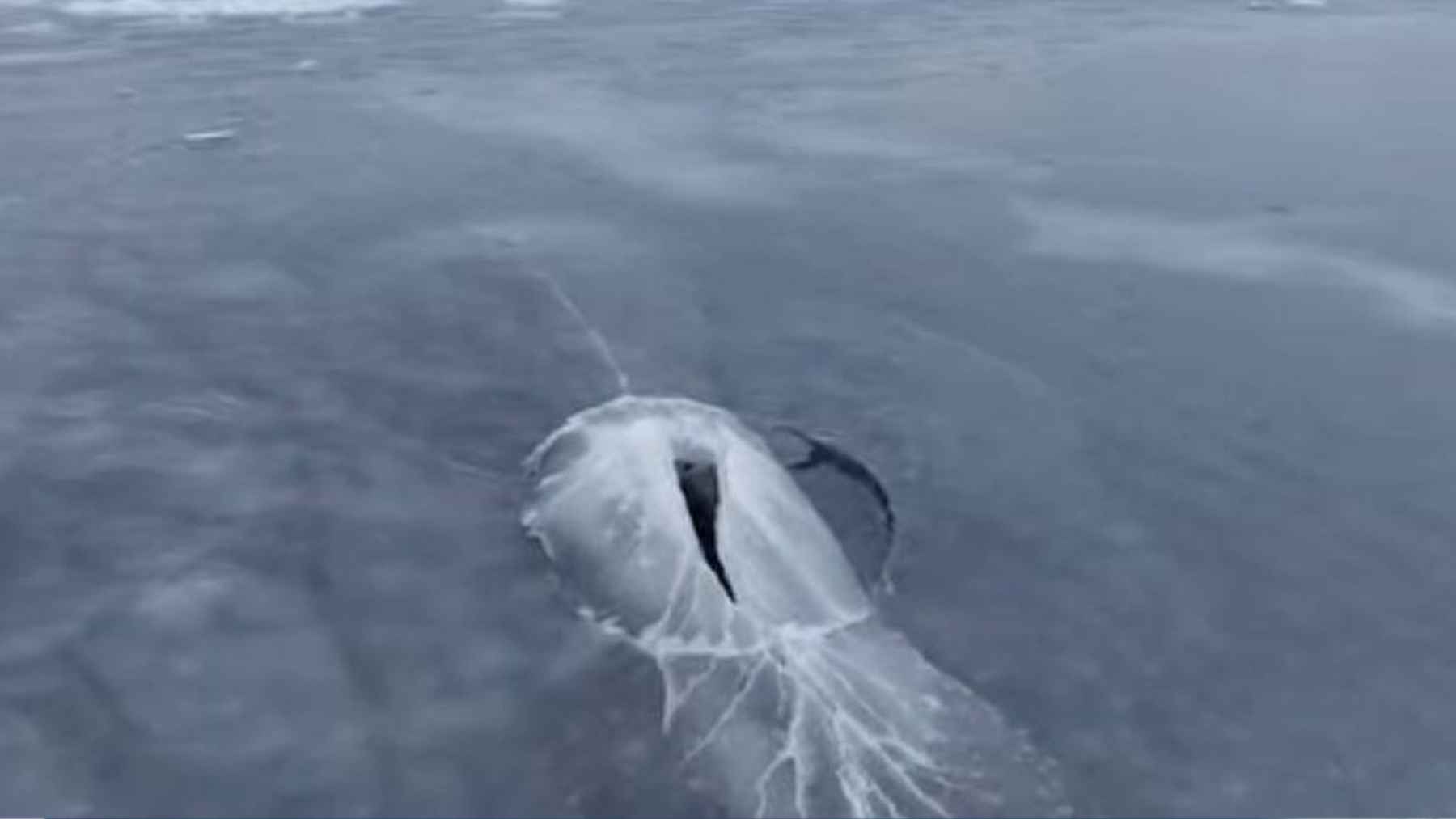
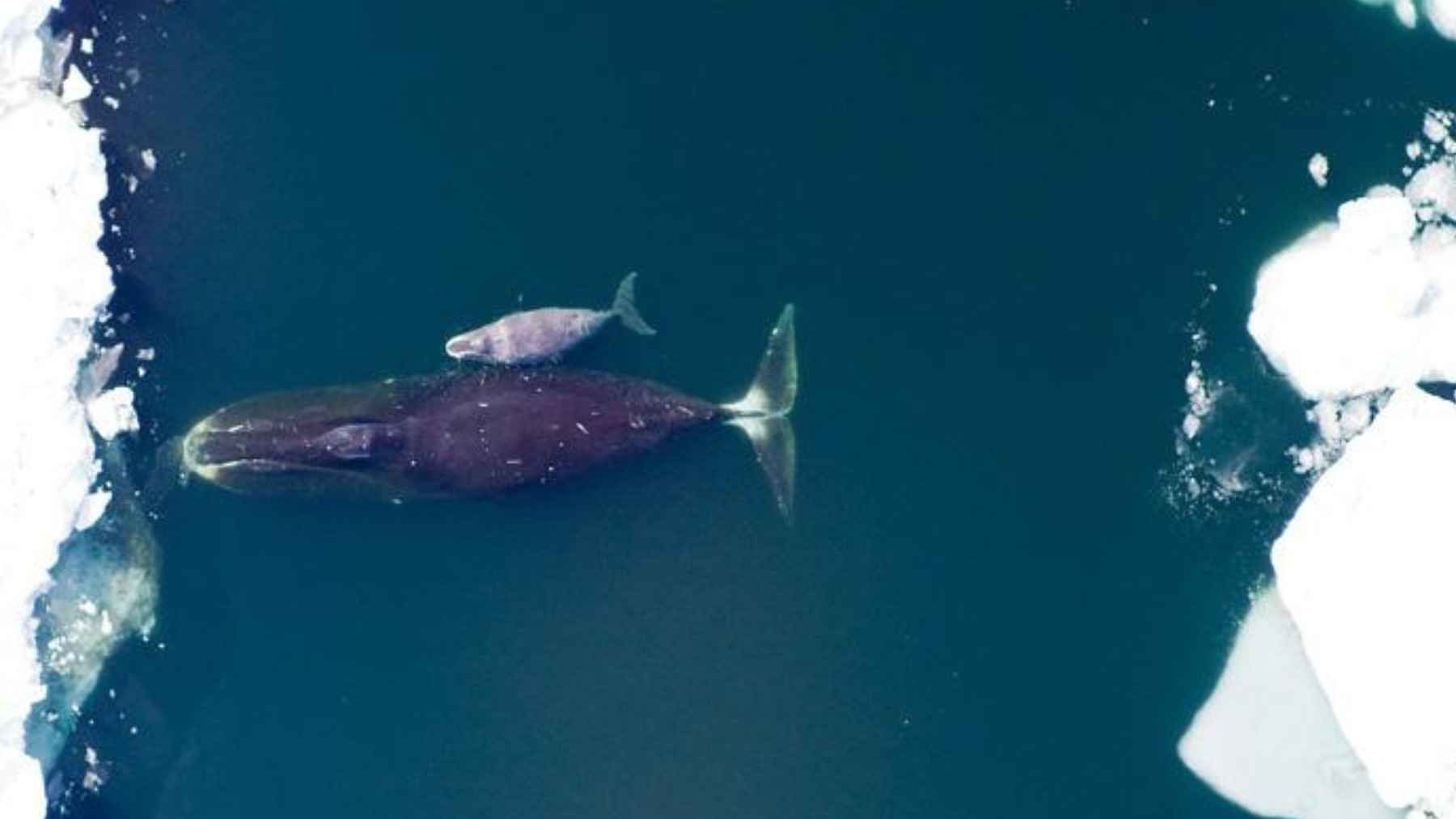
Footage shared by researchers and reported by Discover Wildlife on July 4, 2025, shows a drone flying over Disko Bay in western Greenland. A bowhead whale (Balaena mysticetus) surged upward and punched through roughly 24 inches (60 centimeters) of sea ice, opening just enough space at the surface to breathe before slipping back beneath the frozen lid.
The clip is striking, but it is more than a dramatic moment. It points to a bigger shift in polar science, where drones help researchers watch wildlife up close without getting close at all, and where a single breath through ice can hint at changes in food, sea ice, and survival.
A whale built for life under ice
Bowhead whales are among the most ice-adapted large mammals on Earth. They can reach about 66 feet in length, and NOAA Fisheries notes their bow-shaped skull can be more than 16.5 feet long, backed by a blubber layer roughly 17 to 19 inches thick.
That oversized head is not just for show. Christiansen told Discover Wildlife that “This behavior happens frequently during the colder winter and spring months in Disko Bay,” when open water can be scarce.
What the drone actually showed
From above, the moment looks like a clean crack spreading across a white sheet. The whale’s head meets the ice, fractures it, and the animal takes several breaths before diving, a reminder that these giants still live on a tight schedule set by lungs, not gills.
The reported ice thickness in Disko Bay, about 24 inches, lines up with what scientists and Indigenous observers have described elsewhere. NOAA Fisheries says bowheads can break through about 8 inches of sea ice, and Alaska Native whalers have even reported surfacing through about 2 feet.
Drones turn a dramatic video into useful data
Why fly a drone over whales in the first place? It is a health checkup without the waiting room, a camera that can measure size and shape without tagging, capturing, or crowding animals that already have enough to worry about.
In Disko Bay, Christiansen and colleagues used drone photogrammetry to estimate bowhead body size and condition by measuring body length, width, and height from aerial images. In Polar Biology, they reported 232 measurements from 154 adults and 50 measurements from 39 juveniles collected during spring fieldwork in 2022.
The numbers are surprisingly concrete. The researchers estimated adult body condition increased by 0.112 percentage points per day, which they translated into roughly 12 to 23 gallons of blubber gained per day (44 to 88 liters) for whales about 43 to 56 feet long (13 to 17 meters). Using published data from harvested whales, that blubber gain was estimated at about 82 to 163 pounds per day (37.1 to 73.9 kilograms).
How much food does an Arctic giant need?
Those blubber gains are not cosmetic – they are currency. Bowheads are “capital breeders,” meaning stored energy can help pay for migration, growth, and reproduction, so tracking body condition is one way to track future health.
Based on drone measurements and bioenergetic modeling, the team estimated adults needed about 1,017 to 2,174 kilowatt-hours of energy per day (3.662 to 7.826 gigajoules). That translated into an estimated prey consumption rate of about 225 to 481 pounds per day (102 to 218 kilograms), mostly zooplankton filtered through baleen.
Juveniles, being smaller, were estimated to need less. The study reported a prey consumption estimate of about 37 to 49 pounds per day (17 to 22 kilograms), still a hefty daily “snack” by human standards.
Disko Bay is a seasonal buffet under the ice
So what are they eating down there? In Disko Bay, bowheads are known to feed heavily on copepods, especially Calanus species, during winter and early spring when these tiny animals can be concentrated at depth.
One study combining oceanographic data and telemetry suggested that if whales focus on the densest prey patches, they could consume 26 to 75% of the local Calanus standing stock each year. That estimate carries uncertainty, but it underlines how tightly these whales are linked to the timing and location of microscopic prey.
Sea ice is changing, and that changes everything else too
It is tempting to assume that less sea ice would make breathing easier. In some moments it might, but the Arctic is not just warming – it is reorganizing – and wildlife has to adjust to whatever pattern replaces the old one.
Satellite records show September Arctic sea ice extent has been shrinking at about 12.2% per decade compared with the 1981 to 2010 average, according to NASA. On a chart, it can feel like a line on a weather app, but shifts in ice timing and thickness can affect where prey concentrate and how predictable a feeding hotspot like Disko Bay will be from one year to the next.
Less ice can also invite more ships and more noise, along with higher odds of entanglement or ship strikes, risks NOAA Fisheries lists among the pressures bowheads can face. The trouble is that these added stressors often arrive quietly, long before a population crash makes headlines.
What readers should keep in mind
A single drone clip cannot tell us whether a population is thriving or struggling. But paired with repeated drone surveys, body condition estimates, and sea ice data, it becomes one frame in a longer movie, one that scientists can actually quantify.
For the rest of us, the takeaway is practical. When you see dramatic Arctic wildlife footage, it is worth asking what researchers can measure from it, because in the Arctic even breathing can become data.