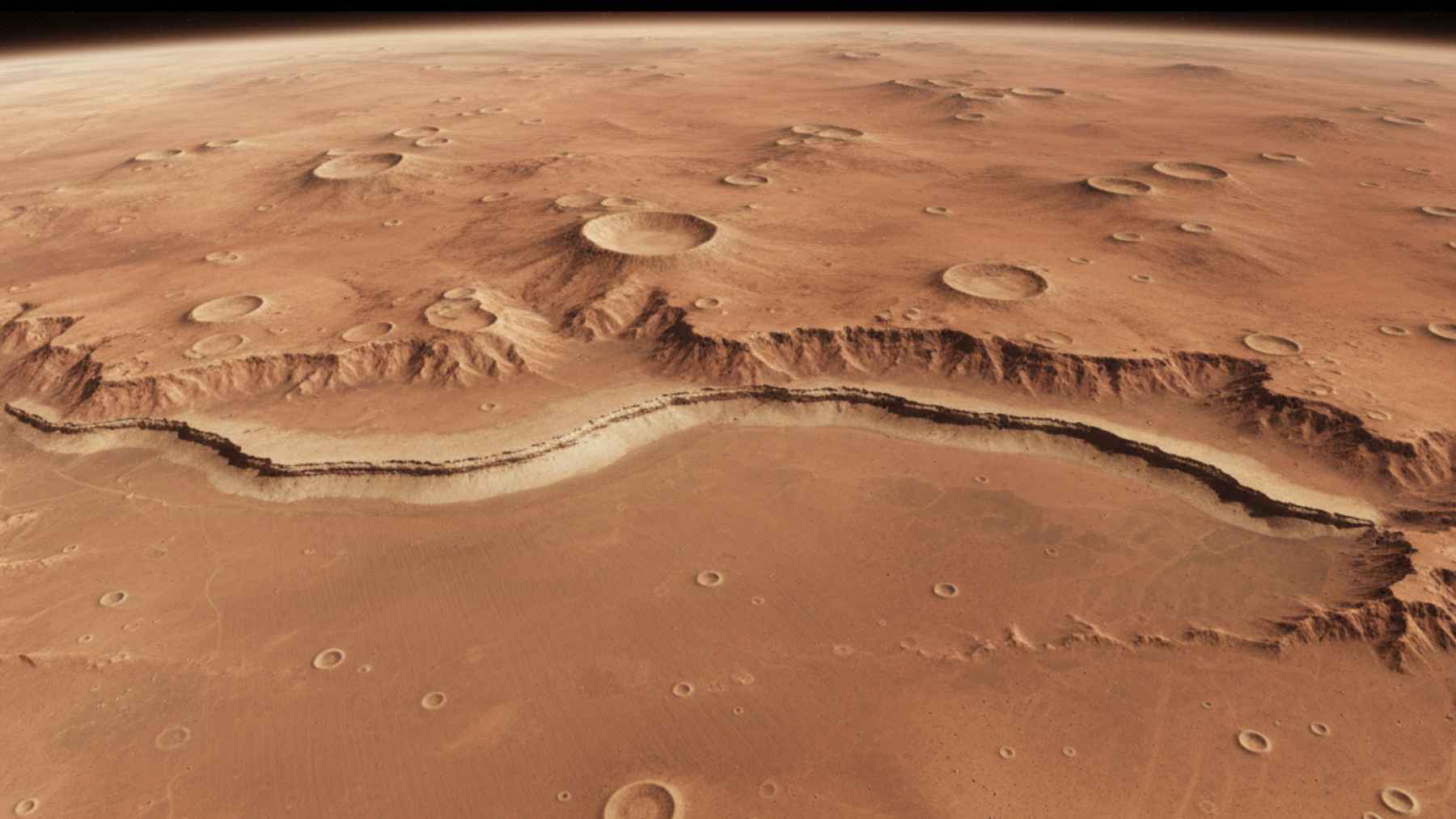
In a paper released April 15, 2026, researchers described a wide, flat band that circles the edge of Mars’s northern lowlands. They say it looks like the ring left behind when a bathtub drains, but on a planet-sized scale. If they are right, a northern ocean could have covered about one-third of the planet’s surface.
The idea is simple and a little mind-bending. A long-lived ocean would not just leave water behind, it would leave geology behind, too, including thick layers of mud and sand that can store a record of what happened next.
A shelf, not a simple shoreline
On Earth, the “continental shelf” is the broad, gently sloping underwater plain just offshore, the place where the land eases into the sea. It is not the thin waterline you see at the beach, but the wide ramp beneath it.
That difference matters after billions of years. A narrow shoreline can be erased like footprints in sand, while a shelf is a bigger landform that can survive longer, even after wind and lava have done their work. Bigger targets last.
In practical terms, a shelf can show up as a long belt of unusually flat terrain where high ground transitions into a lower basin. That is what the new work says it found along the sharp divide between Mars’s higher southern highlands and the lower northern plains.
Why the ocean debate never went away
Scientists have argued for decades about whether Mars had a northern ocean or just scattered lakes and rivers. Earlier missions mapped faint lines that looked like coastlines, but the elevations of those lines did not line up the way a stable sea level should.
Some of the supposed shore marks sit a few miles higher or lower than others, which raised doubts. A 2004 paper in the Journal of Geophysical Research, for example, described how different “shoreline” segments could break into regional pieces rather than one neat global line.
At the same time, Mars is a harsh place for delicate details. Wind erosion, meteor impacts, and volcanic activity can sandblast and bury subtle features, leaving the planet with a blurry memory of its wet past.
Using Earth’s oceans as a disappearing act
The new study took a simple question and flipped it around. Instead of asking what an ancient shoreline should look like, the team asked what parts of an ocean basin would still be visible after the water was gone.
Abdallah Zaki at the University of Texas at Austin and Michael Lamb at Caltech ran computer simulations that dried up Earth’s oceans to see what stood out. Lamb said, “We wanted to find a better topographic feature than shorelines that could be evidence for an ocean.” The lead author also said there is “plenty of follow-up work to be done.”
The answer was not the shoreline itself, but the continental shelf, a wide, persistent band that wraps around ocean basins. Once they knew what to look for on Earth, they used the same approach on Mars.
A flat band around the northern lowlands
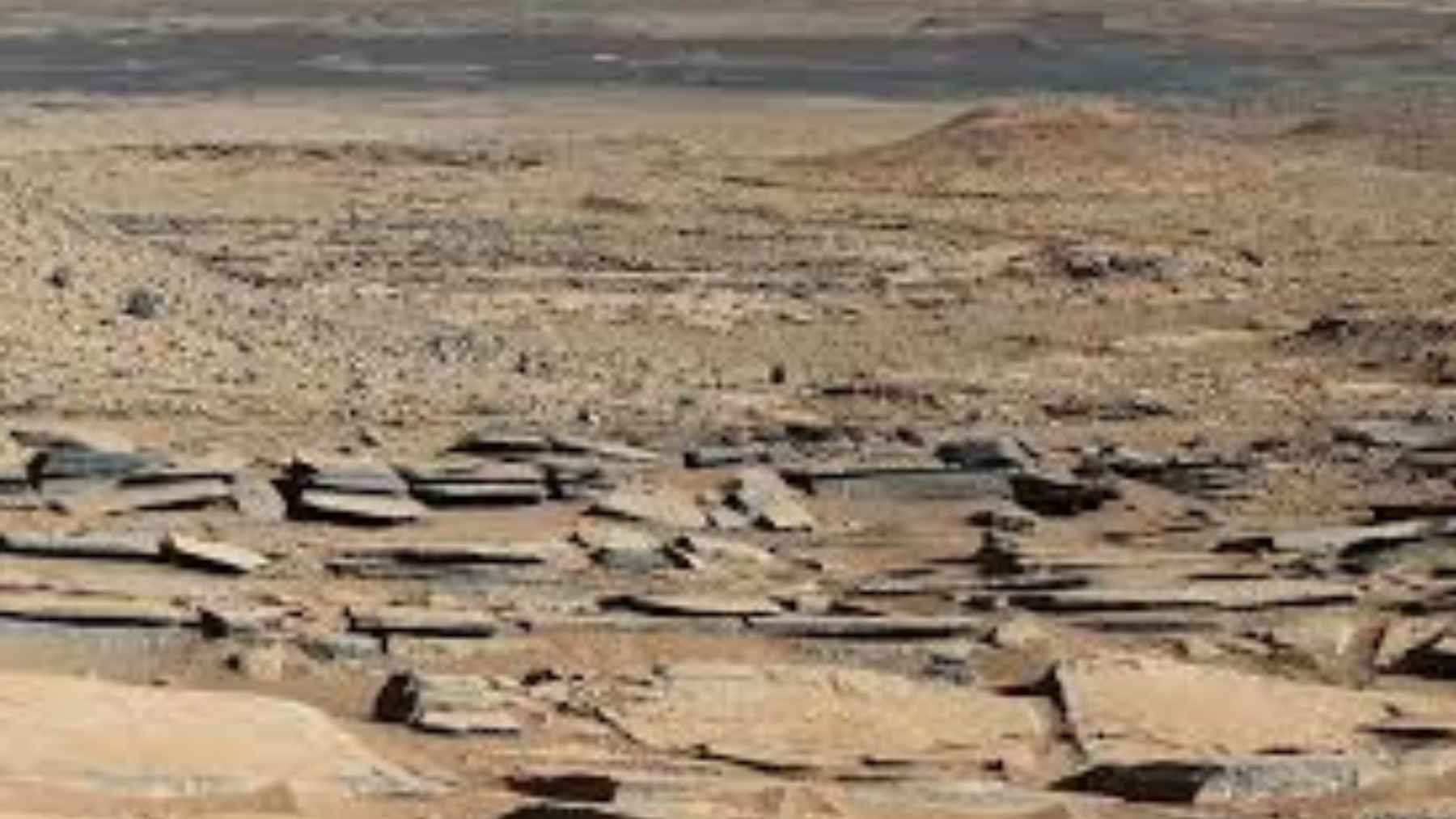
To test the idea, the researchers relied on global topography, basically a planet-wide height map, built from laser readings taken by the Mars Orbiter Laser Altimeter on NASA’s Mars Global Surveyor spacecraft. That dataset lets scientists compare the steepness of terrain across the planet, even in places no rover has visited.
They identified a long zone of unusually low-relief ground between roughly 5,900 and 12,500 feet below a Mars reference level, tracing the edge of the northern basin. In total, the candidate shelf covers about 4 million square miles, and it overlaps areas where scientists have already mapped river deltas and proposed shorelines.
A landform that large is hard to make quickly, so the team argues it points to water that stayed put for a long time, possibly millions of years. It also hints that the ocean’s edge was not a razor-thin line, but a broad transition zone that could be hundreds of miles wide in places.
What this could mean for finding past life
If Mars did have a coast for a long time, it would have been a busy place, with rivers delivering mud and sand and waves reworking it into layers. On Earth, those layers can preserve a detailed record, sometimes including signs of microbes.
The newly mapped shelf zone lines up with major delta deposits, which are the fan-shaped piles of sediment where rivers meet standing water. That combination is why researchers say the area is a promising target for future rover sampling, even though no life has been detected so far.
For mission planners, a broad shelf is easier to aim for than a faint “shoreline” scratch, especially when landing sites have to balance science and safety. If you only get a handful of drill holes, why not pick the layer cake that might have formed at the edge of an ocean?
Big claim, lots of checking ahead
The shelf idea does not end the debate by itself. A flat zone could, in theory, be shaped by other processes, and Mars has had billions of years to blur the details.
One way forward is to compare the shelf map with other independent clues, like subsurface radar that has already spotted layered coastal deposits in the northern plains. A 2025 study in Proceedings of the National Academy of Sciences used China’s Zhurong rover data to report deposits that look like ancient beach-like layers buried underground.
Mars also keeps old landscapes in a different way than Earth, partly because its crust behaves more like one giant plate rather than moving tectonic plates that recycle the surface. That can help ancient features survive, but it also means scientists have to untangle a long, complicated history with limited ground truth.
The main study has been published in Nature.