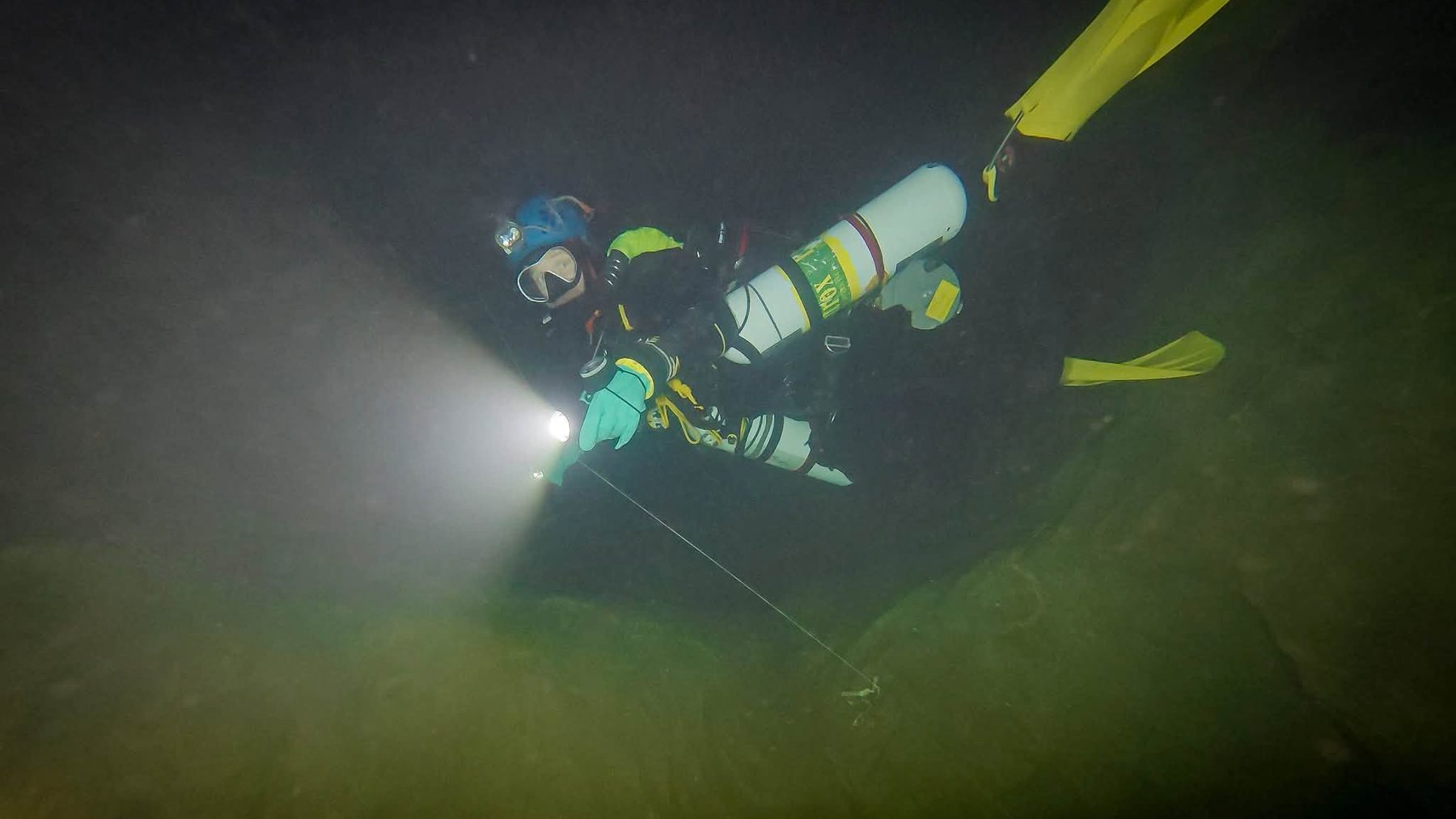
Czech cave divers exploring the Punkva, an underground river in the Moravian Karst, say they have probably found the spot where it is born. Their latest dive came on October 27, 2026. It capped four weeks of work inside Amatérská Cave, where the team went as deep as 115 feet (35 meters).
The divers belong to clubs of the Czech Speleological Society. Jan Sirotek of the Pustý žleb caving group wrote a detailed report after each dive on the group’s official Facebook page.
Two streams that vanish underground
The Punkva is the main river of the northern Moravian Karst, according to the Nature Conservation Agency of the Czech Republic. It drains about 66 square miles (170 square kilometers). Two streams, Sloupský potok and Bílá voda, sink into the limestone separately and join to form it.
From there, the agency says, the river runs through largely unknown caves to the Macocha Abyss. The Amatérská system around it stretches for about 31 miles (50 kilometers). Most of its passages carry water only during floods.
In karst, water slowly dissolves rock and carves caves and karst sinkholes. Streams can cross one another at different depths. A surface map says little about where two of them meet.
Official cave records date the discovery of Amatérská Cave to January 18, 1969. A flood on August 29, 1970, killed explorers Milan Šlechta and Marko Zahradníček. A maze of passages in the cave now carries Šlechta’s name.
Rebreathers and 16-foot visibility
Sirotek and Radek Nejezchleb, known to the team as Bradek, returned to the river on October 3 with rebreathers. These units recycle exhaled gas instead of releasing it as bubbles. Fewer bubbles leave the silt on the ceiling, the divers wrote, and they can stay down longer.
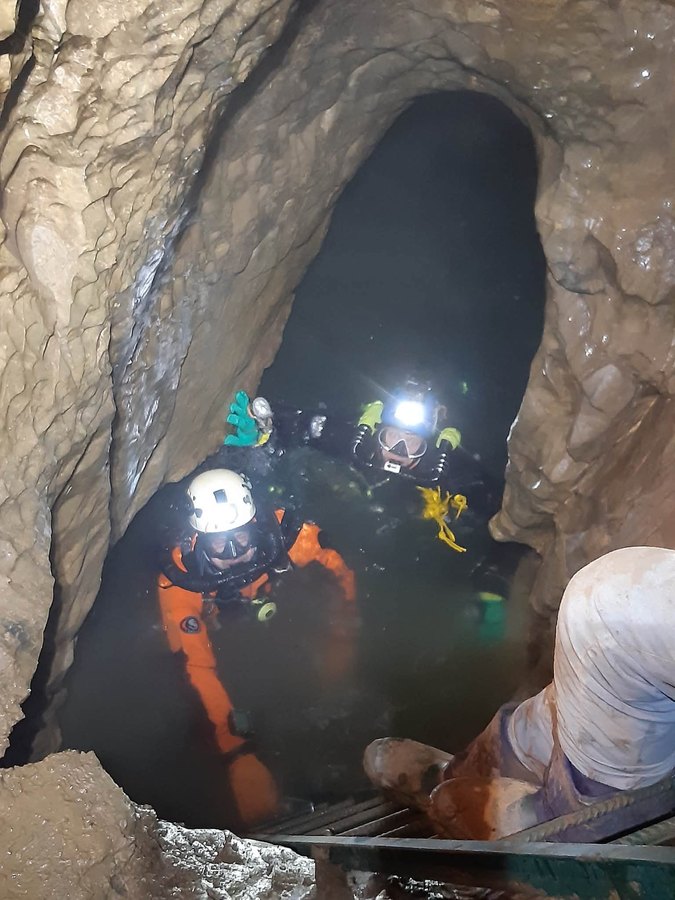
Weeks of low water helped as well. Visibility topped 16 feet (5 meters), which the pair had never seen at this spot.
In places the tunnel is roughly 33 feet (10 meters) wide and tall. With only 6 feet (2 meters) of visibility, they noted, a diver can swim right past a big side passage.
Reels left behind in 2020
On October 6, the pair spent two hours underwater. Inside a shaft, at 49 feet (15 meters), they spotted a round passage about 13 feet (4 meters) across. They changed plans and followed it northwest.
A tangle of old guide line hung on the wall, and about 165 feet (50 meters) farther a reel dangled from the rock. The next morning, cave diver Martin Bartošek confirmed he had left them on solo dives in 2019 and 2020. Back then he fell about 330 feet (100 meters) short of linking up.
That dive joined Šolimova mísa, a lake in the cave, to the Milan Šlechta Labyrinth. The team measured 720 feet (220 meters) of new passage and named it the Moravian Drummers Passage; in Czech, a guide line reel is a buben, or drum.
In 2020, the same divers had found more than 2,300 feet (700 meters) of passage downstream, as the group’s history of its Punkva dives records. Upstream, they stalled after a few dozen yards, and Sirotek wrote that “this question mark would not let us sleep.”
Into a maze of cracks
A third dive on October 13 lasted two and a half hours. The pair squeezed along a low tunnel floored with gravel and sand and reached 75 feet (23 meters). They measured 655 feet (200 meters) of new line, heading northeast.
Four days later, a three-hour dive added about 330 feet (100 meters) of line. There, the clear tunnel broke up into a tangle of cracks.
Meanwhile, a hydrology team checked pools across the Labyrinth and measured the water’s conductivity. That reading helps tell one stream from another. The Punkva had dropped another 8 inches (20 centimeters) since the Tuesday dive.
On a later Saturday, Sirotek and Bartošek surveyed a sump called Studna down to 52 feet (16 meters). Water was flowing out through small pebbles at the end. About 230 feet (70 meters) in a straight line still separated the two ends of their lines.
A clear inflow from the north
On October 27, three divers went in on ordinary open-circuit gear. Sirotek and Bartošek broke off two sharp rock edges with a hammer and dug out the bend of a sump. Then they inched through a tight crawl with zero visibility.
“There was no doubt that we had found the connection to the spaces where Bradek and I had previously ended with the rebreathers,” the report said. The link finished a route to a chamber called Rodeo that the team had wanted since 2020.
Nejezchleb checked a side passage to the north, about 26 feet (8 meters) down. He could not get past a narrow spot, but a camera showed it going on. “The crucial thing is that it is a strong inflow, as confirmed by clearly visible water movement,” he said in the report.
That water was clear, so the team ruled out Bílá voda, which the divers had clouded on the way in. “It is therefore highly probable that it is the Sloupský potok,” Nejezchleb concluded.
If so, the junction looks like a crossroads of flooded passages, the report says. Bílá voda flows in from the east and Sloupský potok from the north, while the Punkva drains away westward and then south.
Dye tracing must still confirm it
Everything hinges on Bílá voda. At these water levels it would have to flow only through the Studna sump, and no channel could exist farther north, according to the report.
To pin down how the two streams mix, the team wants more dye tracing, following tests it has already run. Coming back through the low crawl “was a little scary,” the report said, and in zero visibility the divers jotted down a rough compass bearing and guessed the distance.
Karst caves keep surprising explorers elsewhere too, from a cave passage in Vietnam to a thermal lake in an Albanian cave. In Moravia, the team will finish its maps and summarize the dives in the society’s Speleofórum.
The dive reports quoted here, translated from Czech, were published by the Pustý žleb group in October 2026.
Photo: Pustý žleb caving group (ZO ČSS 6-25) / Czech Speleological Society