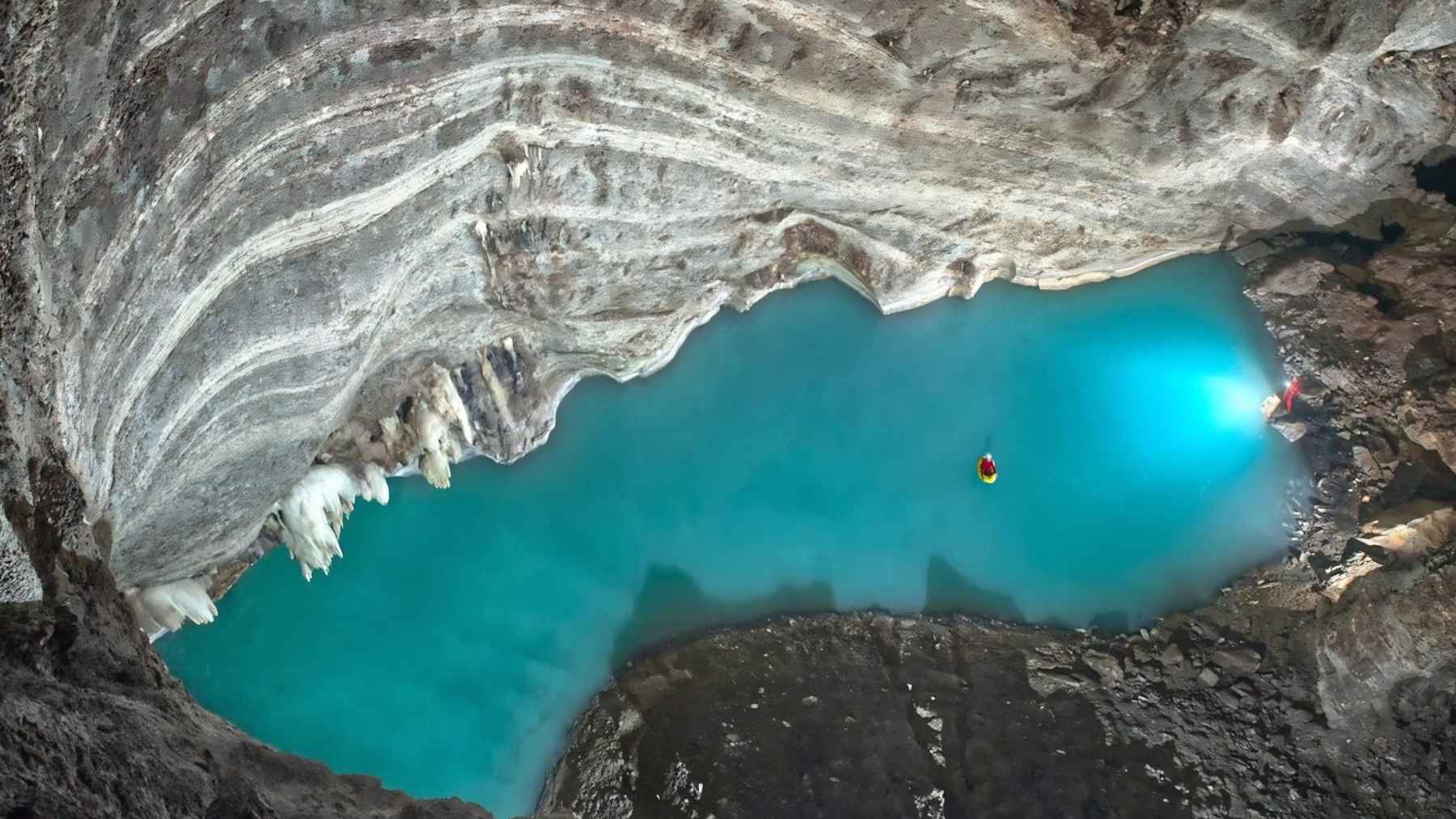
A vast turquoise lake has been confirmed deep beneath southern Albania, and scientists say it is the largest known underground thermal lake on Earth. Hidden at the bottom of a cave system near the Greek border, Lake Neuron stretches about 460 ft. long and 138 ft. wide, holding roughly 294,300 ft.³ of warm mineral water.
The discovery is more than a beautiful cave story. It gives researchers a rare look at how warm, sulfur-rich water can carve limestone from the inside out, quietly building chambers that most people will never see. That is the wonder of it–a whole landscape exists under the surface while life above goes on as usual.
Lake Neuron
Lake Neuron lies in the Vromoner region of southern Albania, inside a cave known as Atmos. According to the Neuron Foundation, Czech scientists first encountered the wider underground system in 2021 while exploring thermal springs in the area.
The lake sits at the bottom of a deep abyss, roughly 330 ft. down by the foundation’s description, while the scientific report places the lake at a depth of about 420 ft. inside Atmos Cave. Either way, this was not a casual walk-in discovery. It took ropes, gas monitoring, mapping tools, and a good deal of patience.
Researchers named the lake after the Neuron Foundation, which funded key equipment for the expedition. The name fits neatly, but the place itself feels far older than any label humans can give it.
How scientists found it
The trail began with steam. During early expeditions, the Czech team noticed a rising column coming from the limestone massif, a sign that warm water and open underground space might be hidden below.
Marek Audy, leader of the Neuron Atmos Expedition, explained that the team located an abyss more than 328 ft. deep after seeing that steam. “At its bottom, we discovered a strong thermal inflow and a vast lake,” he said in the foundation’s statement.
That first sighting was only the beginning. To present the find to the scientific community, the researchers needed precise measurements, not just dramatic photos and field notes.
A record measured in detail
The team returned with a mobile LiDAR scanner and sonar equipment to map the cave and measure the water below. Those tools allowed scientists to build a detailed 3D model of Atmos Cave and nearby caves, including Sulfur, Breška, and Kobyla.
The confirmed numbers are striking. At about 460 ft. by 138 ft., Lake Neuron measures about 1,130 ft. around, with a maximum depth of roughly 25 ft. Its area is about 34,450 ft.², which is close to the footprint of a large supermarket.
The water temperature is about 79°F, warm enough to feel noticeably mild to the touch, though this is not a tourist bathing pool. It is a fragile scientific site inside a cave system where air quality and underground conditions matter.
A cave made by chemistry
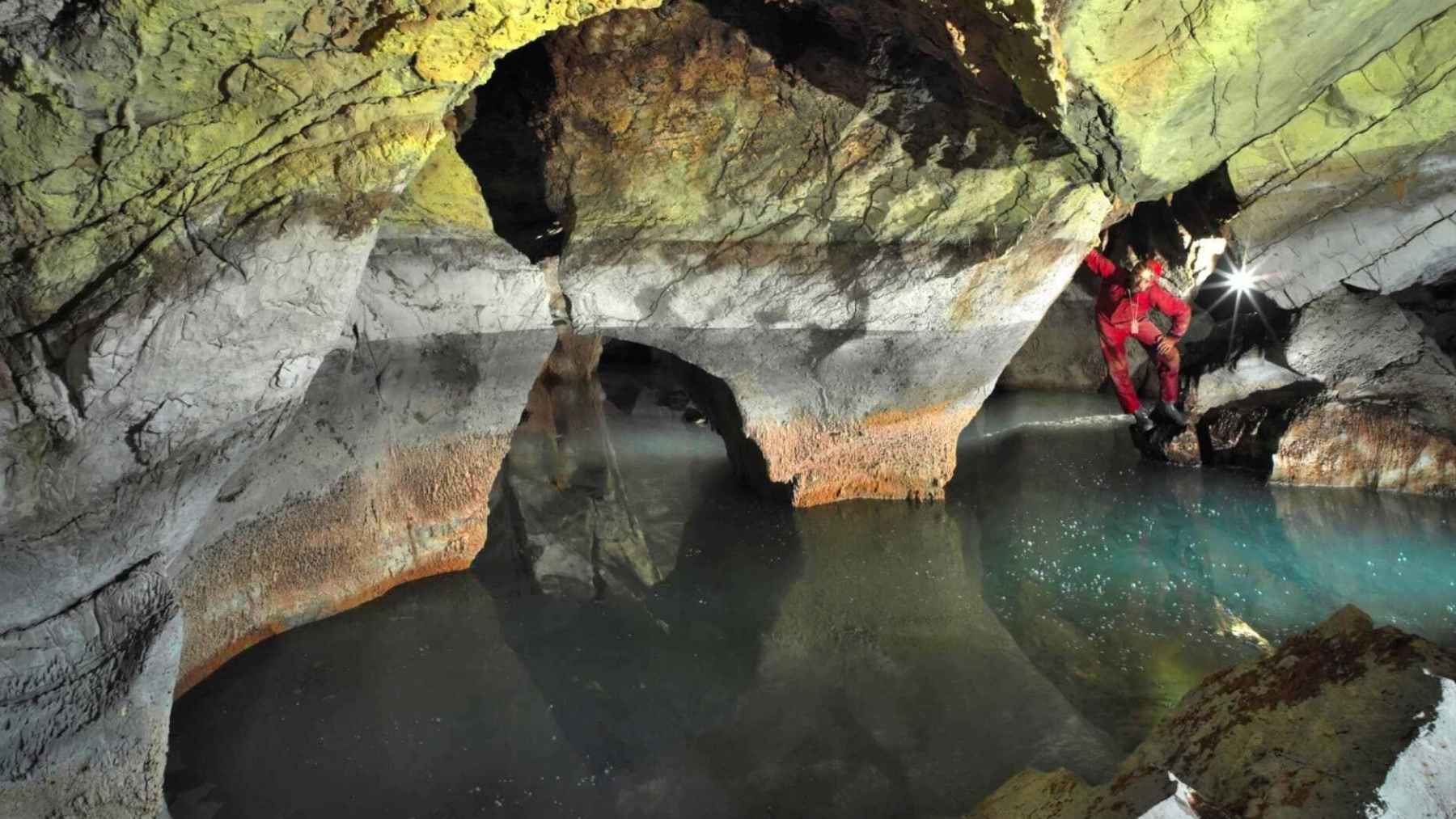
This landscape was shaped by a process called hypogene cave formation. In practical terms, that means the cave was formed from rising mineral-rich water rather than by surface streams simply cutting down through rock.
The scientific report says the thermal waters in the Vromoner Valley are rich in hydrogen sulfide. When that gas meets oxygen in shallow groundwater and cave air, it can oxidize into sulfuric acid, which reacts with limestone and slowly converts parts of it into gypsum.
It is slow chemistry with a dramatic result. Over time, that underground reaction can hollow out huge spaces, leaving behind pale mineral walls, warm water, and the strange feeling that the Earth has built a hidden cathedral.
Why the discovery matters
Scientists describe Lake Neuron as the largest underground thermal lake in the world known to date. That wording is impressive because caves are difficult places to study, and new records can change as unexplored systems are mapped.
The lake also appears to be part of a larger water network. Tracer tests showed that water from Lake Neuron flows into springs across the valley, except for the Old Spa Spring, which researchers suggest may have a different source. The total yield of springs in the area is about 53 gallons per second.
That is where the story becomes environmental, not just geological. Underground water systems are often connected in ways that are hard to see from the surface, so damage in one place can ripple elsewhere.
Protection is already part of the story
Researchers say multidisciplinary work is continuing in the Vromoner area, including geological, hydrological, and biological research. The underground biotope is described as unique, and scientists are still learning how the caves, springs, and surface landscape fit together.
The report also says the team is working with local authorities toward including the hypogene caves in Vjosa National Park. On the other hand, researchers warn that a proposed dam on the Greek side of the Sarandaporo River could negatively affect the habitat of Sulfur Cave.
For the most part, that is the bigger lesson here. A spectacular lake can grab attention, but protecting it means understanding the whole underground system around it.
Albania’s hidden natural wonder
Lake Neuron is easy to picture as a secret blue pool under the mountains, but the real story is even better. It is a record-setting thermal lake, a chemistry lesson written in limestone, and a reminder that some of Earth’s most important places are still being mapped one careful scan at a time.
For Albania, the discovery adds another layer to a landscape already known for rivers, mountains, and geothermal activity. For scientists, it opens a door to future research on cave formation, underground water flow, and rare subterranean ecosystems.
The official statement was published on the Neuron Foundation.