A quiet cemetery in Ithaca, New York, has been hiding something extraordinary beneath its grass. Cornell University researchers estimate that about 5.6 million regular mining bees are living under East Lawn Cemetery, making it one of the largest known aggregations of ground-nesting bees ever recorded.
The finding is not just a strange cemetery story. It points to a bigger lesson about pollinators, especially the wild, solitary bees that often go unnoticed while honeybees get most of the attention. These underground bees may have been thriving there for decades, possibly close to a century, because the soil was left mostly undisturbed.
A hidden bee city
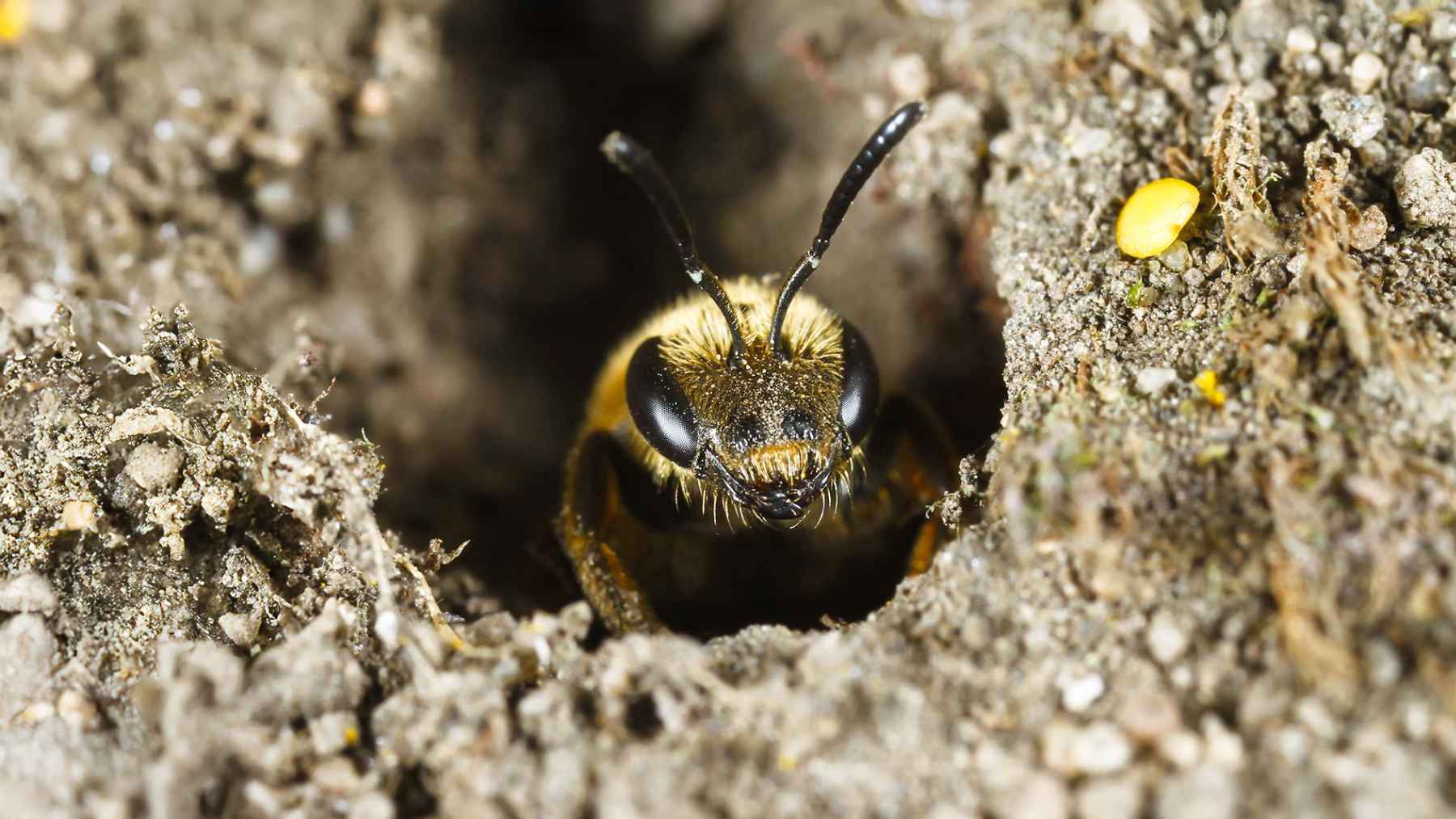
The bees belong to a species called Andrena regularis, also known as the regular mining bee. Unlike honeybees, they do not live in a hive with a queen. Each female digs her own underground nest, lays eggs, and leaves pollen and nectar for her young.
That is what makes the discovery so surprising. This is not one giant colony in the usual sense, but millions of individual bees choosing the same patch of ground. In a practical sense, it is more like a crowded neighborhood than a single household.
Researchers studied the bees using emergence traps, which are small mesh tents placed over the soil before the insects come out in spring. From March 30 to May 16, 2023, the team collected 3,251 insects from 16 species, with A. regularis being by far the dominant one.

Why this cemetery matters
East Lawn Cemetery appears to offer nearly ideal conditions for these bees. The ground is sandy enough for digging, the site is rarely disturbed, and pesticide use is limited. Sometimes, doing less is exactly what nature needs.
Cornell’s public release notes that the cemetery was founded in 1878, while records of A. regularis at the site date back to the early 1900s. The scientific paper gives a more specific record of 1935, suggesting the population could have persisted there for about 90 years, and perhaps longer.
That matters because ground-nesting bees cannot simply pack up and move if their nesting area is paved over, heavily landscaped, or repeatedly sprayed. As Cornell entomologist Bryan Danforth warned, “These populations are huge, and they need protection.”
More than honeybees
When most people hear the word “bee,” they picture honeybees buzzing around a hive. But Cornell points out that 75% of bees are solitary ground nesters, making this underground lifestyle far more common than many people realize.
These native bees can be powerful pollinators. The study notes that wild, solitary bees help pollinate both wild plants and managed crops, including apples, cherries, strawberries, blueberries, and cranberries–not bad for insects many of us never notice underfoot.
The cemetery is also close to Cornell Orchards, about one-third of a mile away. That proximity is important because regular mining bees emerge in early spring, just as apple trees and other early-blooming plants need pollination.
The numbers are staggering
The team estimated an average of 853 bees per square meter, which is roughly 79 bees per square foot. When the researchers scaled that up across the nesting area, they arrived at an average estimate of 5.56 million regular mining bees.
There is some uncertainty, as there should be in any field estimate. The paper gives a likely range of 3.1 million to 8.0 million bees, which still makes the site remarkable even at the low end.
Cornell compared the average estimate to more than 200 honeybee hives in a plot of about 1.5 acres. Imagine walking across a calm cemetery lawn while that much pollinator activity is waiting just below your shoes.
Warm days bring them out
The bees do not emerge randomly. The study found that activity rose sharply on warm spring days, especially when temperatures climbed above about 68°F. Males came out first, followed by females days later.
That pattern gives the bees a head start for mating and nesting. It also puts them in the right place at the right time for apple bloom, which may help explain why A. regularis has been such an important pollinator at Cornell’s nearby orchard.
The researchers also found brood parasites, including Nomada imbricata, sometimes called cuckoo bees. These parasites lay their eggs in the nests of mining bees, but the observed parasitism rate was relatively low at 1.4%.
A clue for conservation
The discovery comes at a time when pollinators face pressure from habitat loss, pesticides, invasive species, pathogens, parasites, and climate-related stress. For the most part, protecting pollinators is not only about planting flowers. They also need safe places to nest.
That is where overlooked places such as cemeteries, parks, grasslands, and old lawns could play a bigger role. They may look ordinary from the sidewalk, but they can hold entire hidden ecosystems.
The bigger takeaway is simple. If one of the world’s largest known ground-nesting bee aggregations can sit near a major university for years without being fully recognized, there may be many more out there.
The study was published in the journal Apidologie on Springer Nature.