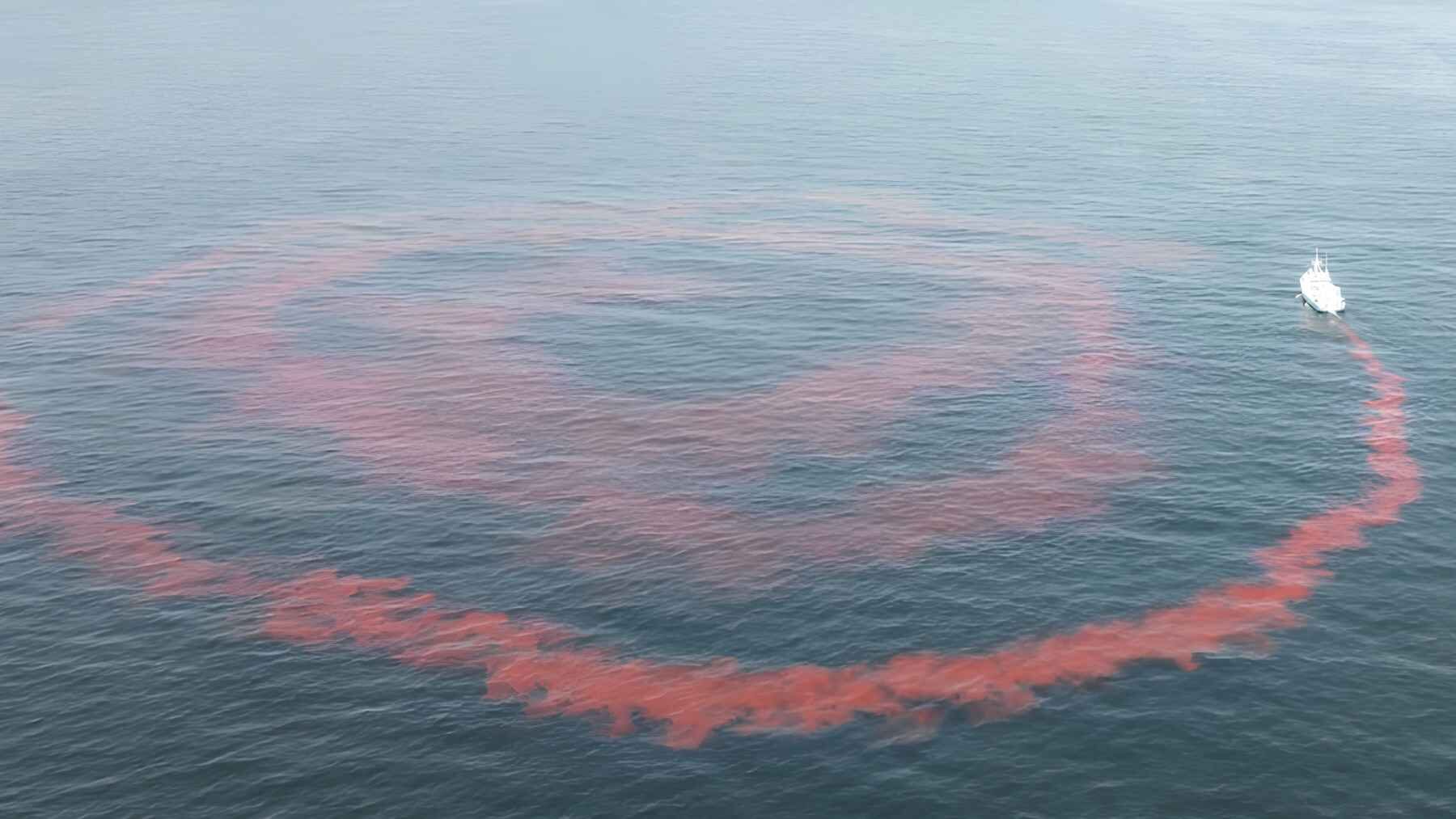
In August 2025, a research vessel released 16,500 gallons of diluted sodium hydroxide solution into the Gulf of Maine while a vivid pink plume spread across the surface. It looked alarming, but the color was deliberate. It was the first open-water ocean alkalinity enhancement experiment in the United States conducted under a federal permit.
The goal was not to clean the entire Gulf in one morning. Scientists from the Woods Hole Oceanographic Institution wanted to learn whether carefully increasing seawater alkalinity could help the ocean draw more carbon dioxide from the air while easing some effects of ocean acidification. Preliminary findings released in February 2026 suggest the small trial was controllable and measurable, but they do not settle whether the approach would remain safe or practical at a climate-relevant scale.
Why add lye to seawater?
The material was high-purity sodium hydroxide, commonly called lye, rather than household chlorine bleach. It was diluted and gradually mixed into surface water during a six-hour release. Why use such a strong chemical at all?
The ocean naturally absorbs about 25% to 30% of human-caused carbon dioxide emissions each year. Its alkalinity helps convert dissolved carbon into bicarbonate, a stable form already abundant in seawater. Adding alkalinity shifts that chemical balance, allowing the surface ocean to potentially take up more carbon dioxide from the atmosphere.
That could offer two benefits at once. More atmospheric carbon might be stored in the ocean, while the added alkalinity could counter part of the chemical change that makes it harder for oysters, clams, corals, and some plankton to build calcium carbonate shells or skeletons. But the chemistry working on paper is only the beginning.
Why turn the ocean pink?
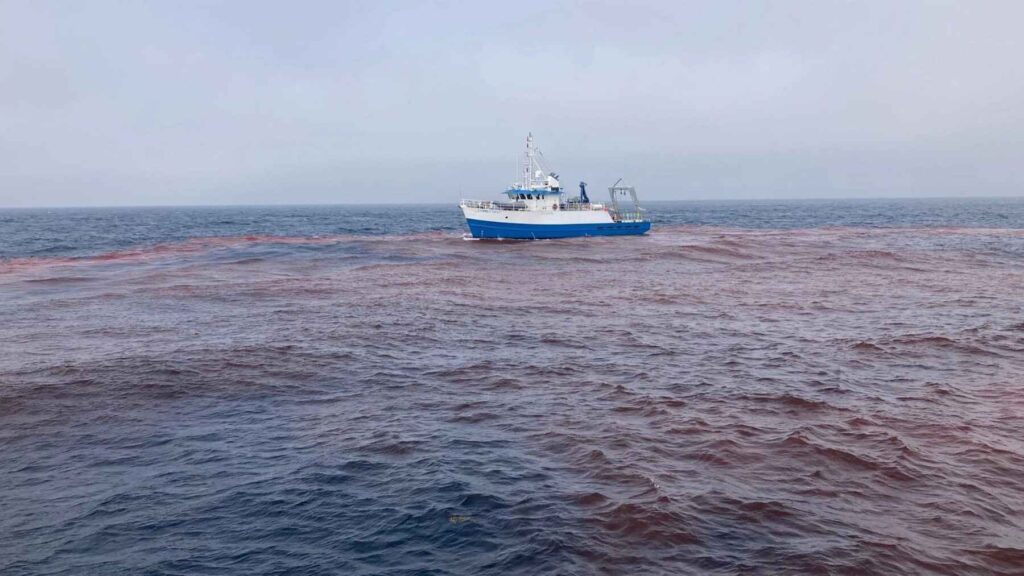
The bright color came from Rhodamine Water Tracer, a dye used to follow water movement. Researchers aboard a second ship tracked the treated patch while sensors measured pH, alkalinity, dissolved carbon dioxide, temperature, salinity, and other conditions. Underwater vehicles, drifting instruments, drones, and satellite images added more eyes to the operation.
The dye was not added for spectacle. Small concentrations can be detected after the color is no longer obvious to the human eye, helping scientists distinguish treated water from the constantly moving ocean around it. A protected-species observer also watched the release area and could halt operations if protected animals appeared nearby.
WHOI later reported that the patch could be followed for about five days and that observed movement closely matched computer forecasts. Seawater pH and tracer readings returned to baseline within the expected periods. Project leader Adam Subhas said the early results showed that small deployments could be “engineered, tracked, and monitored with high precision.”
What happened to marine life?
The first biological results were reassuring within the limited scope of the test. Researchers found no significant differences inside and outside the treated patch in the measurements they examined, including bacteria, phytoplankton, chlorophyll, zooplankton, fish larvae, and lobster larvae. No measurable effect is not the same as proof of zero risk, though.
The team did not directly measure effects on larger animals or higher parts of the food web, and it said possible fisheries impacts still require modeling. That distinction matters in the Gulf of Maine, where shellfish, fishing communities, seafood businesses, and coastal jobs depend on healthy water. A short, diluted exposure cannot answer what repeated or much larger additions might do.
There is another reason the location matters. A Scientific Reports study found that shifts in ocean circulation have recently buffered the Gulf of Maine from the acidification trend researchers expected, but warned that this protection may not last. If that natural shield weakens, pH could fall more quickly and place shell-forming species under greater pressure.
Why the open ocean mattered
Until recently, much of the work on ocean alkalinity enhancement took place in computer models, laboratories, tanks, or tightly contained settings. The open ocean behaves differently. Currents stretch a plume, tides move it, weather changes mixing, and living communities respond in ways a beaker cannot fully reproduce.
The Gulf trial was therefore designed as a measurement test, not a demonstration of large-scale carbon removal. Researchers wanted to check their models, learn how long a treated patch could be followed, and determine whether carbon uptake and ecological responses could be measured accurately in real conditions. In practical terms, it was a field lesson on how future claims might be checked.
The permit followed more than a year of federal review and two public comment periods totaling 75 days. EPA consultations found that significant effects on people, marine ecosystems, and other ocean uses were not expected from the small trial. The project team also held more than 50 outreach and engagement activities with fishing groups, tribal representatives, regulators, industry members, and the public.
The scale problem remains
Ocean alkalinity enhancement has attracted interest because carbon stored as dissolved bicarbonate and carbonate can be durable and does not require a conventional underground storage site. A Nature Climate Change modeling study found that carbon-removal efficiency varies by location and timing. Still, a useful climate technology must account for the energy and emissions needed to make and transport alkaline materials, the cost of monitoring vast areas, and the challenge of proving how much extra carbon actually left the atmosphere.
This experiment treated a small moving patch roughly 38 miles offshore. Scaling the concept enough to influence global warming would involve far more material, many more locations, and long-term oversight. The trouble is that environmental effects can change when a process moves from one carefully watched trial to repeated commercial operations.
That is why the preliminary success should be read as a starting point, not a green light. Marine carbon removal may eventually complement climate action, but it cannot replace rapid cuts in fossil fuel emissions.
The official statement was published on Woods Hole Oceanographic Institution’s website.