Deep inside a limestone mountain in central Vietnam, a river runs past vast chambers where mist drifts above patches of forest. This is Hang Son Doong, the world’s largest known single cave passage, whose immense interior challenges the familiar image of a cramped, dark tunnel.
But the most revealing feature is not how many buildings could fit inside. Sunlight enters through collapsed sections of the ceiling, supporting vegetation that depends on a connection to the world above. This is an underground landscape, not an ecosystem sealed off from the surface.
How big is the world’s largest cave?
Guinness World Records describes Son Doong as the “world’s largest single cave passage” and lists dimensions of around 655 feet high and 490 feet wide (200 by 150 meters). Its listed length is at least four miles (6.5 kilometers), enough to make walking through it feel more like crossing a landscape than exploring a room.
That record needs a little context. Son Doong’s title concerns the size of a passage, not the longest network of connected tunnels, a distinction held by Kentucky’s Mammoth Cave. The Vietnamese national park compares Son Doong’s scale with space for a 40-story skyscraper.
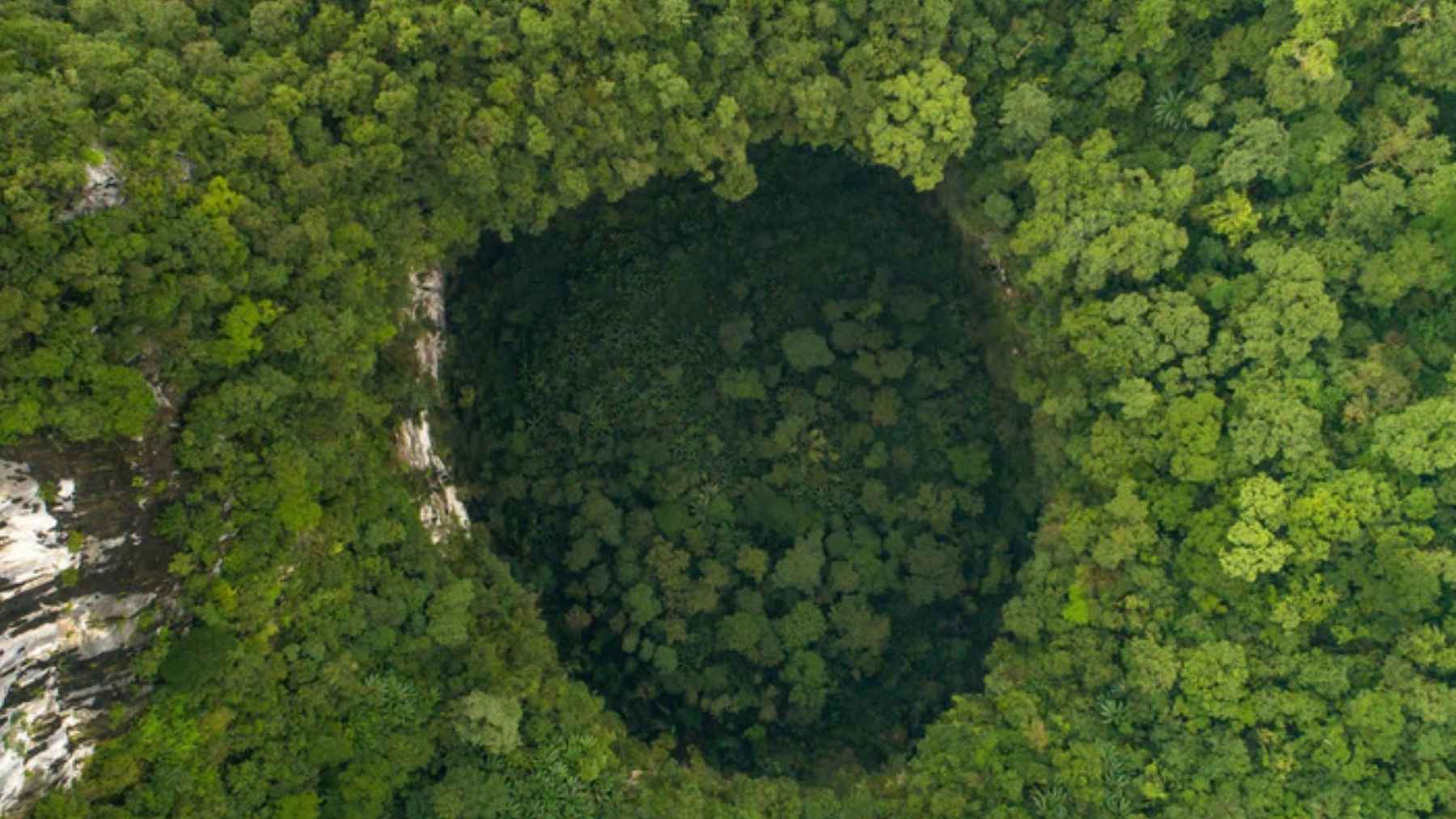
The forest survives because the roof opened
What does a tree need underground? At Son Doong, two major roof collapses created openings called dolines, allowing sunlight into spaces that would otherwise be dark. The second shelters a forest known as the Garden of Edam.
Oxalis Adventure, the cave’s expedition operator, reports trees reaching roughly 130 to 165 feet (40 to 50 meters) there, with mosses and ferns in dimmer areas. Like a houseplant stretching toward a window, the trees grow toward available light. Ancient deposits of bat droppings also supply nutrients to this unusual forest.
Why clouds form inside a cave
The underground river adds moisture to the air, while large openings bring different air temperatures together. Oxalis explains that warm and cool air meeting in these humid conditions can create mist and clouds, giving visitors a view they would normally expect aboveground.
That does not mean the cave has weather completely independent of the outside world. Conditions change with the seasons, and rain can enter through openings and cracks in the roof, sometimes producing waterfalls. Its “own weather” is better understood as a local environment shaped by both shelter and outside influences.
The river has also challenged explorers. In 2019, divers investigating a possible connection to nearby Hang Thung reached about 256 feet (78 meters) underwater, but had to stop because they lacked equipment to explore deeper.
A discovery that took years to reveal
Local resident Ho Khanh found the entrance in 1990 while seeking shelter from a storm during a forest trip. He saw mist and heard rushing water, but did not investigate farther and later lost track of the location.
In 2009, he guided a British-led cave team to the entrance, allowing exploration and measurement to begin. So the cave was not first discovered in 2009, even though that was when its extraordinary scale became widely known.
Wildlife adds another reason to look closely
Animals make this more than a collection of impressive rock formations. In a study published in the journal Diversity in 2022, researchers documented at least six bat species using Son Doong, offering a scientific starting point for understanding its flying residents.
“I believe Son Doong is unique and not yet fully studied,” cave explorer Howard Limbert said in a 2022 statement published by Vietnam’s tourism authority. The bat survey reinforces that point, recording species present in the cave rather than claiming those animals were newly discovered species.
Keeping a giant cave from becoming a crowded attraction
The park’s official guidance limits Son Doong tourism to approximately 1,000 visitors a year, with no more than 10 tourists per group. That is a controlled expedition model, not an open-door sightseeing attraction, and the distinction matters in a habitat with vegetation, waterways, and wildlife.
Across the wider park, a 2025 assessment by the International Union for Conservation of Nature warned that tourism development can outpace conservation safeguards. It also recognized that some visitor management is highly effective, a reminder that the issue is how tourism is managed, not simply whether people visit.
Son Doong’s size should inspire curiosity, not the assumption that it can absorb unlimited disturbance.
The official visitor and conservation information was published on Phong Nha-Ke Bang National Park’s website.