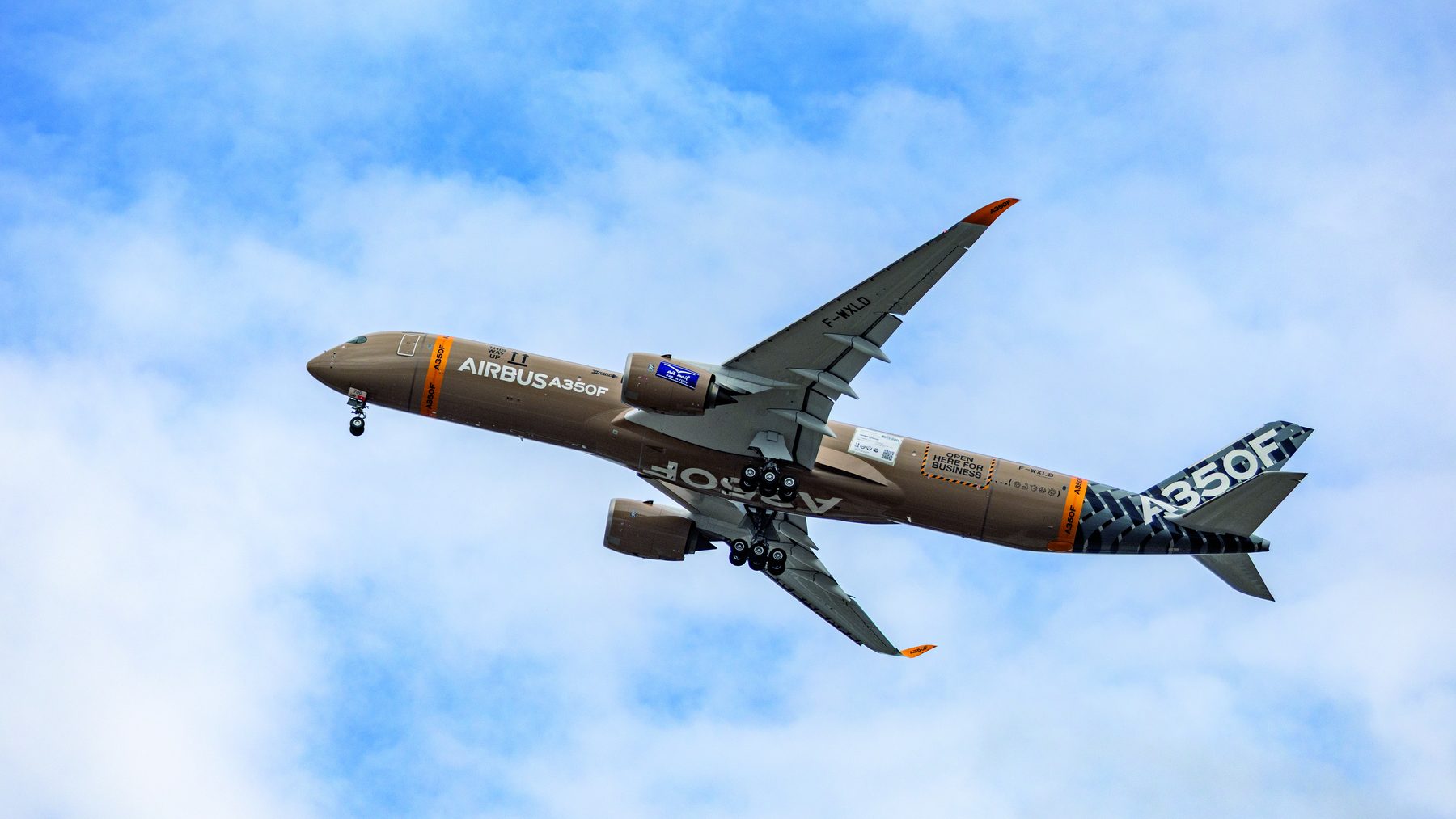
Dozens of buyers, financiers and suppliers stood beside the runway in Toulouse, France, on September 29, 2026, to watch the first A350F freighter take off with “Open Here for Business” painted on its cargo door, Reuters reported. The jet flew a lap of honor over Airbus factories in the southwest of the country and came back four hours and 10 minutes later.
“Everything went smoothly in today’s flight,” Lars Wagner, CEO of Airbus Commercial Aircraft, told reporters afterward, and the company’s announcement repeated its claim that the jet will cut fuel burn and carbon dioxide (CO2) emissions by up to 40 percent compared with competing freighters.
Cargo airlines say big freighters are scarce
The aircraft arrives in a market where the people who fly freight have been saying for a while that they cannot get enough large jets. “We know there’s going to be a tremendous shortage of widebody freighter capacity,” Richard Broekman, chief commercial officer of Atlas Air Worldwide, said during a July 2026 webinar reported by STAT Times.
Atlas operates close to 15 percent of the world’s widebody freighter fleet, yet Broekman said that “the biggest challenge for us is indeed access to additional capacity,” and that the airline had added no aircraft this year, which he called “just really a function of no availability out there.”
Willie Walsh, director general of the International Air Transport Association (IATA), told the group’s cargo symposium in March 2026 that “I think it’s going to be some time before we get back to an environment where we can say we have a stable supply chain environment for freighter aircraft,” according to Air Cargo News.
Older freighters stay in the air longer
Julia Seiermann, IATA’s head of industry analysis, explained the chain reaction to reporters in January 2026. Airlines “that used to convert passenger aircraft after a certain time of service are now keeping them longer and longer because they can’t get any new planes,” she said, as quoted by Air Cargo News, “and that means that they are not being converted for cargo use as early as they used to be.”
“To compensate for this, airlines have pushed the utilisation of the fleet to historic highs, and on the cargo side, we see now that the average age of a cargo widebody is 19.6 years,” Seiermann said, adding that this pushes up maintenance costs and lowers fuel efficiency. “At some point, this strategy will reach its limits when aircraft will need to be retired, and then shortages may become even more pronounced.”
Fuel is at least 40 percent of what it costs to operate a freighter, Broekman said, “so if 40% of your cost suddenly doubles overnight, that has to be reflected in market rates as well.”
A passenger jet shortened and fitted with a door
Julien Puyou, who heads the widebody program at Airbus, told reporters in Toulouse that “to build the A350 freighter we took the A350-1000 and we shortened it a bit in the front part and we put a cargo door behind the wing,” according to Air Cargo News.
The A350-1000 passenger jet was already flying with airlines, but the door was new to the company. “The biggest challenge was the main deck cargo door. Because we had never built such a cargo door inside Airbus. We chose to design it ourselves and build it in Madrid in Spain,” Puyou said, and he told Airliner World that “we wanted to make it as big as possible” and “really went to the limit of technology.”
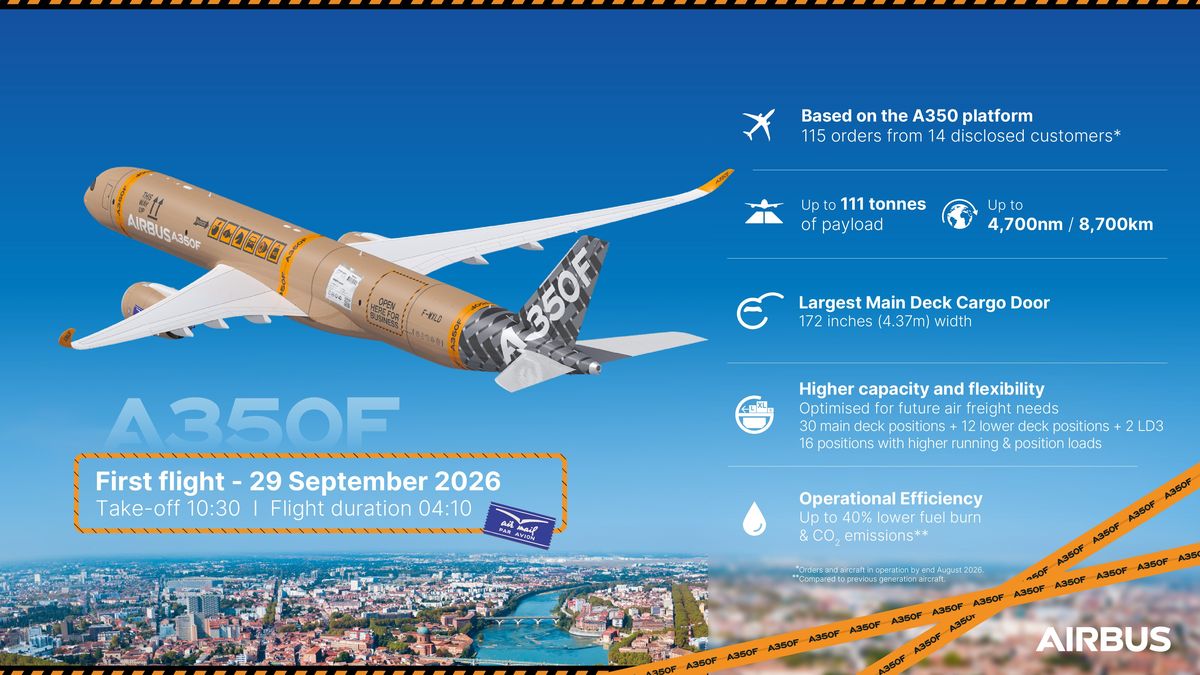
Airbus lists that door at 14.1 feet (4.3 meters) wide and the payload at up to about 244,700 pounds (111 metric tons), enough for big jet engines, though loads as long as wind turbine blades still call for giant cargo planes built for turbine blades. “Most people don’t believe it, but it’s the same loadable volume as a 747F,” Crawford Hamilton, Airbus head of freighter marketing, told The Loadstar in 2024.
Why Atlas switched from Boeing to Airbus
Boeing has dominated this business for decades with the 777F, 767 and 747 freighters, and Atlas had flown only Boeing jets until it ordered 20 A350Fs in March 2026. “There’s a scarcity of wide body freighters in the world today,” Atlas CEO Michael Steen told FreightWaves at the time. “We don’t have enough aircraft in our fleet today to support the demand that we have in our pipeline. And I don’t expect that to change over the next several years.”
“Both platforms are very, very capable. When we compare the two, the A350 is of course a tested aircraft today because it’s already in operation on the passenger side. So the technology has been tested. The aircraft is going to be available before the 777-8 freighter as well,” Steen said. “In addition to the performance characteristics, early access to the platform is also very important to us.”
Boeing saw the same gap coming. “The large end of the market is where the biggest potential undersupply is,” Darren Hulst, Boeing’s vice president of commercial marketing, said at the TIACA Air Cargo Forum in November 2024, as reported by Air Cargo News, explaining that the industry was “transitioning from the metal wing (777F) to the 777-8 freighter, while Airbus is also going to bring a freighter to market.”
A 2028 emissions rule adds pressure
When the International Civil Aviation Organization adopted its aircraft CO2 standard in 2017, it warned that “those in-production aircraft which by 2028 do not meet the standard will no longer be able to be produced unless their designs are sufficiently modified.” The 777F is one of them, and in September 2026 the Federal Aviation Administration granted Boeing an exemption covering first certificates of airworthiness for up to 35 more 777Fs through January 1, 2031, citing “the practical benefits of permitting limited 777F production until its successor is available.”
Airbus says the A350F fully meets the latest standard, helped by an airframe that is more than 70 percent advanced materials such as carbon fiber and titanium. Its Rolls-Royce Trent XWB-97 engines are also certified to run on a 50 percent blend of sustainable aviation fuel, according to Rolls-Royce.
A test campaign cut from 1,000 hours to 400
Jean-Philippe Cottet, who leads flight tests at Airbus, told Simple Flying that “a lot was done on the two previous versions, the A350-900 and 1000, and we took a lot of benefits from that testing,” and that better simulations had let the team “demonstrate to the certification authorities that our models match very well in some areas, and that we can reduce the number of flight test hours.”
“This is why the combination of those two allows us to reduce from 1000 to 400 hours,” Cottet said, and he told reporters, according to Air Cargo News, that a second test aircraft was “a choice, but having two freighters gives us the opportunity to do things in parallel and to save time in the freighters campaign.” Airbus expects the campaign to end in certification by the European Union Aviation Safety Agency (EASA) and an entry into service in 2027.
What one test flight cannot show
The 40 percent figure depends on what the A350F is compared with, and Airbus’s own numbers, as reported by The Loadstar in 2024, put it at 10 to 15 percent less fuel burn than Boeing’s 777-8, 20 percent less than the 777F and 40 percent less than a 747-400F. Cargolux, whose CEO Richard Forson had named emissions as one of the key factors in its choice, ordered the 777-8F after deciding the difference between the two new freighters was negligible, the Loadstar reported.
Fuel is also only part of aviation’s effect on the climate, since EASA, summarizing a March 2026 report from its Aviation Non-CO2 Expert Network, says contrails, nitrogen oxides and other effects contribute “a large fraction” of the sector’s warming influence, with uncertainties that “remain substantially higher than for CO₂,” and the benefit of any new jet depends on which older ones it replaces, the same question that hangs over new electric planes and the trips they would replace.
Steen, for his part, was thinking well past the test campaign when Atlas placed its order. “These assets will be in service for decades, and while there will be cycles, we expect demand to grow over time,” he told STAT Times in March 2026.
Photo: Airbus