Niam Chiang Meng, then chairman of Singapore’s Maritime and Port Authority (MPA), described the first stage of Tuas Port in one line. “In just three years, we built and installed 221 10-storey high gigantic caissons,” he said in a 2021 speech.
The second stage is bigger. “Phase 2 reclamation works is also on track, and it alone will involve the construction of 9.1km of caissons,” Niam said at the same event. Caissons are the concrete structures that line the quay walls, and MPA says each Phase 1 caisson weighs 15,000 metric tons. The authority’s port page says 227 of them, each 10 stories tall, form the 9.1 kilometers (5.7 miles) of Phase 2 seawall.
227 blocks and 387 hectares
MPA’s 2019 plan for Phase 2 called for 227 caissons fabricated on site and 387 hectares (956 acres) of reclaimed land. When the first one went in on July 4, 2019, Lam Pin Min, then senior minister of state for transport and health, called it “an important milestone in the development of the next-generation port at Tuas.” MPA says fabrication of all 227 was completed in April 2022.
Murali Pillai, senior minister of state for transport and law, updated Parliament on March 4, 2026. “Reclamation works for Phase 2 are close to 80% complete, and planning for Phase 3 is underway,” he said. “When completed in the 2040s, Tuas Port will have a capacity of 65m TEUs, and be the world’s largest fully-automated container terminal.”
A TEU, or twenty-foot equivalent unit, is one standard 20-foot container, so a 40-foot box counts as two. MPA says the finished port is planned to cover about 1,337 hectares (3,304 acres), with 66 berths along 26 kilometers (16 miles) of waterfront.
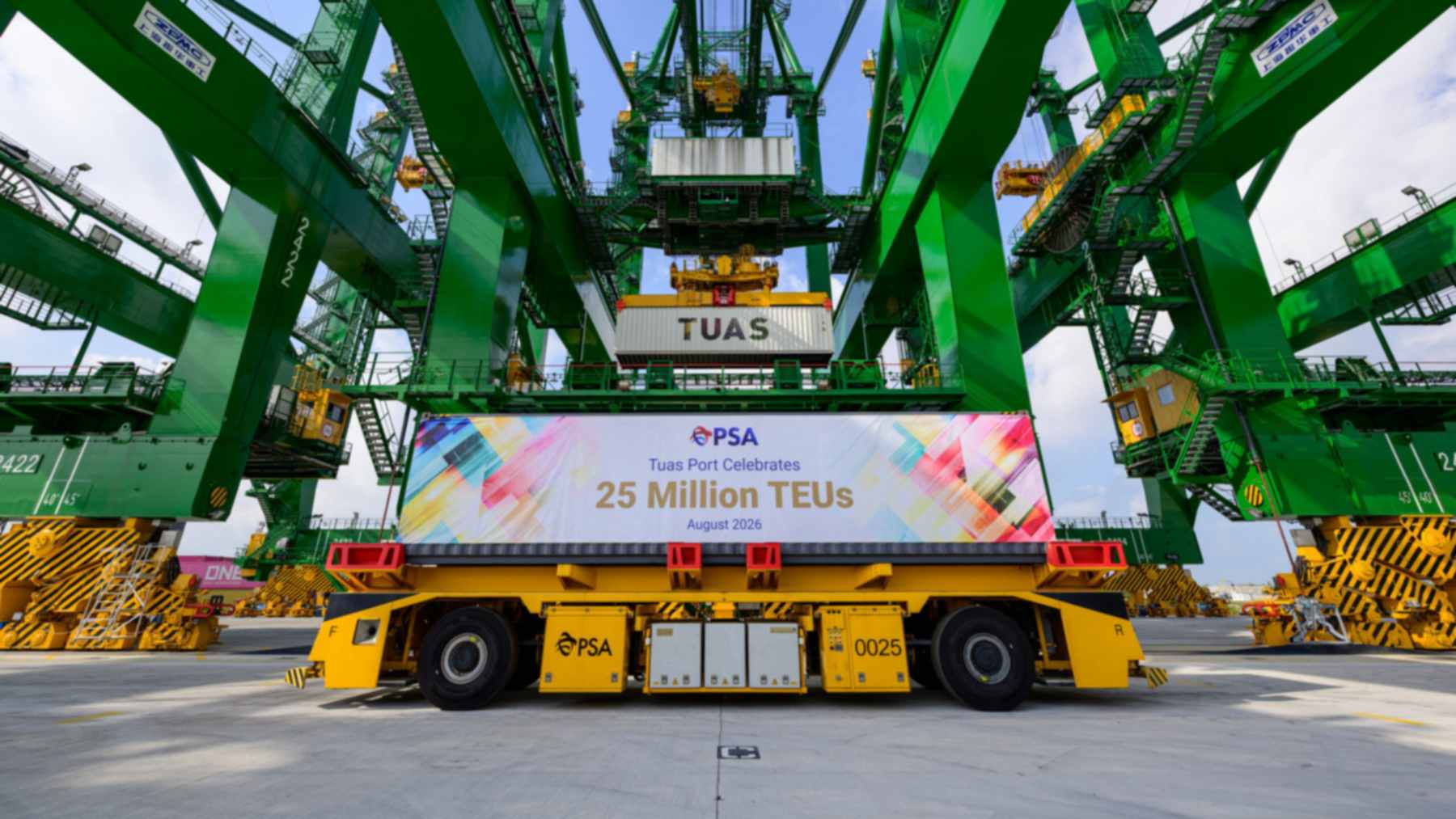
It is already busy. On Aug. 6, 2026, the operator, PSA, announced that Tuas had handled a cumulative 25 million TEUs since its official opening in September 2022, with 14 berths working and 18 expected by 2027.
A port designed to run on electricity
At that opening, Lee Hsien Loong, then prime minister, said “one key design feature of the port is sustainability.” Yard cranes and prime mover vehicles would “be automated and run on electricity, to enhance productivity and reduce their carbon footprint,” he said.
In a 2022 announcement, PSA said its electric automated guided vehicles produce about 50% lower carbon emissions than diesel prime movers, the trucks traditionally used to shuttle containers. That comparison covers the vehicles, not the whole port.
What PSA’s own numbers show
PSA Singapore’s 2025 sustainability report puts its combined direct and purchased-electricity emissions at 370,000 metric tons of carbon dioxide equivalent, up 7% from 2024, while container throughput rose 8.7%. The figures cover all of PSA’s Singapore operations, not Tuas alone.
The breakdown shows where the growth came from. Emissions from purchased electricity rose from 157,000 to 178,000 tons, about 13%. Direct emissions, mostly from diesel burned in cranes and prime movers, went from 189,000 to 192,000 tons, about 1.6%. The report puts the increase down mainly to electrification and more cargo handled at “fully electric Tuas Port,” with less moving through the older City Terminals and their “mostly diesel-powered container handling equipment.”
That electricity comes mostly from gas. Natural gas accounted for 93.1% of Singapore’s fuel mix in the first half of 2025, according to the Energy Market Authority.
Nelson Quek, PSA International’s regional CEO for Southeast Asia, wrote in the report that the company remains “focused on reducing our Scope 1 and 2 emissions by 50% by 2030 and achieving net zero emissions by 2050, relative to our 2019 baseline.” Scope 1 and 2 are the direct and purchased-electricity emissions in that 370,000-ton total.
Fill, dredging and corals
New land needs enormous amounts of fill. MPA reported in 2020 that more than half of the fill for Phases 1 and 2 came from recycled sources, including material dredged from fairways and basins within the site, saving more than S$2 billion in fill costs. It also cited environmental impact assessments and a S$6 million program, started in 2013, to relocate corals affected by the work.
“As a responsible hub port, this award affirms our commitment to balance environmental protection with port development,” said Tham Wai Wah, MPA’s chief engineer, when the project won a World Ports Sustainability award that year. None of that shows every marine impact was avoided, and the coastline is still being rebuilt.
Niam pointed to the next materials question in 2021. “We are also looking into the use of greener concrete with reduced embodied carbon contents,” he said.
Pillai told Parliament the plan will keep changing. “Over the next few decades, we will continue to refine the design of Tuas Port, to meet new needs as our operating environment changes,” he said.
Photo: PSA Singapore