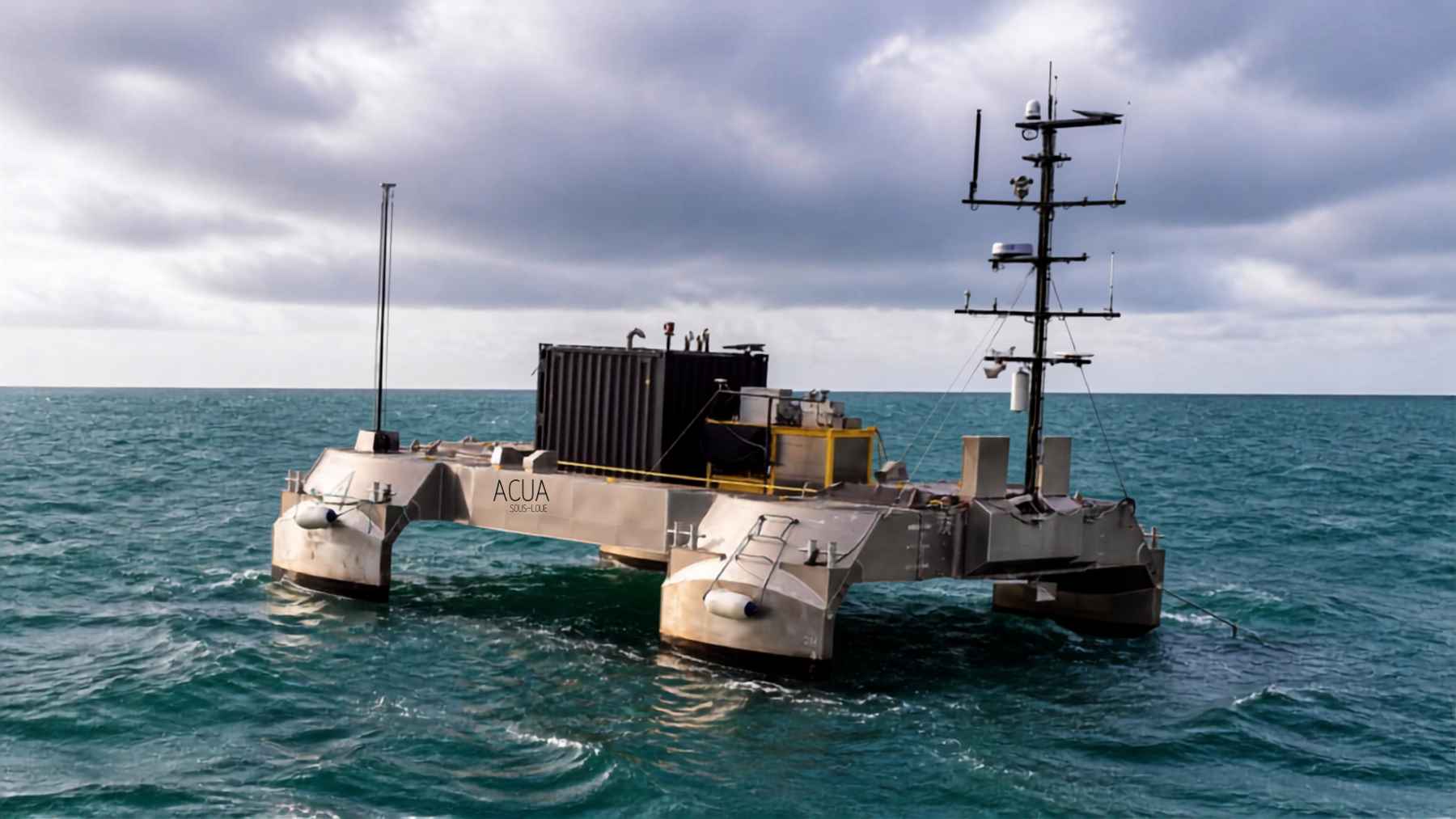
Working at about 16 to 20 nautical miles off the coast of Plymouth, England, a 46-foot uncrewed vesselspent more than 100 hours labouring between storms, 6.5 feet high waves and temperatures above 95°F. Additionally it observed a low-power personal detector beacon which was 13.7 miles away, zeroing in on it with a 65 feet margin of error.
The task seems like an example of an ultramodern marine fuel. Nonetheless, Pioneer, the ship constructed by ACUA Ocean to prove hydrogen propulsion, is equipped with a traditional diesel-electric system. This is not because of a fragile combustible unit, but rather because of an endurance gap, which is of around 18 days on hydrogen, and above 50 days on diesel.

The issue was modified by the efficiency difference
As stated by the company, in August 2025 Pioneer achieved a remotely operated, 24-hour hydrogen mission leading to the Eddystone Lighthouse and back, without emitting any contaminant exhaust. Although it was an impressive evidence of the idea, the same framework, travelling at 4 knots, could stay at sea for 18 days with hydrogen or 50 days with diesel.
According to ACUA, the tailored 45-kilowatt Nuvera fuel cell has a thermal efficiency of 58%, while hydrogen requires up to 9 high-pressure cylinders at 350 bar. On the other hand, diesel fits into around 4,000 liters of liquid storage, providing a ship with an autonomy of about 5,000 nautical miles. The amount of storage required on a 46-foot boat, is further modified.
The SWATH hull is what buyers really want
Short for Small Waterplane Area Twin Hull, Pioneer uses a SWATH design, which is what makes this slow-moving ship useful. Having two underwater pontoons shaped like torpedoes, the deck is supported by 4 narrow struts which rise through the surface.
Being at its strongest near the surface, wave energy is reduced with depth, this means that depending on how much of the floating structure lies below the waterline determines how much the sea can push the boat around. Pioneer could perform better at seakeeping than a monohull ship three times as long and 10 times as heavy, according to tests by the University of Southampton and its Wolfson Unit. ACUA recorded 60% reduced rolling and maximum roll speeds up to 4 times lower in 13.9-foot waves, compared to analogous monohulls.
Sensors are turned into a working system by a steady deck
The real news provided by the June mission was that stability. Pioneer transported two payloads: a multibeam echo sounder collecting survey data to Admiralty charting standards and a CommsAudit SPECTRA direction-finding system, being able to install and commission both of them in just two days. The ship was remotely controlled by ACUA from Plymouth, while, located near Cheltenham, a different team independently operated the radio equipment.
A 6.5 feet wide antenna, placed at around 16 feet above the waterline and weighing 99 pounds was upheld by the twin-hull arrangement. It was able to find the distress beacon, calculate its precise position, sending its location to His Majesty’s Coastguard during these trials. Using a monohull through complicated waters would prove this layout tougher to manipulate.
In July, ACUA and Teledyne FLIR Defense tried a different use for the stable deck. A SkyCarrier container launched and recovered a SkyRanger R70 drone automatically. Because the drone was connected by a cable, it was able to stay in the air without having to land to recharge. ACUA CEO Neil Tinmouth said this system was ready to be used by the Royal Navy.
Diesel gives the Royal Navy more time on station
The Royal Navy has tested Pioneer for different tasks, including watching activity at sea, deploying a remote sonar buoy, and pulling an antenna array. According to ACUA, the hybrid diesel-electric Pioneer Mk2 can travel at 4 knots for more than 50 days. It could also cross the GIUK gap many times without having to stop for fuel or stay in one area for more than 100 days.
This long operating time is perfect for the Royal Navy’s “Atlantic Bastion” strategy. It seeks to use more low-cost vessels in order to patrol the sea and search for submarines. In August 2025, Pioneer was the first unmanned vessel, remotely operated, in the UK to receive Lloyd’s Register certification under the Maritime and Coastguard Agency Workboat Code. This recognition is a huge step if the vessel moves beyond its testing phase and enters regular service.
An unfinished business case
There are still a few doubts. ACUA has not yet received an order for a Pioneer vessel, and the majority of its work has been related to government-funded trials. Its second vessel was supposed to be ready before summer 2026, but now, the launch was moved to the second quarter of 2027. These types of delays are common for new companies, but Pioneer still has a long path before becoming a full fleet.
Hydrogen could be used in the future. The central area of the boat has room for a standard 20-foot container. Its engines are still electric, no matter how the electricity is produced. With this, ACUA may decide the fuel system that works better for each mission. If hydrogen storage improves, or even if an operator prioritizes zero emissions over staying at sea for 50 days, the company may go back to its original design.
For the moment, Pioneer’s main advantage is clear. ACUA originally tested it to try hydrogen at sea, but in the end, the boat may be more useful for other purposes. It can carry sensitive equipment through rough seas and continue working there for several weeks.