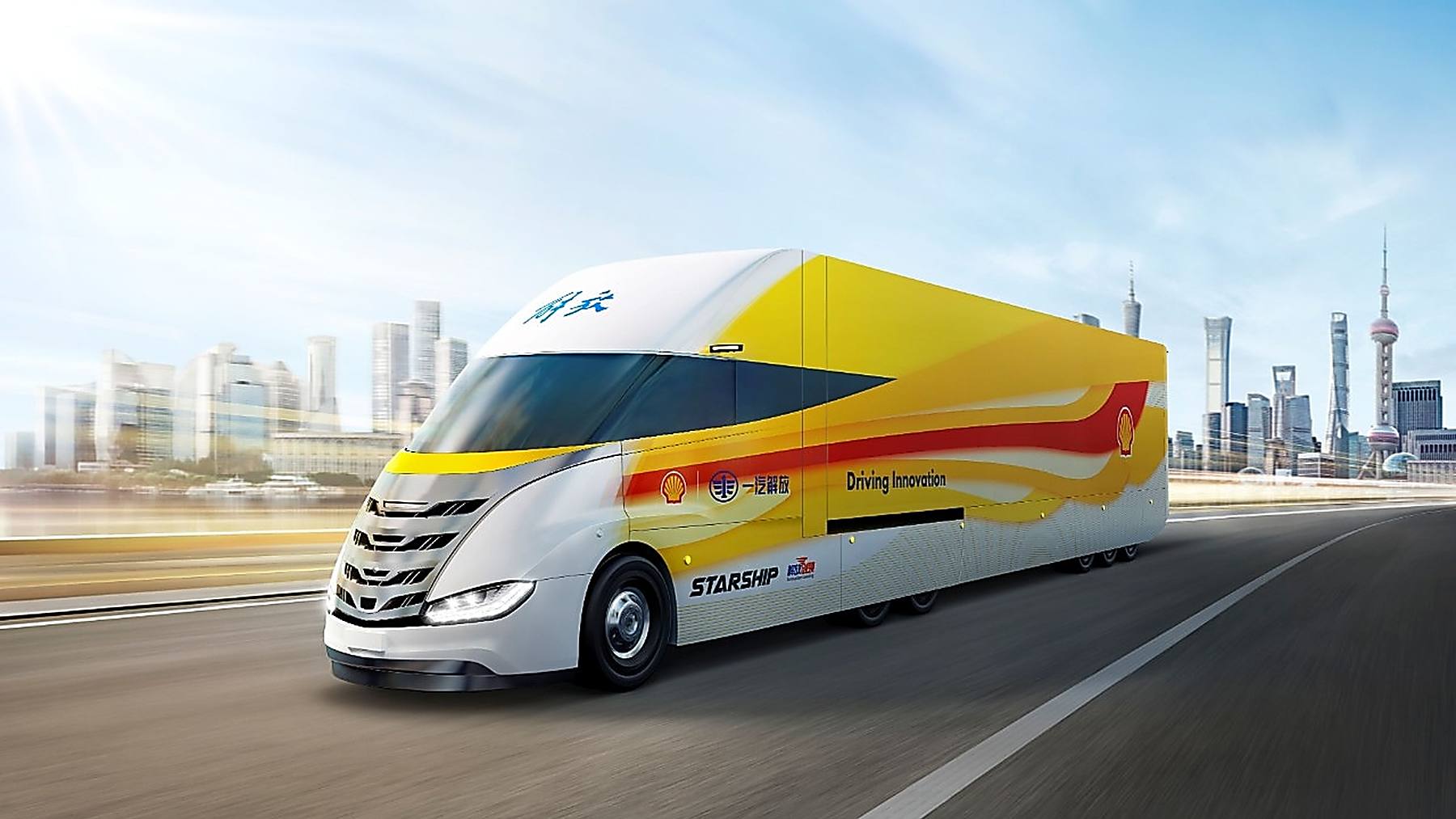
Shell and Chinese manufacturer FAW Trucks have tested an immersion cooling battery on a hybrid concept truck. Its cells sit surrounded by an electrically insulating liquid. In an announcement dated September 9, 2026, Shell said initial vehicle validation indicates potential improvements of up to 98 percent in maximum gradability and up to 32 percent in battery life.
According to a footnote in the release, all of those figures come from joint testing by FAW Trucks and Shell under specific conditions, so they are the companies’ own numbers. Shell says final performance data will follow once validation ends. The pack remains under evaluation for future FAW hybrid commercial vehicles.
Liquid that blocks electric current
Ordinary water around battery terminals would be dangerous, so this pack relies on an engineered fluid. Engineers call such a liquid dielectric. It resists the flow of electricity while still absorbing heat and moving it away from the cells.
Shell draws the comparison with standard packs in its notes to editors. “Unlike conventional systems that primarily cool from the bottom, Shell’s immersion cooling fluid enables direct contact with battery cells across a much larger surface area,” the company writes.
With a plate underneath, heat has to cross the cell and its surrounding materials before the coolant can take it. Shell says direct contact improves heat transfer and evens out cell temperatures. Its release does not disclose what the fluid contains.
Inside the Starship 3.0 trial
The test vehicle, the Shell Starship 3.0 Hybrid, is a concept truck built by the two companies. They use it to try out lubricants, hybrid powertrains, and battery cooling. FAW Trucks is the commercial name of FAW Jiefang Group, based in Changchun, Jilin.
After industry-standard testing, the pack went into the truck for sustained high-power charging and discharging. Shell says the China Automotive Technology and Research Center, known as CATARC, independently verified the pack’s industry-standard testing and the vehicle evaluations. The release does not say that CATARC produced or checked the 98, 0.8 and 32 percent figures.
The jointly developed pack first appeared in 2025, and Shell places it among China’s first immersion cooling solutions for truck batteries. The company says it picked China because of the country’s lead in commercial vehicle manufacturing.
Those results were due to reach a wider audience at IAA Transportation 2026 in Hannover, Germany. Shell planned to show the truck at the FAW Trucks booth from September 14.
Reading the 98 percent figure
Gradability describes the steepest slope a vehicle can climb, which matters on freight routes through hilly country. A rise of 98 percent does not mean the truck scaled a 98 percent grade. The number compares one result with another.
Shell’s public release gives neither the starting slope nor the final one. It does not state the truck’s load during the test either. Without those details, nobody outside the program can apply the percentage to a real road or a real cargo.
Why 0.8 percent earned a footnote
Energy efficiency at the vehicle level improved by 0.8 percent, which looks modest beside the other two numbers. Shell added a note saying the gain “is considered significant in the commercial vehicle industry.” It came from optimizing a single hybrid battery system and left the core powertrain unchanged.
That assessment comes from the company, and the release offers no savings in dollars. Trucks that run long distances every working day could still turn a small percentage into real energy savings. Much depends on the route and the duty cycle.
Nor does the figure translate directly into extra range. On a hybrid, fuel use and battery use both shape what a driver sees on the road.
Heat shortens battery lives
For fleet owners, the 32 percent figure may matter most, since a longer-lived battery delays an expensive replacement. Shell calls it a potential improvement. The company has not reported a pack that actually lasted that much longer.
Battery aging involves much more than temperature. The National Laboratory of the Rockies, part of the U.S. Department of Energy, says battery lifetime models must consider “temperature, operating windows, charge/discharge rates, storage environment, and cycling patterns.”
In passenger cars, EV battery degradation is often gradual, but heavy trucks work at high power for long hours. Cell chemistry changes the picture too, as with the lithium manganese-rich cells GM and LG plan to build in Tennessee.
No price, weight, or recipe
Buyers will want numbers the release leaves out, starting with cost, added mass, and service intervals. A tank of fluid adds weight, but the design may also remove some cooling hardware. Shell has published no figures on either side of that comparison.
Anyone weighing the environmental case would need data on how the fluid is made, replaced, and disposed of. Operating costs decide many purchases too, as a transport owner in Chile comparing electric trucks with diesel has argued.
FAW Trucks frames the work as a step toward market. “Validation on the Starship Hybrid brings us closer to commercial application,” said Wang Jianyu, president of the company’s Commercial Vehicle Development Institute. He cited “the potential to enhance performance, durability and safety for the next generation of hybrid commercial vehicles.”
Shell has given no production date or price for the pack. The official statement is available on Shell’s website.
Image: Shell