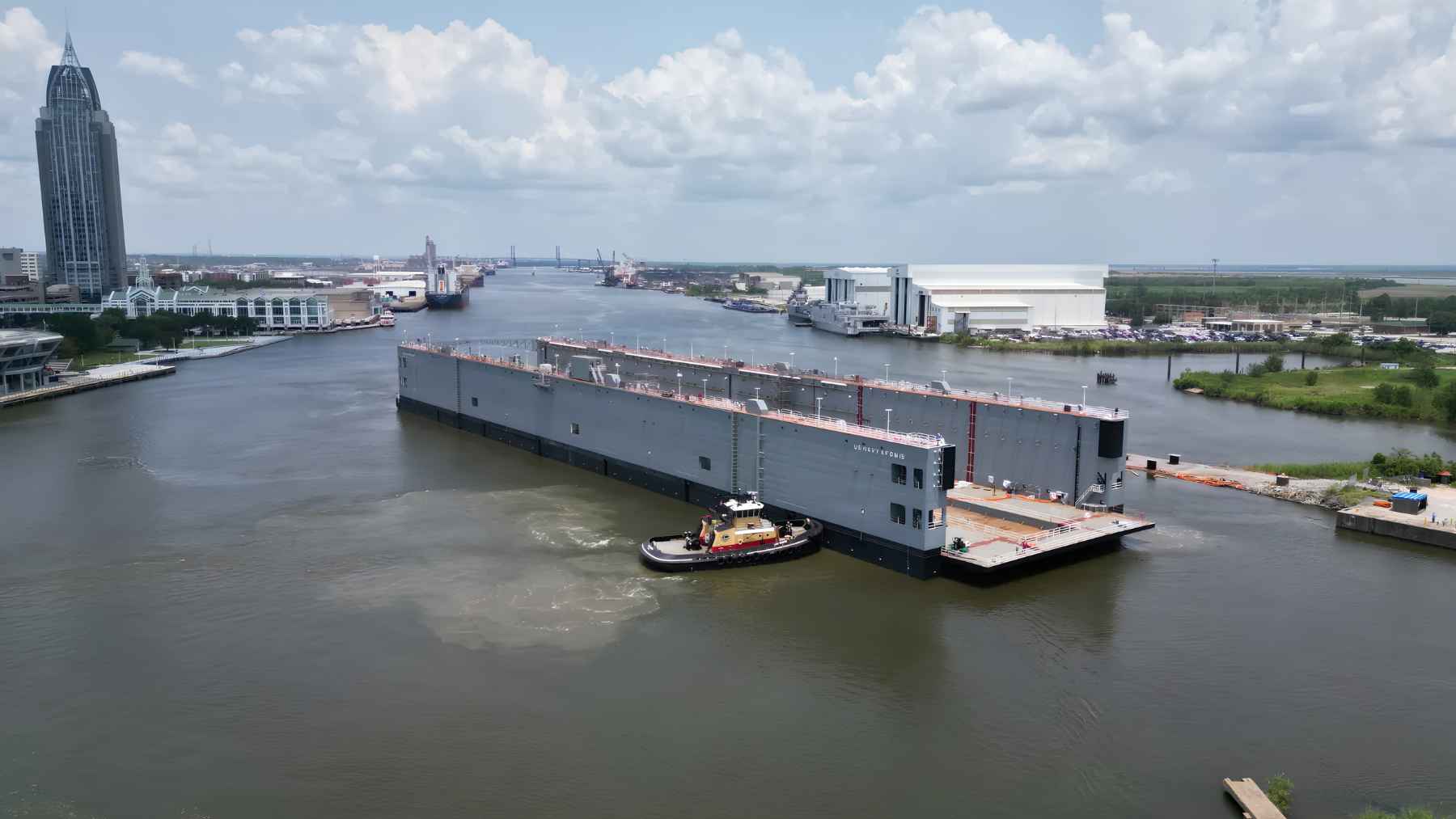
Austal USA has launched AFDM 15 into the Mobile River, a steel structure that measures 694 feet (about 212 meters), weighs approximately 12,000 tons and offers 90,800 square feet of working deck. This is the Navy´s first new Auxiliary Floating Dry Dock Medium in more than 40 years.
This dock works by doing something ships normally try to avoid: instead of being designed to remain high in the water, the objective is to flood its ballast tanks, so that it sinks enough to place itself beneath a warship. Then the tanks are emptied, lifting both vessels out of the water. The AFDM can support up to 18,000 long tons, so this ability to control its buoyancy could help the Navy solve maintenance delays that keep big ships out of service longer than expected.
A floating dry dock used as a tool
Lifting a destroyer for maintenance is not as simple as raising a car. At around 500 feet long, it needs a huge dry dock to lift the sections that are below the waterline. This action is necessary to access and repair the hull, propeller shafts, and the sonar equipment.
The process follows different stages. First, the dock fills its ballast tanks and moves its deck below the vessel. After this step, tugboats and crews position the ship above a series of support blocks. After pumps remove the water, the dock rises carrying the ship on top of it, pulling it out of the water. Although the scale is huge, the method is quite simple.
AFDM 15 is not attached to a single basin, so it can be moved when it is necessary. This “Rennie” design includes side walls with separate pontoon sections, to gain buoyancy and stability. The dock measures 157 feet wide and 65 feet from its base to the wing deck, with enough power to move heavy Navy destroyers and cruisers.
A dock without engines
Before entering the river, AFDM 15 had to be carried by a bigger dry dock. After it was built on land at Alabama Shipyard, it was taken to Dry Dock Alabama on July 25, 2026. Three days later, the larger dock was flooded, allowing AFDM 15 to float free.
This summary does not really show the real scale of the operation. Crews worked for nine days, getting ready to receive the dock and used 1,500 crane mats. Berard Transportation then moved the giant structure on self-propelled transporters, and finally, tugboats guided it into the Mobile River.
Austal USA President Gene Miller called this launch “no small feat”. According to the company, the operation required the work of engineers, rigging teams, harbor pilots, transportation specialists, and towing teams. During one of the stages, two huge steel structures had to fit closely together without crashing or causing any damage.
The reason the Navy requires more lifting capacity
The new dock appears during a complicated maintenance context. In December 2025, the Congressional Budget Office stated that the reconditioning of standard big Navy vessels usually require between 20% to 100% more time than originally estimated. Additionally, it also expected that Arleigh Burke class destroyers will spend more than 25% of their predicted service lives, out of commission for repairs, averaging up to 9 years of maintenance.
But, all these holdups will not be solved by one new dry dock. Ship age, delayed checkups, unavailability of new parts, unplanned work, and contract difficulties can all cause delays in reparations. Even so, a combat ship is not available for either exercises or stationing while it waits for repairs, this is why constant delays means the Navy has a smaller operational fleet, according to the CBO.
In June 2022, Austal USA was given an advantageously bid $128 million design and construction contract by the Navy. At that moment, the company stated AFDM was its second steel vessel program for the maintenance, and that the layout took examples from working on an analogous dock in their repair plant in Mobile.
A fleet taking ideas from World War II
The new steelwork has many things in common with older versions. Built in 1943, AFDM-3, could also lift 18,000 tons. So, this means that there was no real progress in the lifting capacity, but it did enhance a system of maintenance infrastructure that was directly inspired by what was done during World War II.
Mobile has already done something similar before. During the war, the Navy built one of its earliest floating dry docks. This was later referred to as AFDM-2. More than eighty years later, this same port launched a huge floating repair platform into the water.
The inauguration is only one step, as AFDM 15 still requires other important things before their programmed delivery in early 2027: the installation of cranes, the activation of its generator, and the completion of a series of tests. For now, this impressive restoration dock remains, waiting to show that sometimes, the most effective way to lift a vessel is to sink it.
Official press release published on Austal USA.