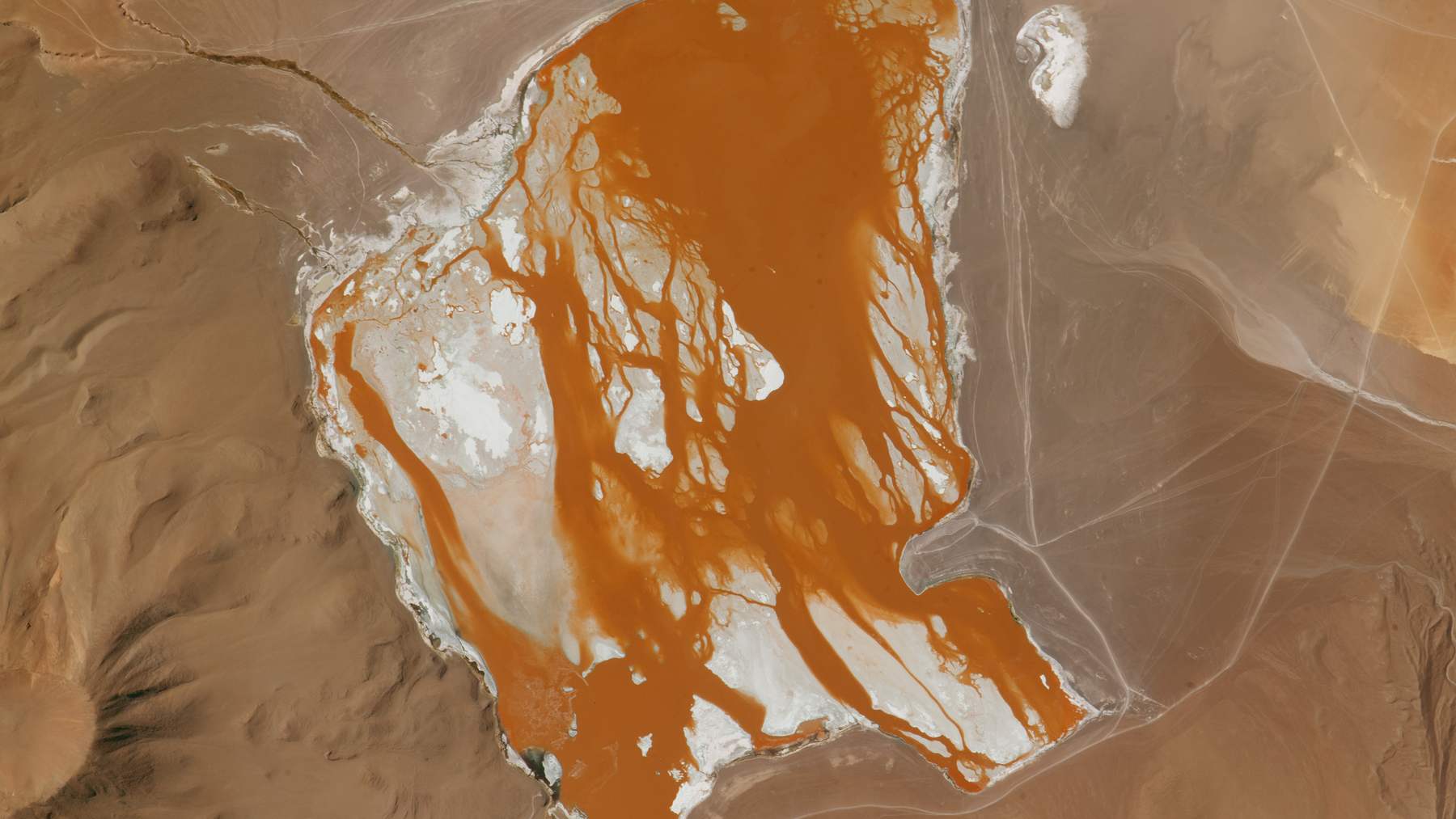
The European Space Agency’s latest picture of Laguna Colorada, a lake in the Bolivian Andes known for its red water, barely shows any red at all. In the Copernicus Sentinel-2 image ESA released on September 18, 2026, the lake comes out blue and brown.
“It is a false-colour image, using the mission’s near-infrared channel that picks out vegetation in red,” ESA says in its caption. For that reason, the agency adds, “the Laguna Colorada appears to be a mix of blue and brown, as the near-infrared channels reflect the water and areas of bare soil in and around the body of water.”
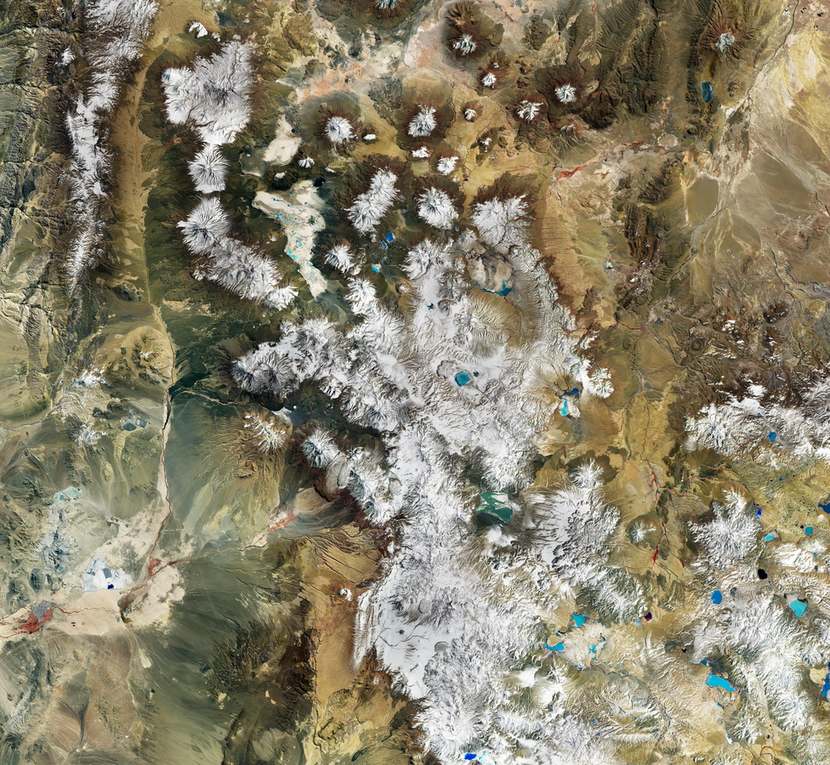
Red, in this picture, means plants, and up here there are few. “Due to the sparsity of this high-altitude region, vegetation is found mainly along lower-altitude river valleys and near urban areas,” the ESA caption notes, pointing to the city of Calama in Chile and the Río Pata in Bolivia.
Algae and sediment turn the water red
ESA places the lake at 4,278 meters (14,035 feet), fed by the Sulor River inside the Eduardo Avaroa Andean Fauna National Reserve. “With high levels of sodium chloride, sulphates and microorganisms, the lagoon is much saltier than ocean water,” the agency writes. “Its composition, which varies according to the seasons, causes the water to appear red to the naked eye.”
NASA’s Earth Observatory put it this way in 2015, under an astronaut photo of the lake: “The strong red-brown color of this shallow, 10 kilometer (6 mile) long lake is derived from algae that thrive in its salty water.” Sometimes it turns green, the caption went on, because “different algae display different colors.”
Back in 1998, Omar Rocha and José Luis Eyzaguirre of the Wildlife Conservation Society in Bolivia wrote the lake’s information sheet for the Ramsar Convention on wetlands. They blamed fine reddish sediments and a dense population of Dunaliella salina, a single-celled alga, and noted that warm, bright days could bring blooms of blue-green algae that turned the water brick red or even purple.
Salt-loving microbes are also behind the pink, heart-shaped salt lake in Argentina photographed from the space station.
A 2026 study read the DNA of the lake’s microbes
Claudia Hoepfner of Universidad Mayor in Santiago, Chile, and the Universidad Mayor de San Simón in Cochabamba, Bolivia, led a study published in March 2026 together with Ramón Alberto Batista-García of the Universidad Autónoma del Estado de Morelos in Mexico. Her team sequenced the DNA in surface sediments from the shallows of four salty lakes in southwestern Bolivia: Colorada, Hedionda, Mama Khumu and Loromayu.
“Laguna Colorada, located at 4298 m above sea level, is characterized by its striking red coloration produced by high densities of pigmented plankton and photosynthetic microorganisms adapted to hypersaline, alkaline waters,” the authors write, giving an altitude (14,101 feet) about 20 meters above ESA’s.
At Colorada, “the lake also contained high concentrations of lithium (3157 mg/L) and arsenic (34.5 mg/L), which likely act as selective pressures for microorganisms with metal- resistance and detoxification capabilities,” they report.
The arsenic may be natural. A 2021 flamingo study by Omar Rocha and colleagues describes Laguna Colorada as a lake that “does not receive contaminants from anthropogenic sources” and notes that arsenic and lead “may be naturally in high concentrations in remote areas, like Laguna Colorada.”
The famous red alga ruled a different lake
In the study’s samples, Dunaliella dominated the algae at Laguna Hedionda, while Colorada and Mama Khumu “supported more heterogeneous phototrophic communities including Micromonas, Chlamydomonas, and Chlorella,” the researchers write.
In April 2025, a Sentinel-2 pass caught the lake looking “greenish-yellow,” according to the European Union’s Copernicus image of the day.
Flamingos eat what colors the lake
“Algae and other microorganisms serve as a vital food source for vulnerable bird species, such as the Andean flamingo in the Laguna Colorada,” NASA wrote in a 2023 Earth Observatory caption.
Marita Davison and Jennifer Moslemi, then graduate students at Cornell University, described the birds in Living Bird magazine in 2010. Andean and James’s flamingos, they wrote, “subsist on microscopic algae by filtering individual algal cells through their highly adapted bills.” Carotenoid pigments from that diet are what turn flamingos pink, which is why flamingo parents can fade while feeding their chicks red crop milk.
The two kept flamingos out of parts of an Altiplano lake for more than a year. “In the areas where we prevented flamingo activity, an almost instant boom in algae took place, and was sustained for months,” they wrote. Without the birds, “rates of photosynthesis slump, leaving behind an accumulation of algae of poor nutritional value.”
“Flocks can assemble unexpectedly by the thousands and just as easily disappear without warning,” they added. “Like all flamingos, they lay a single egg atop a mud mound nest. Even a slight disruption to a nesting colony can spell catastrophe for a breeding population.”
How much the James’s flamingo leans on this one lake depends on who you ask. Davison and Moslemi put it at “nearly one-third of the entire population.” The Ramsar summary for the wider Los Lípez wetland says about 50 percent of the species’ global population concentrates there.
Explorers had to drag each other out of the mud
The James’s flamingo seemed to vanish after 1909, Living Bird recounts, until a 1957 expedition reached Laguna Colorada through “salty slime of uncertain depth” and found a nesting colony. William Conway led another trip there in 1960.
“The bottom was riddled with apparently bottomless holes where subterranean geysers pour into the lake. We found it important to stay close so we might drag each other out of these holes,” Conway said, as quoted by the magazine. “Progress became a series of short struggles punctuated with rest periods while we stood covered from head to foot with mud and gasped at each other.”
Bolivian biologist Omar Rocha first saw the birds there in 1991. “I felt extremely emotional to see them up close, thousands of flamingos together feeding in the wetlands, forming part of the desolate landscape of the high-Andean region,” he told NBC News in 2016. “I marveled at the sight of them, attracted by their colors, behavior, and elegance. In that moment, I knew I wanted to study and focus my studies and research on these beautiful and charismatic birds.”
According to that NBC report, Rocha makes the 17-hour journey up to the lake “as often as once a month,” and he “has figured out that 90 percent of the population of James flamingos nest on this lake,” a higher share than the other estimates. He and his volunteers band up to 1,000 chicks each year.
Tourism and mining press on a huge protected area
Laguna Colorada became a Ramsar wetland of international importance in 1990. In 2009 the site grew from 51,318 to 1,427,717 hectares, roughly 3.5 million acres, under the name Los Lípez, according to the Ramsar records for Bolivia.
The site is Bolivia’s most visited protected area, with about 70,000 tourists a year in that record, last updated in 2009, “which has caused negative impacts on the lakes,” it says. “Mining represents another important threat.”
Davison and Moslemi saw the same pressures in 2010. “Annual tourist visits have increased from fewer than 5,000 to more than 70,000 during the last 13 years,” they wrote, and “lithium reserves in Bolivia’s prime flamingo areas are reportedly large enough to become the nexus of raw materials for electric car battery production.”
They also worried about water. “Too much, and nests are drowned. Too little, and food sources desiccate in the oppressive desert sun.”
What one picture and one set of samples can show
ESA invites viewers to “zoom in to explore this image at its full 10 m resolution,” or about 33 feet per pixel, which is enough to trace the shore of Laguna Colorada and not enough to pick out a single flamingo.
The DNA study comes with its own caveat, in the authors’ words: “While our metagenomes provide a robust system-level snapshot, future work should expand toward seasonal-resolved sampling, isotope-based fluxes, and multi-omic approaches.” Only two of its six pooled samples came from Colorada.
Repeat satellite images can fill in some of that seasonal picture, as they already have for Antarctic penguin colonies read from the color of their droppings.
The full study was published in Environmental Microbiome.
ESA published its Laguna Colorada image on September 18, 2026, as part of its Earth from Space series.
Photo: ISS Crew Earth Observations Facility and the Earth Science and Remote Sensing Unit, NASA Johnson Space Center