Confirmed by NHTSA: new fuel economy rules for automakers take effect November 30, with standards projected to average about 34.9 mpg for new cars and light trucks in 2031
Under the fuel economy rule, new vehicles could cost $1,289 less in 2031 if savings are passed on, while gasoline use rises 4.6 percent through 2050.

· 4 min read
New federal fuel economy rules for automakers take effect Monday, November 30. The National Highway Traffic Safety Administration calls the final rule SAFE Vehicles Rule III, and it resets fuel economy standards for passenger cars and light trucks for model years 2022 through 2031. The agency projects a combined industry average of roughly 34.9 miles per gallon in 2031. It says the 2020, 2022 and 2024 standards were set in a way that was inconsistent with the law, because they counted electric vehicles. NHTSA estimates the average new vehicle could cost $1,289 less, but gasoline consumption would rise 4.6 percent through 2050 compared with its baseline. Critics, including a coalition of state attorneys general, argue the reasoning was pretextual. The rule also ends trading of fuel economy credits between manufacturers, starting with credits earned in model year 2028.
Key points
- Real-world mileage is generally 20 to 30 percent below the CAFE figure.
- NHTSA puts the 2024 gasoline and diesel fleet at 35.4 mpg.
- Automakers face no fines for falling short under current law.
- Credit trading between manufacturers ends with model year 2028 credits.
New federal fuel economy rules for automakers take effect on Monday, November 30. The National Highway Traffic Safety Administration published the final rule on September 30. Its name is SAFE Vehicles Rule III.
It resets the Corporate Average Fuel Economy standards, known as CAFE, for passenger cars and light trucks. The new levels cover model years 2022 through 2031. They apply to manufacturers, not to drivers.
Each automaker is judged on the average fuel economy of the vehicles it builds, compared with the targets for those vehicles. No single model has to hit its own target exactly, the rule explains.
What the numbers mean
NHTSA estimates that the final standards correspond to a combined industry average of roughly 34.9 miles per gallon in model year 2031. The agency calls this a projection. The real standards are curves tied to each vehicle's footprint.
Footprint is the area between a vehicle's four tires, measured from wheelbase and track width. The final mix of vehicles automakers sell will decide the actual fleet average, NHTSA notes.
The rule also warns that real-world fuel economy is generally 20 to 30 percent lower than the CAFE figure. Compliance relies on a two-cycle test that weights city driving at 55 percent and highway driving at 45 percent. The window sticker on new cars, provided by the EPA, uses adjusted real-world values.

Why NHTSA changed course
NHTSA argues that the 2020, 2022 and 2024 standards were set in a way that was inconsistent with the law, because the analysis behind them counted electric vehicles, plug-in hybrids and compliance credits, which it says the law bars it from considering. It says the new levels are the maximum feasible for the gasoline- and diesel-powered vehicles now on the market.
The rule also points out that each extra mile per gallon saves less fuel as cars get more efficient. A driver covering 15,000 miles a year saves 250 gallons by moving from 15 to 20 mpg, but only 125 gallons going from 30 to 40 mpg.
The agency also redrew the target curves using the latest data. It concluded that the link between footprint and fuel economy has shifted since model year 2008, the year the old curves were based on.
How it compares with 2024
NHTSA's own analysis puts the 2024 fleet of gasoline and diesel vehicles at a combined 35.4 mpg. With plug-in hybrids and electric vehicles counted, the 2024 fleet reaches 36.2 mpg.
The agency left electric vehicles out of its baseline. Including even a small number of them, it argues, would push standards above what is technologically feasible or economically practicable for gasoline-powered fleets.
Several commenters disagreed, including the Southern Environmental Law Center and the American Council for an Energy-Efficient Economy. According to the rule's summary of comments, they noted that the proposed 2031 level of 34.5 mpg was lower than the 2024 fleet's 35.4 mpg.
A coalition of state attorneys general went further. They argued that the proposal's reasoning was pretextual and shaped by executive orders promoting fossil fuels over zero-emission technology.
Cheaper cars, more gasoline
NHTSA projects that fleetwide technology costs could fall by $15.3 billion for model year 2031, compared with keeping the previous standards. If automakers pass those savings on, the average new vehicle would cost $1,289 less.
The trade-off is fuel. The agency estimates the new standards will increase gasoline consumption by 4.6 percent through 2050 compared with that baseline.
It adds that total fuel use by the fleet is still expected to decline as older, less efficient vehicles are retired. Overall, NHTSA puts the net benefits at about $41.8 billion using a 3 percent discount rate.
Some commenters noted that for certain model years, higher lifetime fuel costs outweigh the lower purchase price. NHTSA replies that, counting other private costs and benefits, buyers still come out ahead.
No fines for missing targets
Under current law, automakers face no fines for falling short. The One Big Beautiful Bill Act, Public Law 119-21, changed the civil penalty provisions, and the rule updates NHTSA's CAFE penalty to match.
The rule also ends trading of fuel economy credits between manufacturers, starting with credits earned in model year 2028. New definitions for telling passenger cars apart from light trucks apply from model year 2030.
The passenger car standards are in section 531.5 of Title 49 of the Code of Federal Regulations, and the light truck standards are in section 533.5. Section 531.5 also keeps a minimum standard for domestically built passenger cars, which reaches 36.6 mpg in 2031.
The full text is available as Federal Register document 2026-19964.
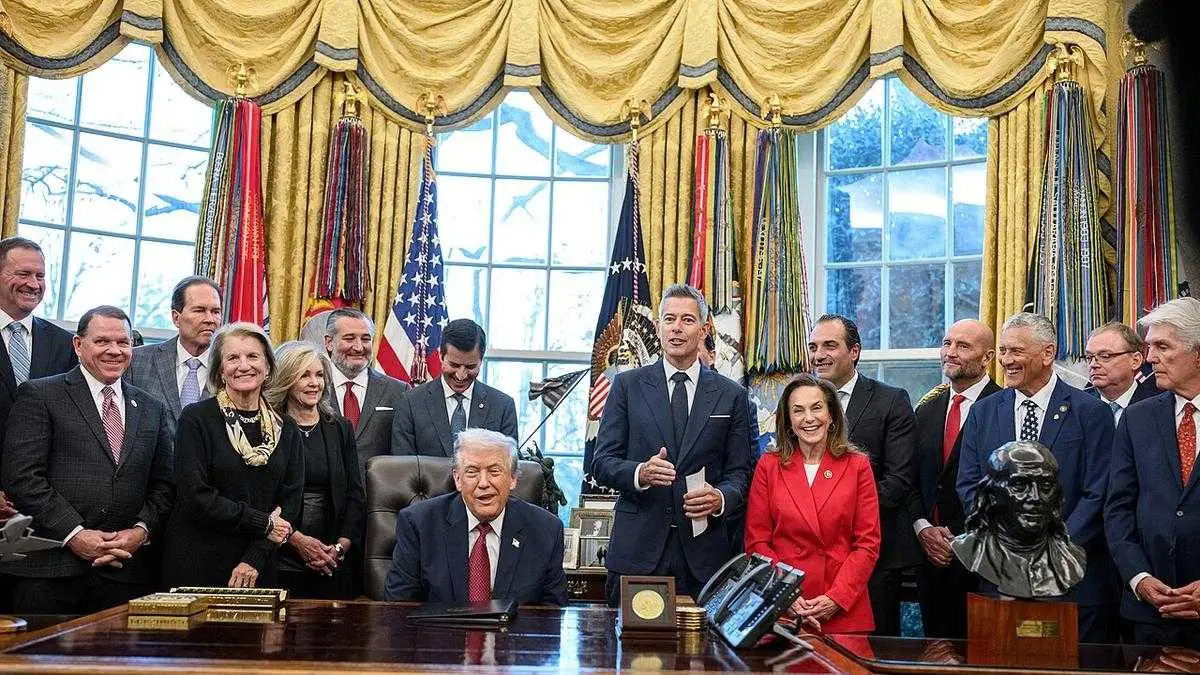
Official White House Photo by Molly Riley
Glossary for this story
- EPA
- The Environmental Protection Agency: the U.S. federal agency in charge of protecting air, water and land and enforcing environmental laws.
- Electric vehicle
- A vehicle powered by one or more electric motors running on rechargeable batteries that are charged by plugging in.
- Plug-in hybrid
- A car with both a gas engine and an electric motor whose battery charges from a plug. It can drive a few dozen miles on electricity alone.
- Fossil fuels
- Coal, oil and natural gas. They formed over millions of years from the remains of living things and release CO₂ when burned.
Adrián Villellas
Writer at ECOnewsAdrián Villellas is a computer engineer and entrepreneur in the fields of digital marketing and advertising technology. He has led projects in data analysis, sustainable advertising, and solutions for new audiences. He also contributes to scientific initiatives related to astronomy and space observation. He writes for science, technology, and environmental media outlets, where he makes complex topics and innovative advances accessible to a broad audience.
More from Adrián VillellasComments · 0
Rules ›No comments yet. Be the first to share your view.