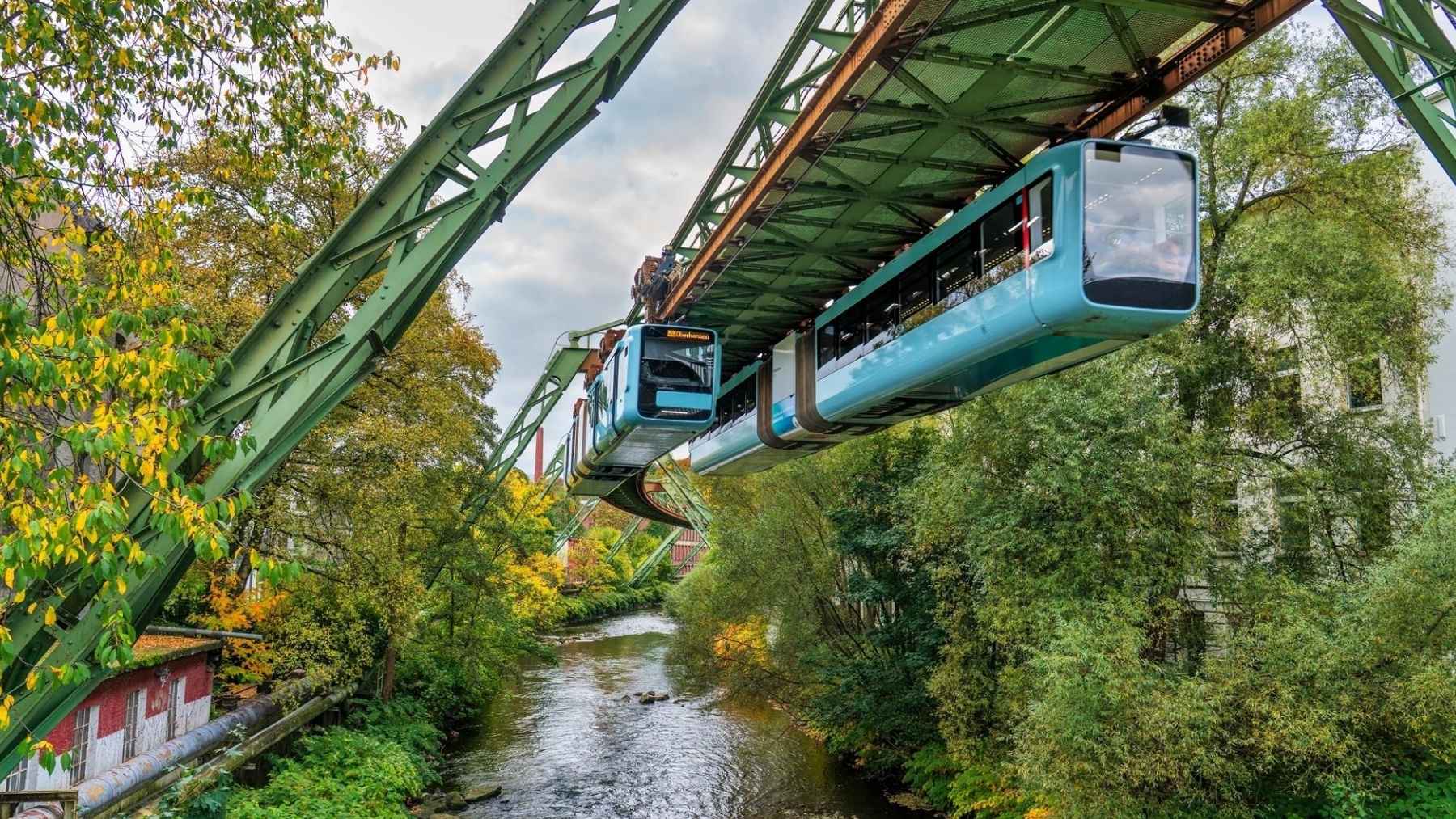
Germany’s “flying train” is not a futuristic proposal waiting for approval. Wuppertal’s Schwebebahn opened to passengers on March 1, 1901, and, 125 years later, its operator says it carries more than 80,000 people a day.
Its cars hang from an overhead track, traveling roughly 26 to 39 feet (8 to 12 meters) above the river and streets. But the remarkable view is only part of the story. This railway shows how a crowded industrial valley found room for public transportation without squeezing another route onto its busy roads.
Why the Wupper Valley looked upward
By the 1880s, the textile centers of Elberfeld and Barmen needed better transportation for their growing populations. Factories and homes crowded the riverbanks, while steep hills hemmed in the valley, leaving little room for additional roads or conventional railway tracks. Horse-drawn transportation was struggling to keep up.
“The space above the river was the only space we had,” explains Thomas Helbig of the Schwebodrom museum. The solution was to make that overlooked space part of the transportation network rather than force another line through the built-up valley.
Engineer Eugen Langen proposed passenger cars hanging beneath a steel rail, with wheels running overhead. Elberfeld and Barmen accepted his system in 1894, and construction began in 1898. The operator’s historical timeline dates completion of the full route to 1903, two years after the first passenger service.
A railway older than the city it serves
The Schwebebahn connected Elberfeld, Barmen, and Vohwinkel long before they became parts of the same municipality. In 1929, those communities merged with Cronenberg and Ronsdorf to form the city now known as Wuppertal. The railway had already linked the first three for nearly three decades, giving them a common route before a common administration.
That connection still runs between Vohwinkel in the west and Oberbarmen in the east. According to the operator, passengers can travel between the terminals in about 30 minutes, passing through a network of 20 stations along roughly eight miles of track. For residents, the unusual-looking train is an everyday way to get across town.
What this old railway offers modern transportation
What makes the Schwebebahn relevant beyond its appearance? Its separate route allows trains to move independently of street traffic, without street-level crossings. For a passenger trying to get to work, that practical distinction matters more than whether the vehicle looks futuristic.
The technology has also moved forward. According to the operator’s vehicle description, the newer Generation 15 trains introduced energy recovery during braking, allowing the railway to reclaim energy as its trains slow down. Wuppertal has kept the familiar suspended layout while updating the machinery that moves people along it.
Those features offer a specific efficiency benefit, although the operator’s description does not quantify annual CO2 savings. The broader lesson is easier to see in the route itself. Its designers made a practical transit connection fit a place that had little room to spare.
An emperor, an elephant, and a shared identity
The railway attracted distinguished passengers before it even opened to the public. Emperor Wilhelm II and his wife, Auguste Viktoria, took a trial ride on October 24, 1900, giving the preserved Kaiserwagen its name. The operator now advertises special trips and guided “coffee rides,” with costumed guides recounting the city’s history inside the restored carriage.
Then came a very different passenger. In July 1950, a circus publicity stunt brought a young elephant named Tuffi aboard, but the frightened animal ended up falling into the Wupper. She survived with minor injuries, and the incident became part of local folklore.
Today, Tuffi appears on souvenirs, while sculptures preserve her place in the city’s memory. A stone elephant in the river marks the remembered site of her fall. The Schwebodrom museum also explores the railway’s history, giving visitors another way to understand why a commuting route became a source of local pride.
Still moving after 125 years
The anniversary is about more than preserving an unusual machine. With tens of thousands of daily passengers, the Schwebebahn remains a working connection between neighborhoods, not simply a historic attraction. Its enduring appeal suggests that practical infrastructure can become something a community genuinely identifies with.
Wuppertal has announced a family festival around its main station on September 19, 2026, celebrating the railway’s 125th anniversary.
The event is scheduled to run from noon to 6 p.m. The latest anniversary press release was published on September 3, 2026, on Wuppertaler Stadtwerke.