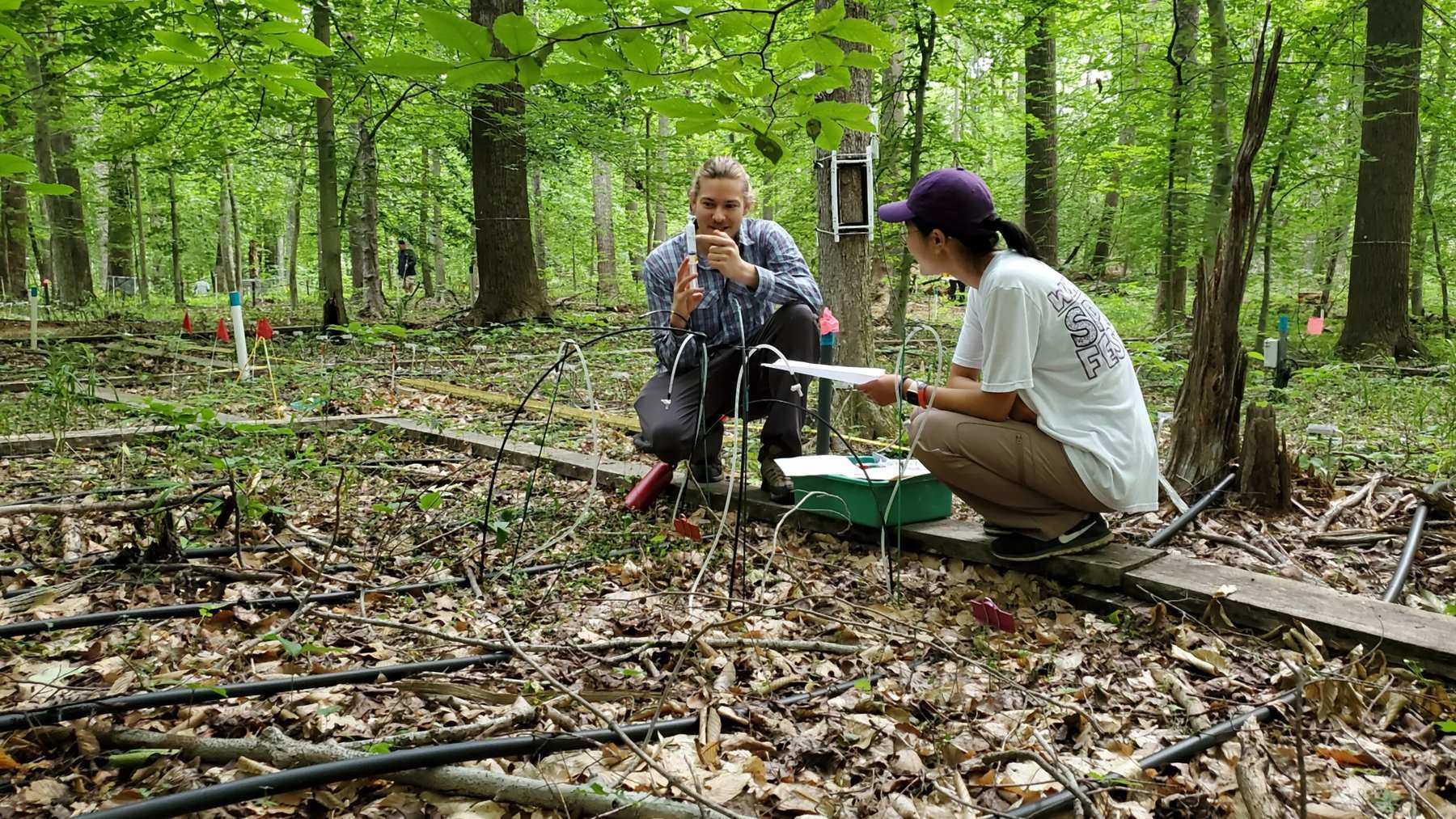
Scientists in Edgewater, Maryland, soaked a coastal forest with about 80,000 gallons (303,000 liters) of brackish water in a single day. The point was to watch a ghost forest begin, from the roots up. Soil readings shifted within hours, yet the trees overhead gave no consistent signal in the days after.
The work comes from TEMPEST, an experiment at the Smithsonian Environmental Research Center. Its first results appeared in Proceedings of the National Academy of Sciences in October 2025. A second paper, on the trees alone, landed in October 2026.
Sprinklers under the Maryland canopy
The name stands for Terrestrial Ecosystem Manipulation to Probe the Effects of Storm Treatments. The site is a stand of upland woods on the Chesapeake shore, right next to a tidal marsh. In 2019 and 2020 the team marked out three plots of 40 by 50 meters, about half an acre each.
City tap water goes on one plot. Water pumped from the Rhode River, a tributary of the bay, with about 7 parts salt per thousand, goes on the second, and the third gets no added water at all.
Black irrigation lines cross the flooded plots, and roughly 200 sensors sit on trunks or in the ground. That is according to the Smithsonian’s account of the project. During a flood, hundreds of sprinklers pop up from those lines.
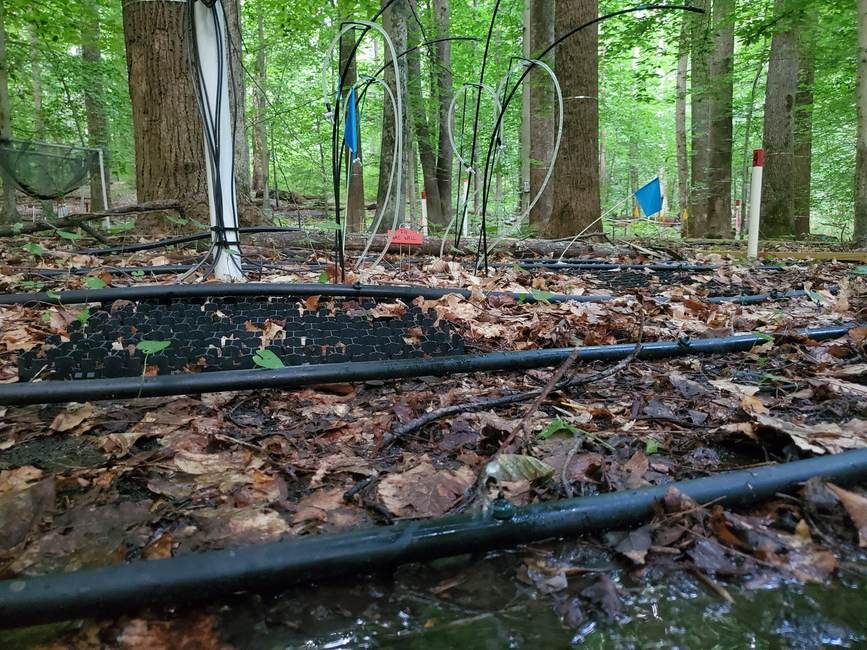
The first treatment came in June 2022. In June 2023, the team ran two 10-hour floods that began 24 hours apart. Each one poured about 80,000 gallons onto each treated plot, or roughly 6 inches (15 centimeters) of water.
Salt lingered after the oxygen returned
Peter Regier, an Earth scientist at Pacific Northwest National Laboratory, led the PNAS study. Smithsonian biogeochemist Pat Megonigal and more than 20 others joined him.
In the saltwater plot, soil electrical conductivity climbed to more than 19 times its starting level. Conductivity is a stand-in for how salty the ground is. Five days later it was still over 10 times higher, the Smithsonian said.
Oxygen moved faster. Before the floods, soil oxygen sat at 86 to 96 percent of air saturation. Both flooded plots then fell below 1 percent at their lowest point.
Within three days after the water stopped, most of the soil had bounced back close to normal. The salt signal stayed.
“These systems could begin to change even before you can see them changing,” Megonigal said. The paper’s title sums up the gap: flooding affected soil chemistry “but not aboveground vegetation” in the short term.
Thirsty roots in soaked ground
How can a tree run short of water while standing in a puddle? “Salt tends to starve the tree of water,” Megonigal explained, because it makes water harder for roots to draw from the soil.
For a tree, then, a salty flood can feel a lot like a drought that shrinks roots underground. Water also fills the tiny pores that normally carry air through the soil.
Roots and soil microbes go on breathing, and air can’t seep back in quickly enough. Anyone who has drowned a houseplant has seen a small version of this.
Bare trunks along Chesapeake Bay
The National Oceanic and Atmospheric Administration calls a ghost forest the watery remains of a once green woodland. Its dead and dying trees stand in or near brackish water. Seawater moving inland overtakes the fresh water those trees need.
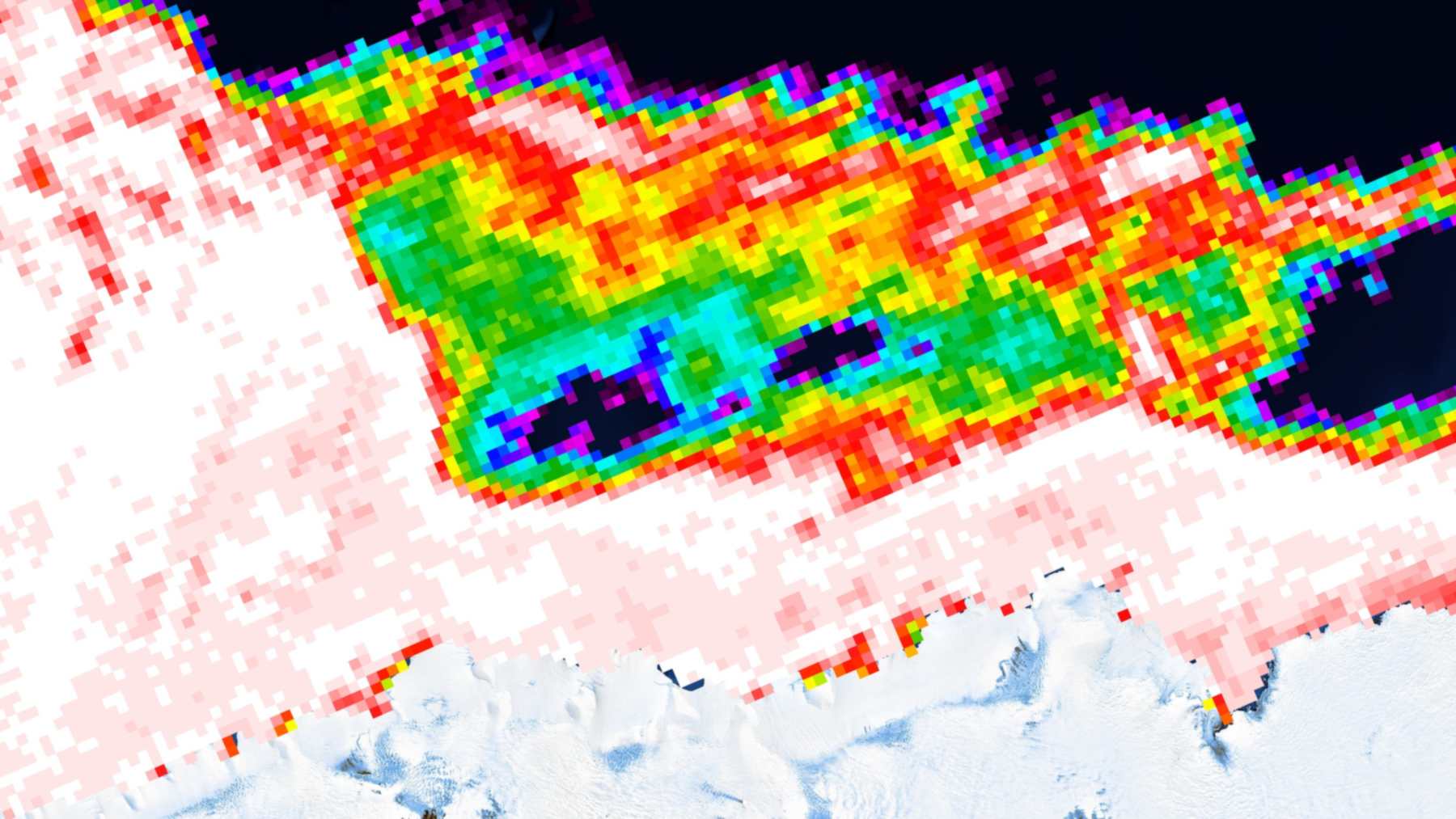
Around Chesapeake Bay, rising seas combine with land that is still sinking since the last ice age, NOAA says. Ocean levels keep climbing worldwide, with Antarctic ice adding to the rise. Many U.S. coastal wetlands are already falling behind.
Losing the trees means losing their grip on the land. Vanessa Bailey, an Earth scientist at Pacific Northwest National Laboratory and project co-lead, said: “Those root systems are really important for keeping soil from eroding.”
Tulip poplars took the hardest hit
American beech, red maple and tulip poplar dominate the plots. The team tracked sap flux, the speed at which water moves up a trunk. Sensors sat in six trees of each species per plot.
During the 2023 season, beech sap flux rose in both flooded plots. Red maples and tulip poplars slowed down. Tulip poplars in the saltwater plot had the steepest decline, twice as steep as in the freshwater plot.
Their leaves also turned brown about two months earlier than those of the other trees. “Detecting species-specific declines in sap flux after just our second year of flooding treatments was earlier than we anticipated,” Regier said.
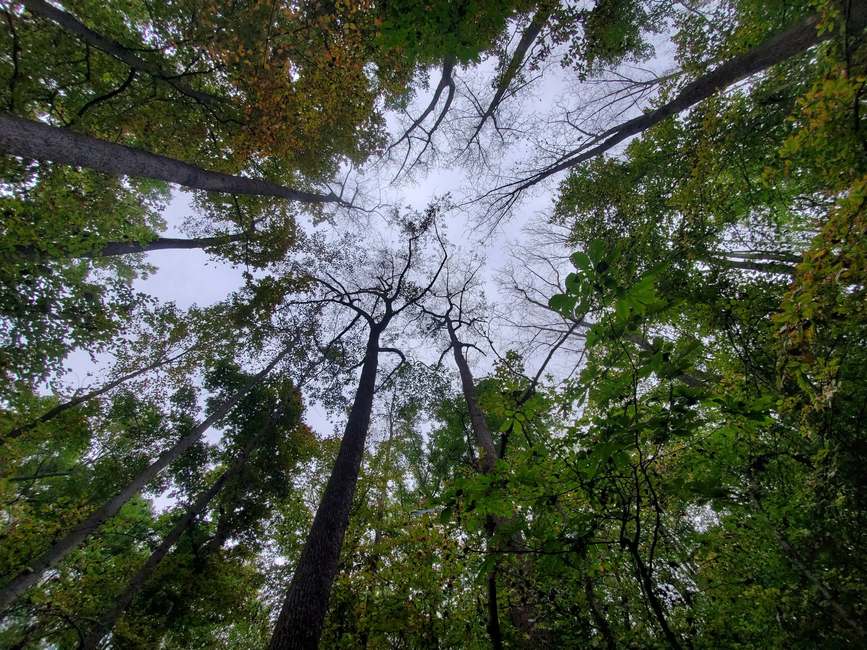
A follow-up study in Oecologia came out online on October 7, 2026, with five years of sap data from 2021 through 2025. Led by Radha Srinivasan of the University of California, Berkeley, it found that tulip poplar sap flux rose in every plot but was strongly held back by saltwater. Soil salinity was a key predictor of that drop.
Red maples showed no significant change, so a forest that looks healthy from a distance can hide very different stories, tree by tree.
One plot per treatment
Each treatment has a single plot, so the team compares before and after against the control. The Oecologia authors also measured sap in just 6 to 8 trees per species in each plot. Each plot holds roughly 150 to 200 trees.
Sap flux tracks a tree’s water use, but the authors warn it may or may not predict future deaths. TEMPEST is only about halfway through its planned decade. A third round of floods, in 2024, was left out of the PNAS analysis.
Even so, early warning signs could help land managers choose which stands to protect. They could also guide which trees go into restoration projects. The PNAS authors suggest tulip poplars could act as a sentinel species for salty floods in eastern North America.
Photo: Alice Stearns / Smithsonian Environmental Research Center