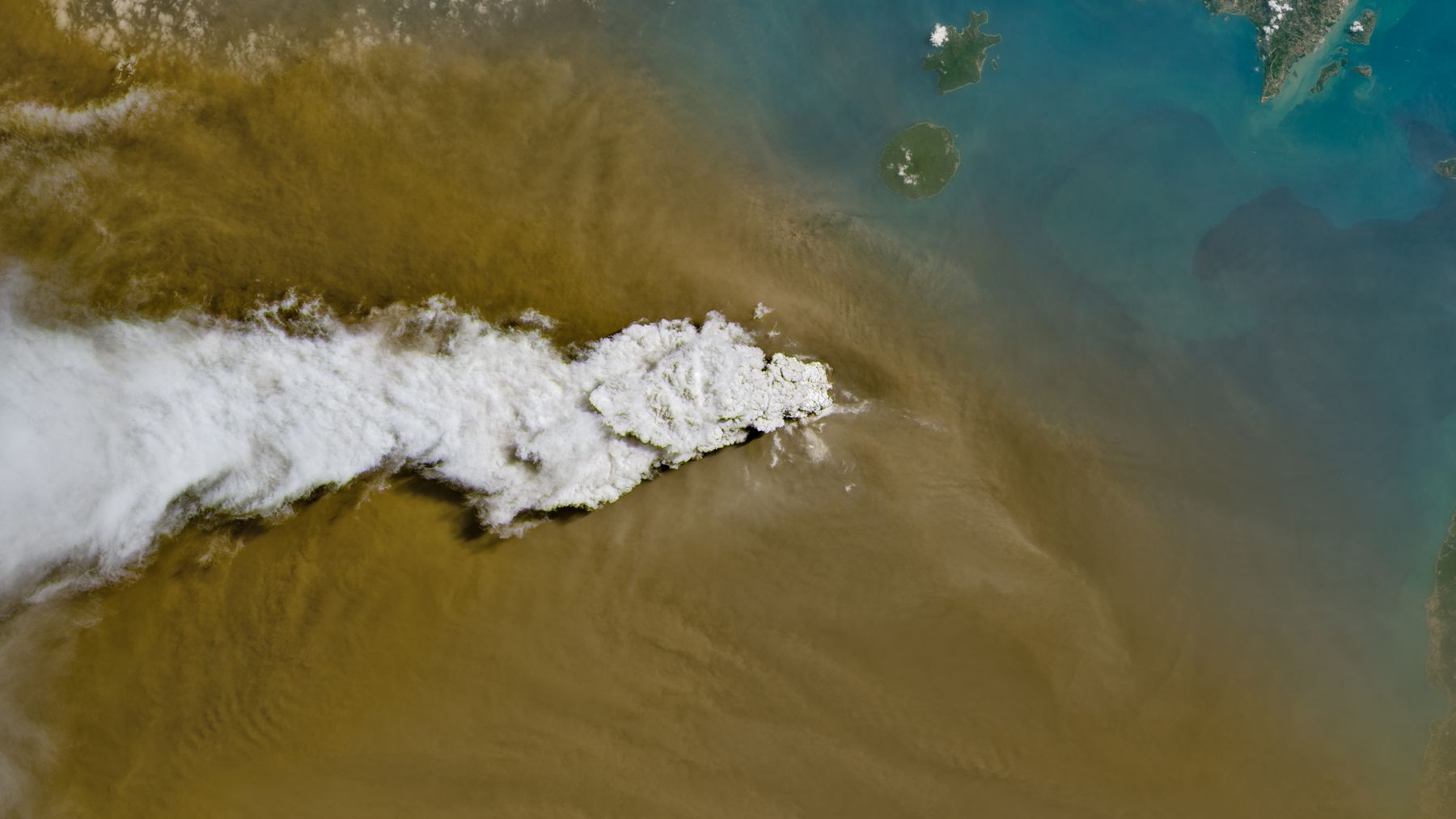
The Anak Krakatau eruption that began at 11:07 p.m. local time on Friday, September 4, 2026, ran without a break for about 25 hours, until 12:04 a.m. on Sunday, according to Indonesia’s volcano monitoring agency. Satellite images later showed that it had sent lava flows toward the northwest, west and southwest of the vent.
Ash reached up to 50,000 feet (15,000 meters) to the west by September 6, and nearly 3,000 flights in and out of the area were disrupted, NASA Earth Observatory reported, citing Indonesia’s meteorological agency and news reports.
A few days later, Agus Hikmat, a plant conservation expert and lecturer in the Department of Forest Resources Conservation and Ecotourism at IPB University’s Faculty of Forestry and Environment, explained what an eruption like this does to the island’s living things.
“A volcanic eruption will reset the existing ecosystem into a new ecosystem. The ecosystem in the Krakatau area responds in three phases, namely the destruction, colonization and stabilization phases of the ecosystem,” Hikmat said in an Indonesian-language statement released by IPB University on September 10. Quotes from Indonesian sources in this article are translated.
Twenty-five hours of eruption
Anak Krakatau, whose name means “child of Krakatau,” rose from the flooded caldera left by the 1883 eruption of Krakatau, the explosion that produced the loudest sound ever recorded.
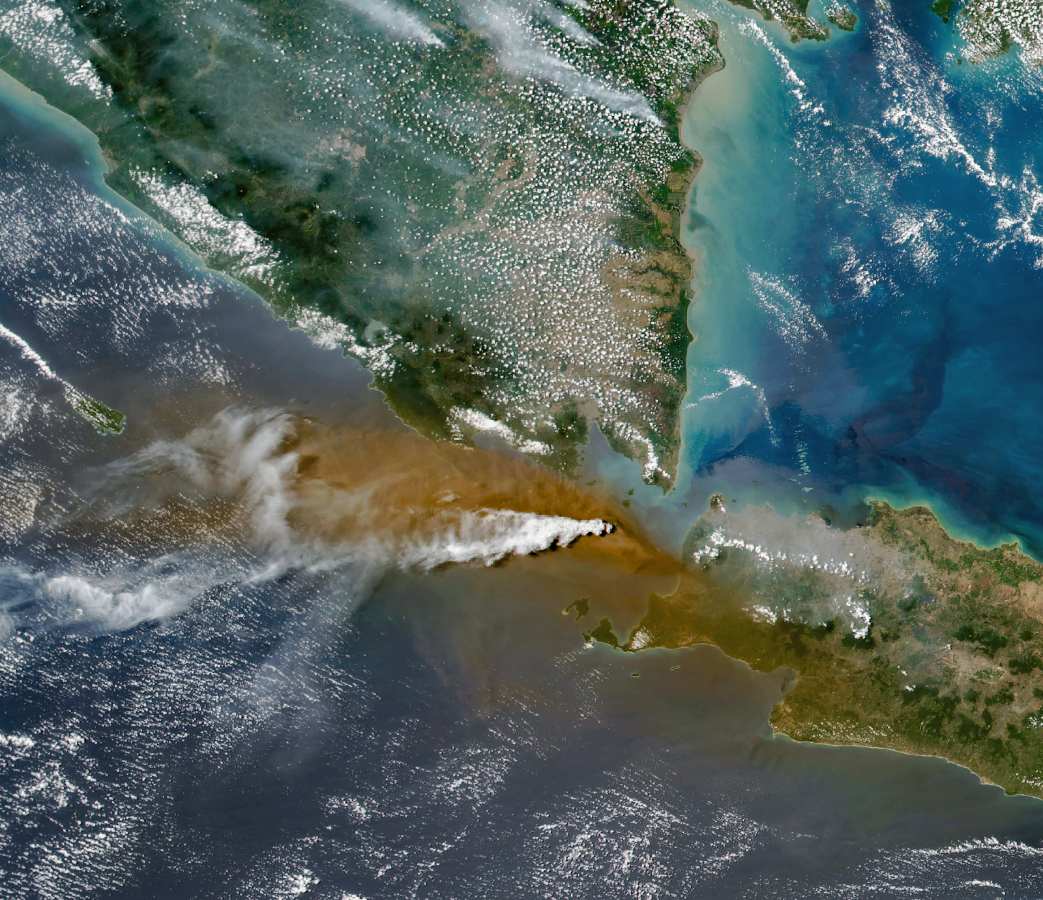
Indonesia’s Center for Volcanology and Geological Hazard Mitigation, known as PVMBG, had held the volcano at Level III, the second-highest of four alert levels, since July 2, after it detected more volcanic earthquakes and ground deformation. It recorded 224 eruptions between then and September 3.
“Based on our instrumental records, the continuous eruption earthquake episode began to be recorded on Friday, September 4, 2026 at 23.07 WIB and officially stopped on Sunday, September 6, 2026 at 00.04 WIB,” Siti Sumilah Rita Susilawati, the head of PVMBG, told a press conference on September 6.
One more Strombolian blast, lasting about 30 seconds, followed at 3:53 a.m. “We will continue to evaluate the activity level of Anak Krakatau periodically,” she said.
On September 21, the head of the Geological Agency, Lana Saria, announced that the alert had been lowered to Level II and the no-go zone cut from 1.9 miles (3 kilometers) to 1.2 miles (2 kilometers), according to a statement from the Ministry of Energy and Mineral Resources. It did not last. After a new run of eruptions, the agency raised Anak Krakatau back to Level III from 9 p.m. local time on October 9 and widened the exclusion zone to 3.1 miles (5 kilometers) from the eruption center.
Destruction, colonization and stabilization
In the destruction phase, Hikmat said, heat, volcanic ash, toxic gases such as sulfur dioxide and tsunamis can leave the vegetation badly damaged or dead.
“Wildlife is also affected, whether through death, fleeing, or being carried away by waves. However, some animals such as seabirds, bats and flying insects can survive and at the same time act as seed dispersal agents,” he said.
That process, he said, opens the door to primary succession, the term ecologists use for life building a community on new ground that has no soil. Once the surface of the island is covered with sand or volcanic rock, pioneer organisms such as microbes, mosses and fungi begin to appear.
As the ground and conditions change, grasses, bushes, shrubs and small trees can gradually grow and form a young forest. Researchers elsewhere have watched microbes appear just hours after an eruption.
“The process of primary succession can last for decades or even hundreds of years, depending on environmental conditions and the presence of seed dispersal agents,” Hikmat said.
Sand with almost no carbon
Indonesian soil scientists took samples from seven points on the island’s southeast slope in July 2018, and reported in the Jurnal Tanah Tropika that the soil was 98.82 to 99.59 percent sand, with 0.06 to 0.72 percent organic carbon.
In a 1989 paper in Ecological Monographs, Robert J. Whittaker and colleagues compared plant surveys across the Krakatau islands, which the 1883 eruption had sterilized. Their fieldwork took place in 1979, 1983 and 1984.
“On Anak Krakatau, volcanic action has prevented successful colonization away from accreting coastal deposits, and has several times eliminated the entire flora,” the authors wrote, adding that “the major source of propagules for Anak Krakatau is from within the group.”
Another reset came on December 22, 2018. A team led by Thomas R. Walter of the GFZ German Research Centre for Geosciences reported in Nature Communications that a flank collapse cut the island’s height from 1,050 to 390 feet (320 to 120 meters).
“This sector collapse decapitated the cone-shaped edifice and triggered a tsunami that caused 430 fatalities,” Walter and his colleagues wrote.
Ash on crops and the sea
Iskandar, a professor of soil science at IPB University, said on September 7 that ash covering leaves and stems blocks the stomata, the small pores plants use to exchange gases during photosynthesis.
“If the disturbance lasts for days or even weeks, the impact will be bad,” he said in an online interview. “Plants can fail in the flowering process and crops can fail.”
“At relatively close distances, volcanic ash is still quite hot and can cause physical damage. Plants wilt and eventually die,” Iskandar said, adding that rain releases nutrients from the ash “such as calcium (Ca), magnesium (Mg), potassium (K) and others.”
IPB oceanographer Agus Atmadippoera said that “volcanic ash that falls into marine waters does not automatically become a pollutant or poison for the ecosystem. It depends on its intensity and magnitude.”
His colleague Setyo Budi Susilo, of the Department of Marine Science and Technology, added that “the material contains a number of micronutrients, including silica and iron,” which, once stirred by currents, waves and tides, can enrich marine ecosystems.
Caves, cliffs and two small islands
Eruptions also create new habitat, Hikmat said. Lava that cools becomes volcanic rock, which “through weathering can develop into mineral-rich soil,” and lava caves, craters and new cliffs “can become niches for bats, birds, lizards and other organisms,” according to the IPB statement.
On October 2, Susilawati told AFP that “based on an evaluation of Sentinel satellite imagery, two formations resembling small islands can be seen around Mount Anak Krakatau,” one about 2,500 feet (760 meters) to the northwest and the other about 1,620 feet (495 meters) to the southwest. In its October 9 safety recommendations, the Geological Agency placed the new islands in the volcano’s northwest and southeast sectors.
Susilawati said it was too early to call them “children” of Anak Krakatau. In the case of Anak Krakatau itself, she told the agency, several landmasses briefly emerged starting in 1927 and then disappeared due to erosion before an enduring island formed in 1930. Scientists are asking the same kind of question about a possible new island in the Bismarck Sea.
“When an eruption occurs, many animals die from direct exposure to hot lahars and volcanic dust, causing the population to decline significantly,” said Abdul Haris Mustari, a wildlife expert in the same IPB department as Hikmat.
Mustari pointed to the banteng, a wild cattle species, which vanished from the Pananjung Pangandaran Nature Reserve partly because the 1982 eruption of Mount Galunggung buried the grasslands it fed on. He said it can take about 25 to 30 years of regrowth before a forest supports more diverse animal communities.
Experts ask people to let it recover
Because Anak Krakatau is a nature reserve and still volcanically active, Hikmat called for keeping out invasive species, not introducing plants from outside, and monitoring eruptions, tsunamis, vegetation and wildlife over the long term.
“Krakatau is a natural laboratory for the process of primary succession. The task of conservation is not to return nature to what it was, but to protect the natural succession process so that it runs well,” he said.
Limits of what is known so far
The IPB experts spoke about succession and ash in general terms, and their statements do not report new measurements from the island after the 2026 eruption. The soil figures come from samples taken in July 2018, and Whittaker’s plant data from fieldwork in 1979, 1983 and 1984.
Under the current Level III, residents, visitors, tourists and climbers are not allowed to enter or carry out activities within 3.1 miles (5 kilometers) of the eruption center, or within 0.6 miles (1 kilometer) of the new islands in the volcano’s northwest and southeast sectors, according to the Geological Agency’s activity reports on MAGMA Indonesia.
The expert explanation of primary succession at Anak Krakatau was published by IPB University on September 10, 2026.
Monitoring data and recommendations for the volcano are posted by Indonesia’s Geological Agency through its MAGMA Indonesia service.
Image: NASA Earth Observatory/Michala Garrison, using Landsat data from the U.S. Geological Survey