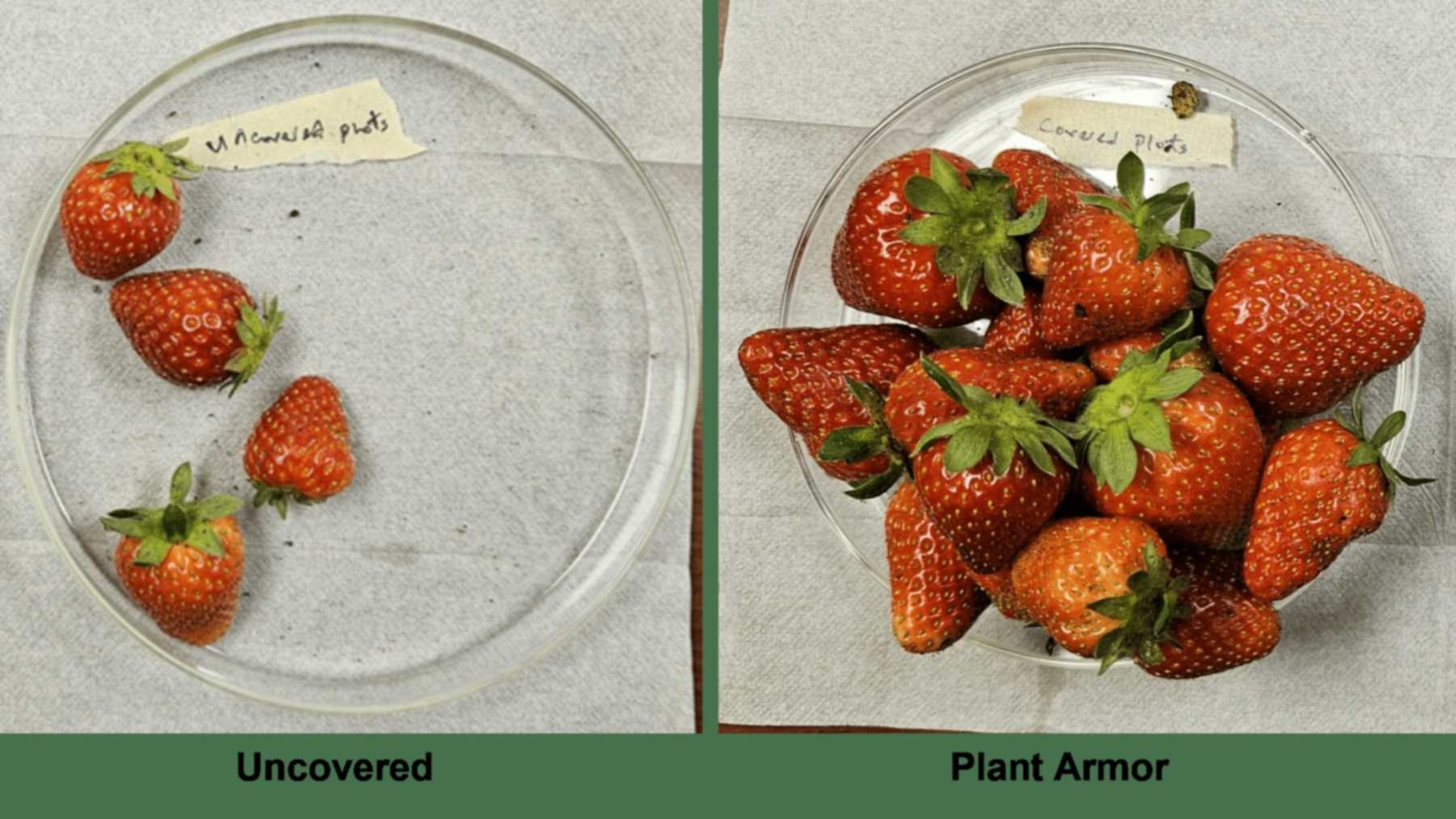
Every other morning in the spring of 2025, researchers at North Carolina State University picked ripe strawberries by hand from three raised beds in Raleigh, where half of the plants had spent the winter under a knitted textile called the Plant Armor fabric. By mid-May the covered plants had produced an estimated 3.56 times as many berries as the uncovered ones, and their total fruit weight was 1.84 times higher.
“Then, through trial and error, we arrive at a product which could triple the output of strawberry farms here in North Carolina,” said R. Michael Roe, a William Neal Reynolds Distinguished Professor at NC State and a co-author of the study, which was led by graduate research assistant Gabriel Olawuyi and published September 25 in the journal Agriculture.
Growers already know what covers can do
“Each time it appeared that the more times that the row cover was applied, the more yield we actually had with the exception of Sweet Charlie,” Edgar Vinson, then an Auburn University Extension specialist, told Specialty Crop Grower in 2020 about row cover trials he ran in Alabama.
Sweet Charlie, the early variety in Vinson’s comment, is the same one the NC State team planted. “Sweet Charlie increased with the fall cover but seemed to fall off with the fall/winter application. I think that’s probably because Sweet Charlie is an early variety. It begins to really sputter around three weeks. It’s a really a great tasting berry, early berry. A lot of people have it in their operations because it’s so early and get on the market early. But you really can’t expect much out of that after three weeks,” Vinson said.
Barclay Poling, a retired NC State Extension horticulture specialist, put the case for covers to Farm Progress in 2011. “A floating row cover of 1.5 ounce-per-square-yard weight can do the same job as overhead sprinkler irrigation for frost protection,” he said, and “Farmers with relatively limited water supplies can now grow strawberries in the plasticulture system and achieve full crops in most seasons using the covers.”
A thicker fabric and a worry about light
Ordinary row covers are thin sheets, and “they are most commonly made of polypropylene or polyester,” Victor Lilley, a vice president at Reddick Fumigants, told Farm Progress in the same 2011 story, adding that “such covers can improve earliness, yield and quality” but warning that “covers that block more than 50 percent of available light can actually slow growth and advancement of one’s strawberry crop.”
Plant Armor is a three-dimensional polyester knit with several layers, sewn over hoops about 3.3 feet (1 meter) tall and left over 12 of the trial’s 24 Sweet Charlie plants from fall to spring, so Olawuyi expected it to cut the light, as Lilley warned heavy covers do, and push the plants toward leaves instead of fruit.
“To produce fruit, plants need sunlight,” Olawuyi said in an NC State news release. “However, we found the fabric did not impede access to light at all, and fruit production increased significantly.”
When the plants were dug up and weighed, the covered ones had no extra leafy growth, and the authors write that “for strawberries, PA Gen 2 did not cause vegetative ‘stretching.'”
Warmer air and an earlier first picking
Under the fabric the air ran about 3.5 °F (1.93 °C) warmer on average than in the open halves, with no change in humidity, and the covered plants were ready to pick about a week sooner.
“Plants require a certain amount of accumulated heat, calculated as ‘growing degree-days,’ to progress through developmental stages including fruiting. Our plant cover has proven to enhance these,” Olawuyi said. “The plants were in a condition whereby the warmth they need to go through each phenological stage to their production was given to them optimally, and they produced far more than the uncovered plants.”
Earlier growth carries its own risk, as Vinson pointed out in Alabama. “Buds are dormant and as long as that tissue is not quite as susceptible as a plant that’s developing and about to bloom,” he said in 2020. “The more the flowers progress, the more they are susceptible to cold damage.”
Farms elsewhere are trying other overhead covers too, from berries grown beneath solar panels in Colorado to tomatoes under solar modules in a Swiss greenhouse.
A maze for insects
Roe explained the idea behind the fabric in 2022, when the team was testing it against tobacco thrips on cabbage. “To exclude insects that are really small using traditional textile cover designs, the size of the openings would have to be so small that it would also prevent water, air and moisture from penetrating,” he said in a 2022 NC State release.
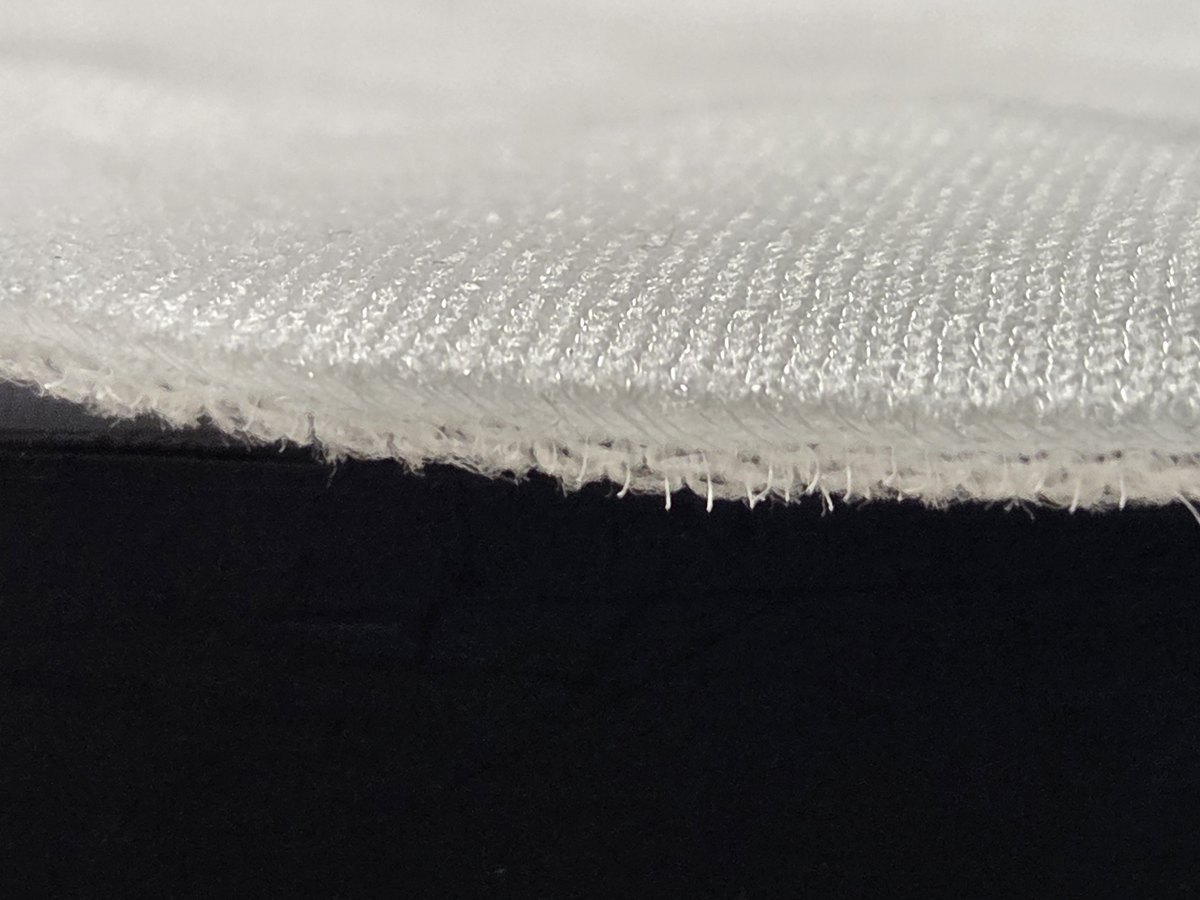
“With our design, the insect has to figure out how to get through the maze to get to the plant on the other side,” Roe said then. “The tortuosity makes it more challenging to get through. The insect has a certain amount of time to find food or it will die. That time is relatively fast for a young insect.”
“Thrips are extremely tiny,” said Grayson Cave, then a doctoral candidate and first author of the cabbage study. “If we could keep them out, we think we have a good chance of keeping other, larger insects out.”
When the NC State team put young aphids on top of the fabric with a strawberry leaf below, none of them made it through in three hours, though they did get past an ordinary fly screen. “In real life, the insect has a lot of other choices of where to go to find food; this was a worst-case scenario where they had only one place to go,” Roe said of the earlier tests in 2022.
Aphids still got in
Out in the beds, aphids showed up in March 2025 on covered and uncovered plants alike, both halves were sprayed once with insecticidal soap, and the authors think the insects may have come in on the transplants, “possibly as overwintering eggs,” or slipped in “when the fabric was raised to take the temperature and humidity data.”
Growers who leave ordinary freeze covers on for long stretches see something similar, which is why NC State Extension told them in February 2026 that “the warm, protected environment under the covers can favor pest buildup, and it is common to see an increase in winged aphids once the covers are removed.”
Nobody can promise perfectly clean transplants either, as Mark Hoffmann, an NC State associate professor and small fruits Extension specialist, told Specialty Crop Grower this October while discussing a fungal disease that travels on nursery plants. “That’s a big statement to make that I have clean plants, right?” he said. “Making sure that you actually have clean plant material is extremely challenging, right? Because you don’t know.”
From body armor to strawberry beds
“The path to Plant Armor started with trying to make a cloth to go on a soldier’s chest to make body armor more comfortable,” Roe said this September. “We couldn’t have predicted that when we started,” he added. “Without all these people here doing research and following the science, we wouldn’t have arrived at this product.”
What growers would want from it is a physical barrier that replaces some chemical sprays, the same goal behind laser machines being tested in Germany to cut pesticide use.
What the trial cannot show yet
“When you have those row covers on, bees can’t get under there to do their job and pollinate,” Nash County grower Sue Leggett told NC State’s College of Agriculture and Life Sciences in 2019, and the new paper does not say how the flowers under the fabric were pollinated. “Strawberries are such a high-value crop that decisions and small anomalies in the weather make a huge difference,” she said.
Water is another open question. Poling said an irrigation pond for frost protection “would need to hold about 150,000 gallons of water for each acre of plasticulture production under these conditions,” adding, “That’s a lot of water.” The Plant Armor paper says the fabric lets rain through, but it did not measure water use, and both halves were watered by hose on the same schedule.
The trial used 24 plants at one site over one season, and NC State, which has patented the fabric and licensed it for commercial development, disclosed in 2022 that Roe is among the inventors on a related patent.
“On-farm testing is now needed to examine the utility of this new textile for a variety of crop plants in different geographical locations,” the authors write.
The full study was published in Agriculture.
NC State announced the results in a news release on September 29, 2026.
Photo: Gabriel Olawuyi / NC State