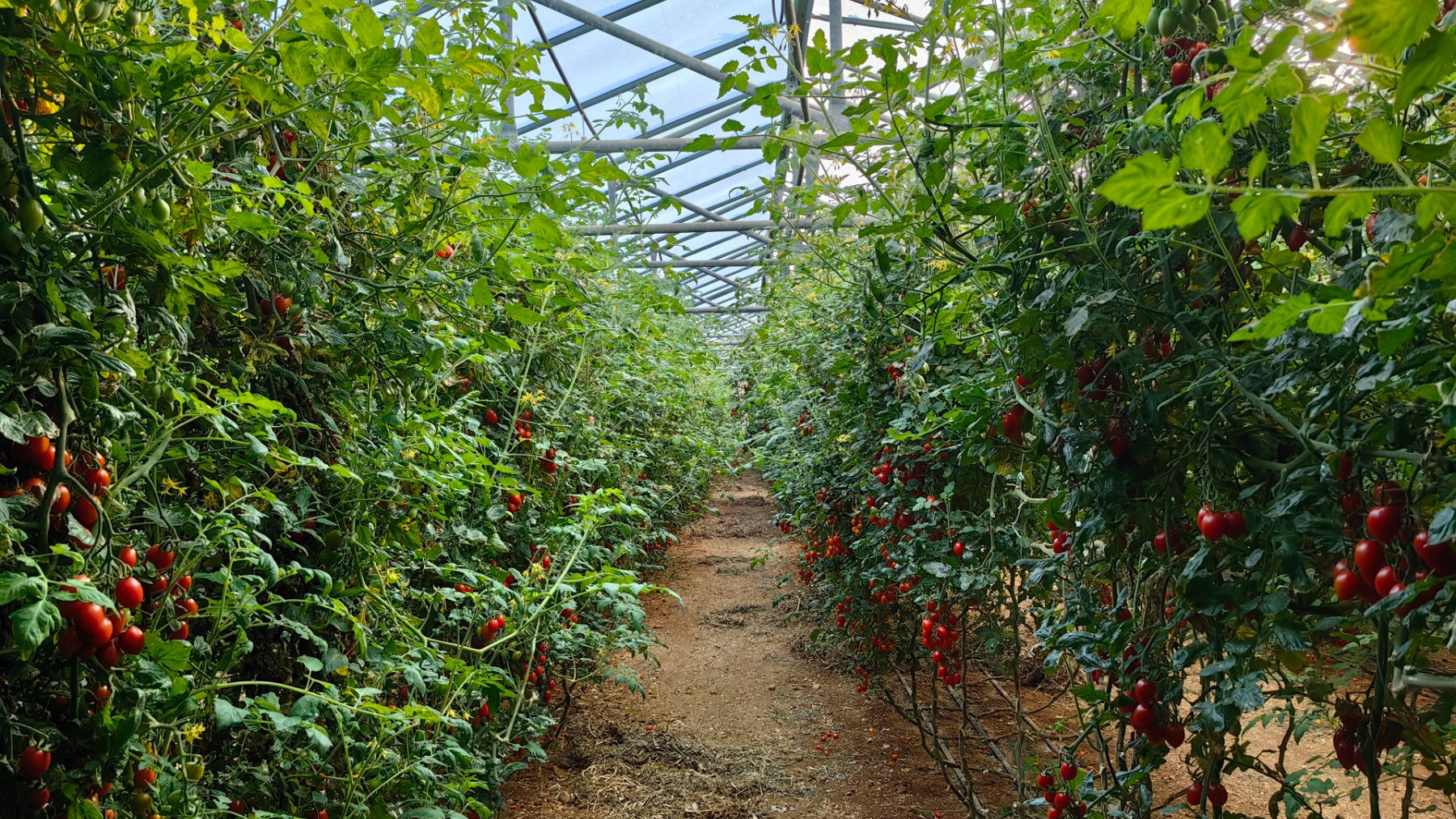
Putting solar equipment above tomatoes sounds like a recipe for a smaller harvest. But at Meier Gemüse in Rütihof, Switzerland, 1,736 Voltiris modules were installed in a working greenhouse in 2025 without interrupting production.
According to results presented by Voltiris that October, the system produced up to 1 megawatt-hour of electricity per day, reduced summer grid electricity use by about 35%, and delivered a 1% yield increase against a reference compartment. The bigger story is not extra tomatoes, but electricity without a reported crop penalty.
A mirror that gives sunlight two jobs
How can crops and solar cells share the same sunshine? Voltiris uses spectral filtering, which separates light by wavelength, allowing photosynthetically active radiation (PAR) through to the plants while redirecting near-infrared radiation toward electricity-generating cells. PAR is the light used for photosynthesis, the process plants rely on to make sugars that support growth.
The filter was developed with 3M, and its curved reflector concentrates the redirected light onto a small solar cell. That arrangement limits the area occupied by opaque photovoltaic material, helping reduce crop shading. Dual-axis tracking also moves the modules to follow the sun throughout the day.
Cooler leaves and a more comfortable harvest
Leaf temperatures averaged 3°C (5.4°F) lower during sunny periods. The crop spent 74% of the time within the reported optimal range of 20–25°C (68–77°F), compared with 57% in the reference section. These are plant measurements, not a claim that the entire greenhouse air temperature dropped by the same amount.
The difference reached the people picking the fruit, too. Voltiris reported that harvesting teams preferred working beneath the modules during the hottest summer hours because those rows felt cooler.
Four weeks without stopping production
The installation took four weeks, with the equipment fitted inside the existing greenhouse rather than replacing its glass roof. This was a commercial growing operation, not an empty building waiting for its first plants, making the uninterrupted installation an important part of the demonstration.
Owner Ruedi Meier described the wider ambition by saying that “tomato and energy production do not have to compete.” His farm’s experience suggests why growers might be interested in that combination, provided electricity production does not undermine the crop that pays the bills.
What the electricity numbers actually mean
A megawatt-hour equals 1,000 kilowatt-hours, but “up to” matters here. The reported daily figure is not a year-round average and cannot simply be multiplied by 365 to establish annual production. Similarly, using less grid electricity does not by itself establish an equivalent percentage reduction in the total electric bill.
The 35% figure concerns summer grid electricity, not all the energy the business uses over a full year. It should not be read as a measured 35% reduction in the farm’s total carbon footprint.
Voltiris markets an “Energy-as-a-Service” arrangement under which growers pay for the electricity they use, with minimal upfront investment and maintenance included. For anyone considering the system, the useful comparison would be the contract price against avoided grid purchases over time. The public project summaries do not provide enough pricing detail to calculate that return.
Strawberries are the next commercial test
On May 20, 2026, Voltiris announced a project with Dutch strawberry grower Genson Group involving nearly 2,000 modules over one hectare. Its stated output target of 25 kilowatt-hours per square meter annually translates to about 250 megawatt-hours across that area. Those are projected figures, not reported annual results from the new installation.
The announcement cited earlier trials at Delphy IC and Proefcentrum Hoogstraten that increased premium strawberry yield by up to 26%, a different measure from total tomato yield. It scheduled the Genson system to become operational in September 2026. That timetable is not, by itself, confirmation that commissioning has been completed.
Promising results still need longer testing
Voltiris’s October summary does not establish whether the 1% yield difference was statistically significant. Its commercial comparison supports a cautious reading of stable production, not a promise of higher harvests everywhere. Longer-term costs and performance still need scrutiny.
More monitoring is now being reported. In a September 1, 2026 update, Voltiris said Sigrow cameras recorded average leaf-temperature reductions of 3–5°C on sunny summer days at several locations, with peak reductions reaching 7°C. Those measurements add evidence about cooling, although they do not settle the full economic case.
For growers, the practical test is whether the system can keep producing useful electricity while protecting crop income over many seasons.
The latest official company update was published on Voltiris.