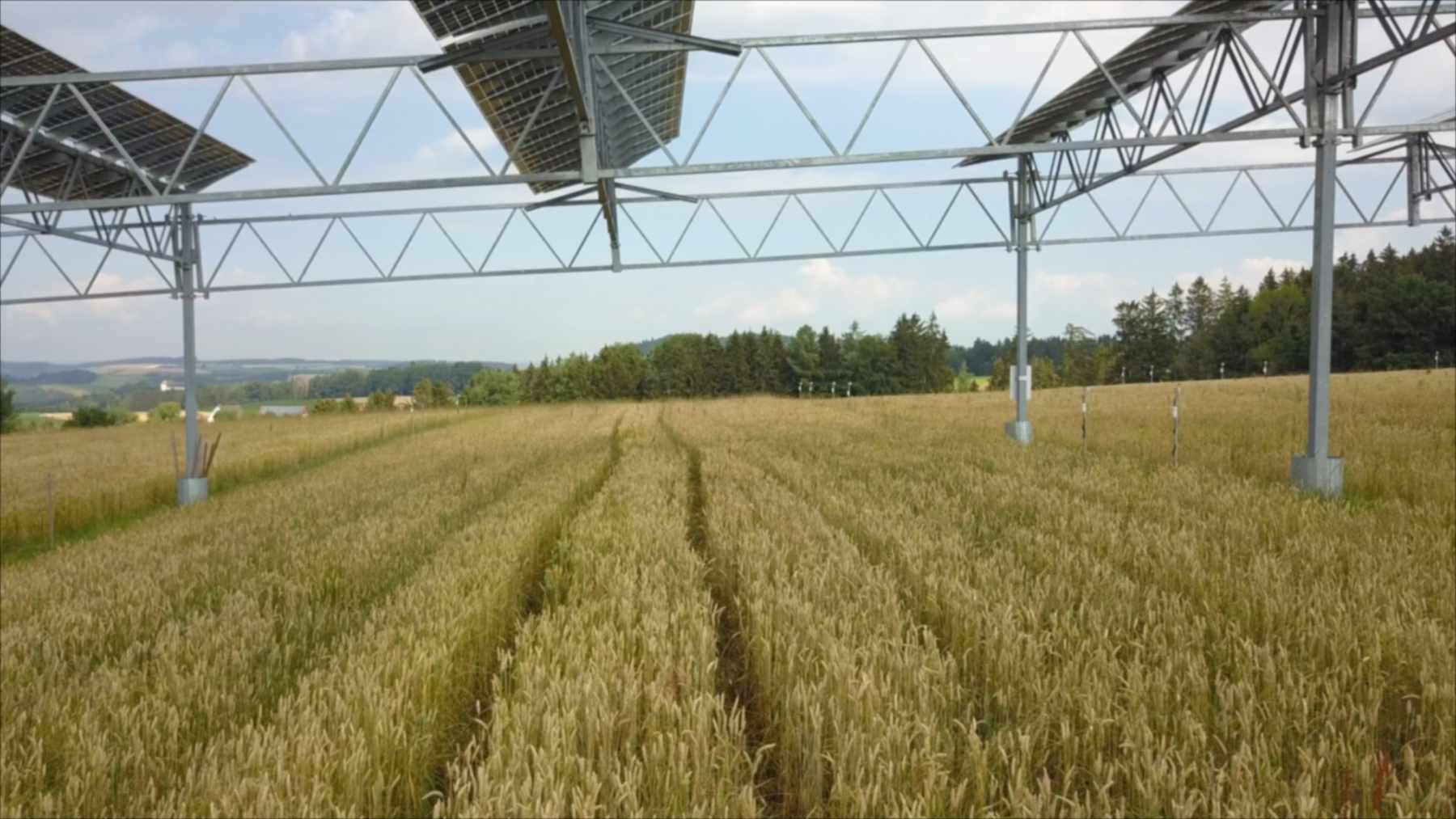
At Joe Czajkowski Farm in Hadley, Massachusetts, sweet corn is growing beneath a canopy of solar panels. Czajkowski told the Daily Hampshire Gazette that the shaded crop produces about 80% of the yield of nearby open fields, with comparable quality.
The same 2.2 acres also host a solar installation rated at 445 kilowatts of direct-current capacity. That combination makes the farm a useful example of “agrivoltaics,” where food production and solar generation share land, while raising a practical question about how much crop loss the added income can justify.
Room for crops and tractors
Hyperion Systems completed construction of the 832-panel array in July 2023, according to the U.S. Department of Energy. A UMass research report places the panels 10 feet above the ground when horizontal, leaving space beneath the structure for farming.
The rows are spaced 26 feet apart from post to post, and the panels rotate on trackers to follow the sun. Equipment supplier SMA America says tractors can pass between rows for routine fieldwork, showing why equipment access matters as much as panel placement.
The 445-kilowatt figure describes the installation’s rated capacity. It does not mean the array delivers that output continuously, and it should not be confused with kilowatt-hours, the measure of energy that appears on an electric bill.
What the corn harvest actually tells us
“It’s worked really well for us,” Czajkowski told the Gazette. His 80% estimate is an observation from this farm, and the newspaper report does not present it as the result of a controlled corn experiment.
The implied reduction of about 20% deserves attention because those missing ears still represent food and potential sales. Broccoli, lettuce, and cilantro have also grown beneath the panels, and Czajkowski said asparagus was next on his list, but the report gives no comparable yield figures for those crops.
For other growers, the useful question is whether the combined returns from farming and solar improve the business after costs. The corn estimate alone cannot answer that, even if it shows that a substantial harvest can continue beneath this particular array.
Shade changes the growing conditions
Dwayne Breger, director of UMass Amherst’s Clean Energy Extension, studies how agrivoltaic installations affect farmland. In an August 25, 2026, university news post, UMass explained that panels can create a local microclimate, changing temperatures and potentially influencing crop choices and harvesting practices.
That makes shade something farmers need to measure and manage. The Energy Department identifies reduced irrigation needs and improved yields in some hot or dry settings as potential benefits, but its guidance stresses that designs must fit the land and the farming operation.
An early UMass experiment at the Hadley site examined broccoli in 2023, when the panels remained horizontal and were not yet connected to the grid. Those conditions matter when comparing research findings with later harvests under a working tracking system.
Another income stream for the farm
Hyperion’s Jake Marley told the Gazette that the project brings lease payments and a roughly 15% reduction in electric bills. The farm also uses solar electricity to charge a van that delivers produce to UMass Amherst.
For Czajkowski, the appeal extends beyond the next electricity bill. In the Energy Department’s account of the project, he described solar income as a way to strengthen his finances as he gets older and help pass the farm to the next generation.
Massachusetts ties support to continued farming
Massachusetts’ SMART 3.0 program lists a 2026 allocation of 600 megawatts of alternating-current capacity for projects subject to its cap. It also offers qualifying dual-use agricultural projects an additional payment of 9 cents per kilowatt-hour, separate from the base compensation rate.
Eligibility requires more than placing panels on a field. The state’s application form requires a farm plan that accounts for shading and maintains productive agriculture, along with annual reports on agricultural production and changes to that plan.
The design has to work at ground level
There are costs to leaving room for crops. The Energy Department’s farmer guide explains that raising panels can require more structural steel, while wider spacing reduces the electricity that can be generated on a given area of land.
The Hadley experience suggests that continued harvests and solar income can make those compromises worthwhile for some farms, provided the design supports their daily work.
The university’s official update was published on August 25, 2026, on the UMass Amherst website.