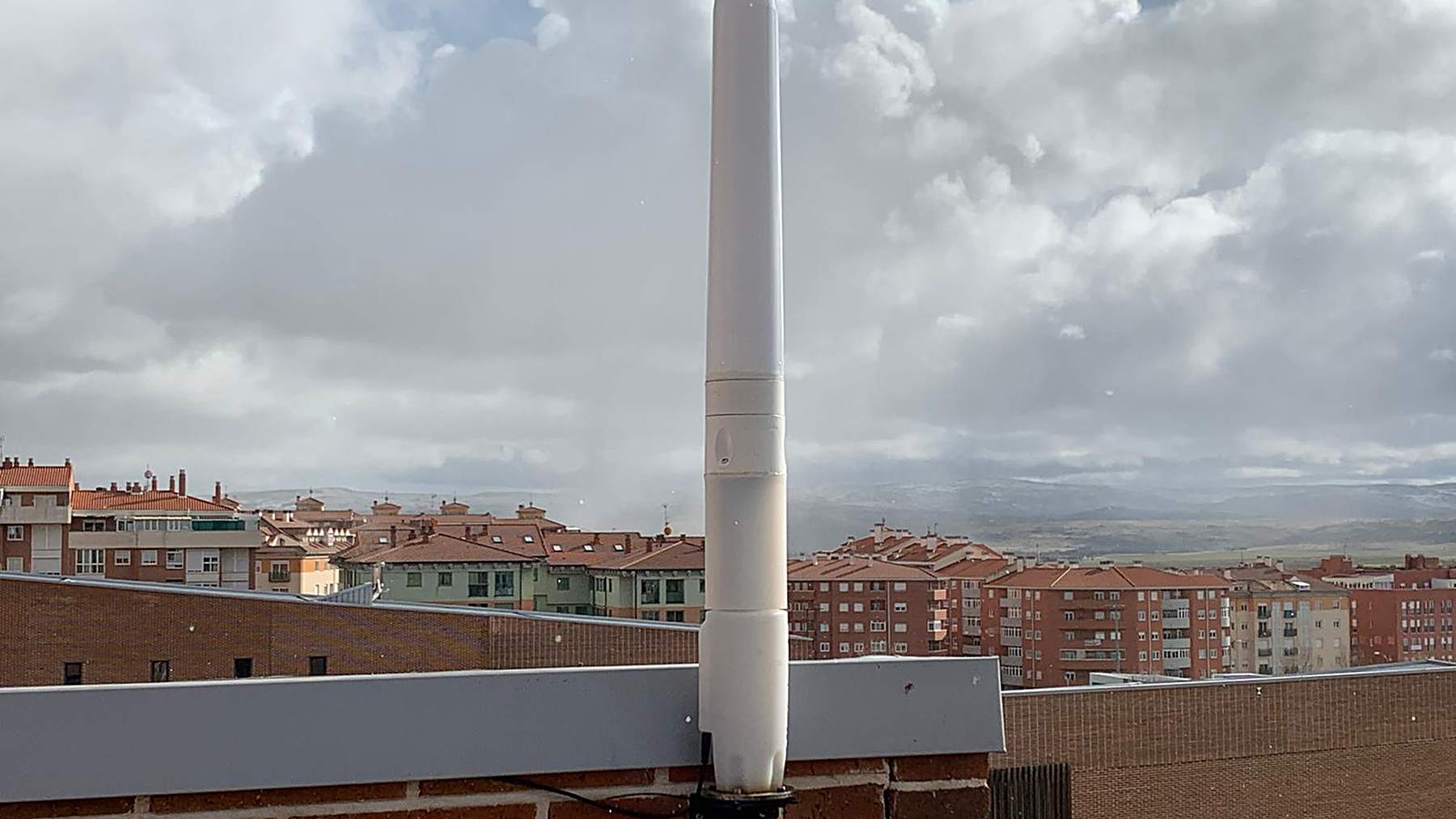
Computer simulations from the University of Glasgow suggest that a bladeless wind turbine with a mast just 31.5 inches (0.8 meters) long could safely produce 460 watts. The engineers work at the university’s James Watt School of Engineering, and their study appeared in the journal Renewable Energy in June 2025.
The university says real prototypes built so far have topped out at about 100 watts. Glasgow’s 460 watts is modeled mechanical power, though. The study never wired its mast to a generator, let alone a house.
Nylon rod, hollow mast
Master’s student Janis Breen wrote the paper with corresponding authors Wrik Mallik and Sondipon Adhikari, and the announcement says they ran thousands of design variations. In the paper’s diagram, a rigid hollow mast sits on top of a flexible rod clamped at the ground.
In the version they recommend, the mast measures 25.6 inches (0.65 meters) across. The rod underneath is 9.8 inches (0.25 meters) long and about 3.9 inches thick. The paper models it in nylon.
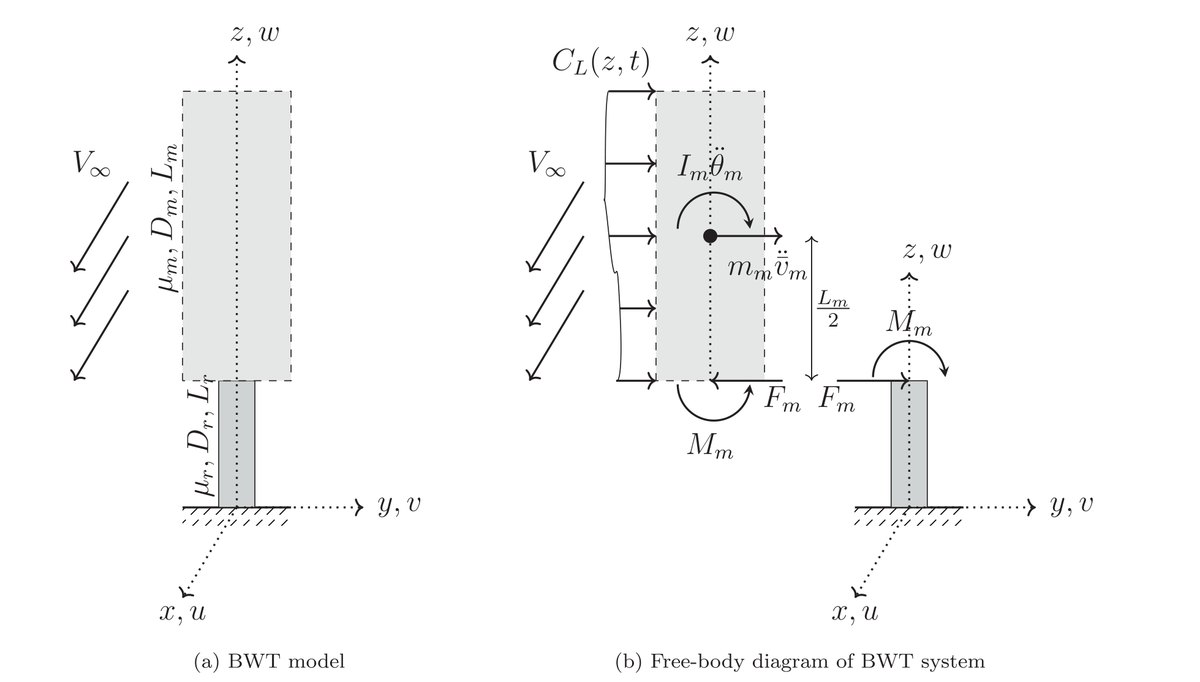
According to the university’s announcement, the simulations covered winds between 20 and 70 miles per hour. In the paper, mast diameters run from about 9.8 to 29.5 inches and lengths from 31.5 to 63 inches.
Swirling air rocks the cylinder
Instead of spinning, these machines rely on vortex-induced vibration. The university compares the masts to lampposts swaying in bad weather. As wind blows against a mast, it creates alternating swirls of air, first on one side and then the other, and those rock the whole structure back and forth.
If the rocking hits the mast’s own natural frequency, the motion is “amplified significantly,” the announcement says. Engineers call that lock-in, and only inside it does a pole that vibrates in the wind produce significant power.
Commercial efforts using this effect have so far worked at small scales, between 1 and 100 watts, the authors write. Spanish company Vortex Bladeless has tested masts of this kind in the field.
The 600-watt version would fail
Some shapes in the simulations beat 460 watts. A mast 31.5 inches long and about 29.5 inches wide pulled more than 600 watts from the wind. Yet the stress at the base of its rod went beyond the yield strength of nylon, which the paper puts at 40 to 60 megapascals.
When the team ranked designs by efficiency instead, the longest masts came out on top. They captured the largest share of the wind’s energy, peaking at 6 percent, but still produced less power overall.
Speaking in the university’s announcement, Mallik said that “the structure with the highest efficiency for extracting energy is not in fact the structure which gives the highest power output.” The authors concluded that a narrower mast is the safer path, since at 25.6 inches the rod stays under the 60-megapascal threshold.
Watts are not kilowatt-hours
In the paper, the authors say they “will only focus on the mechanical power output.” They assume electrical output rises in step with it. No generator, wiring or conversion losses appear in the model.
The 460 watts is also the maximum the model found during lock-in, which happens only within a band of wind speeds. Picture a device delivering that much electricity around the clock. A 30-day month would add up to about 331 kilowatt-hours, and no wind machine runs flat out all the time.
The Energy Department’s Small Wind Guidebook offers a benchmark. A 1.5-kilowatt turbine can meet the needs of a home using 300 kilowatt-hours a month at a site averaging 14 mph. The guidebook treats annual energy output as the best yardstick, and that number does not exist yet for this design.
Rooftops amplify the shaking problem
Mallik sees cities as the natural home for these devices. In the announcement, he said they “are quieter than wind turbines, take up less space, pose less of a threat to wildlife, and have fewer moving parts.”
With no rotor, there are no blades for birds to fly into. The Glasgow study did not look at seabird collisions or wildlife behavior, however.
On buildings, the Energy Department flags a separate issue. Its guidebook warns that all wind turbines pass their vibration into whatever they are mounted on, which can cause noise indoors. Turbulent air on rooftops can also shorten a turbine’s life and cut production.
A bladeless mast is designed to sway as much as it safely can, so that warning hits it harder. Like other small wind turbine designs, it would need to prove itself on a real site first.
Gusts and turbine rows stay unmodeled
Because the model assumes a steady wind, real gusts are missing from it. The authors list atmospheric turbulence and changing wind conditions as next steps. They also want to study how closely turbines can be spaced and to run larger experiments that check the predictions.
Adhikari said the group hopes the work “will help spur industry to develop new prototypes.” The team also plans to test metamaterials, which are engineered to have properties not found in nature. It sees the method as a basis for machines of 1 kilowatt and beyond.
The full study was published in Renewable Energy.
Photo: Vortex Bladeless