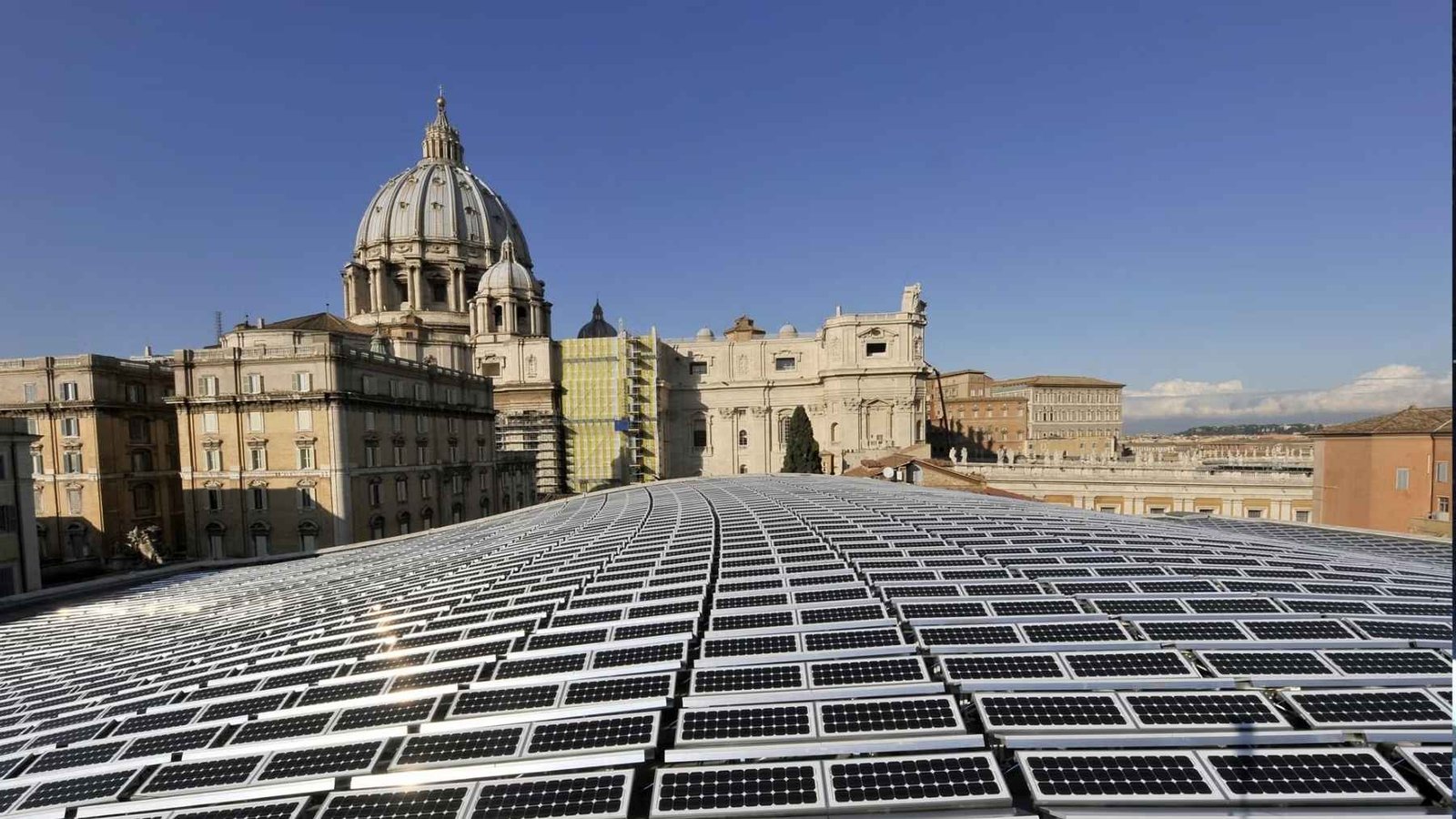
The Vatican already has 2,400 solar panels on the roof of the Paul VI Audience Hall, but now it is getting ready for an enormous agrivoltaic project in Santa Maria di Galería (a place near Rome). This area is nearly 10 times bigger than the Vatican City itself!
Although the plan is to stimulate the ecologic transition, covering all the electric consumption of the Vatican City State, construction has not started yet. Also, all this project required an international agreement between Italy and the Holy See because the energy produced will cross a sovereign border.
A solar site bigger than Vatican City
Where the plant will be built is in Santa Maria di Galeria, covering 424 hectares and Vatican Radio has transmitted from the property since 1957. They even say that their shortwave antennas still send programming to Africa, Asia and the Americas.
So, the electricity produced on Holy See Land and delivered into Italy’s electrical grid crosses a border, which means that the process will never be the one of an owner calling a local solar installer.
Why one solar farm needed an international agreement
The two states signed their agreement on July 31, 2025. It entered into force on May 27, 2026, providing the legal framework to build the plant and connect it to the Italian electricity system. In the case of Italy, the agreement was ratified through Law No. 52 of April 1, 2026.
On August 4, the commission held its inaugural meeting at Palazzo Chigi to discuss this project. The Italian delegation included many officials, from energy regulator ARERA to grid operator Terna, and in the case of the Vatican, representatives included the Governorate, APSA, and the Gendarmerie.
Pope Leo XIV created a foundation to run it
Pope Francis set the plan in motion with the 2024 apostolic letter Fratello Sole, calling for an agrivoltaic plant able to power the radio station and provide the “complete energy sustenance” of Vatican City State. It was finally on June 1, 2026, that Pope Leo XIV established the Fratello Sole Foundation to turn that previous instruction into an operating project. That was seen as a big honor to commemorate Pope Francis.
This will not be just a symbolic environmental office, since it has given a role in the production, distribution, selling, supply, and monitoring of electricity, with Sister Raffaella Petrini serving as president and Archbishop Giordano Piccinotti as vice president for the first three years.
But that is not all…On June 10, the Governorate, APSA, and Acea signed a memorandum to develop the project gradually and progressively. Acea’s role is huge, since it has experience in energy, water and agriculture, which is very important because the installation needs to work as a power facility and as productive farmland.
Agrivoltaics keeps farming beneath the panels
Agrivoltaics means the land is not supposed to stop producing food when the panels arrive there. THe solar modules can be raised up or spaced out so that the crops or the grazing continue below, and the agreement requires that the agricultural use be preserved while environmental impacts are minimized.
This can seem to be simple, but actually crops do not always respond in the same way to shade. In hot summers, some plants can benefit from cooler conditions and lower evaporation, while others can lose their capacity if they do not have enough solar light.
The numbers are large, but they are not yet official
Recent reporting based on unnamed sources says that the projects will cost around €100 million, with a capacity of 80 to 90 megawatts and panels covering about 200 hectares.
I think that the real test will come later when the procurement, permitting and final engineering are completed. Until the contracts are awarded, the solar future of the Vatican remains a legal framework instead of a finished power plant.