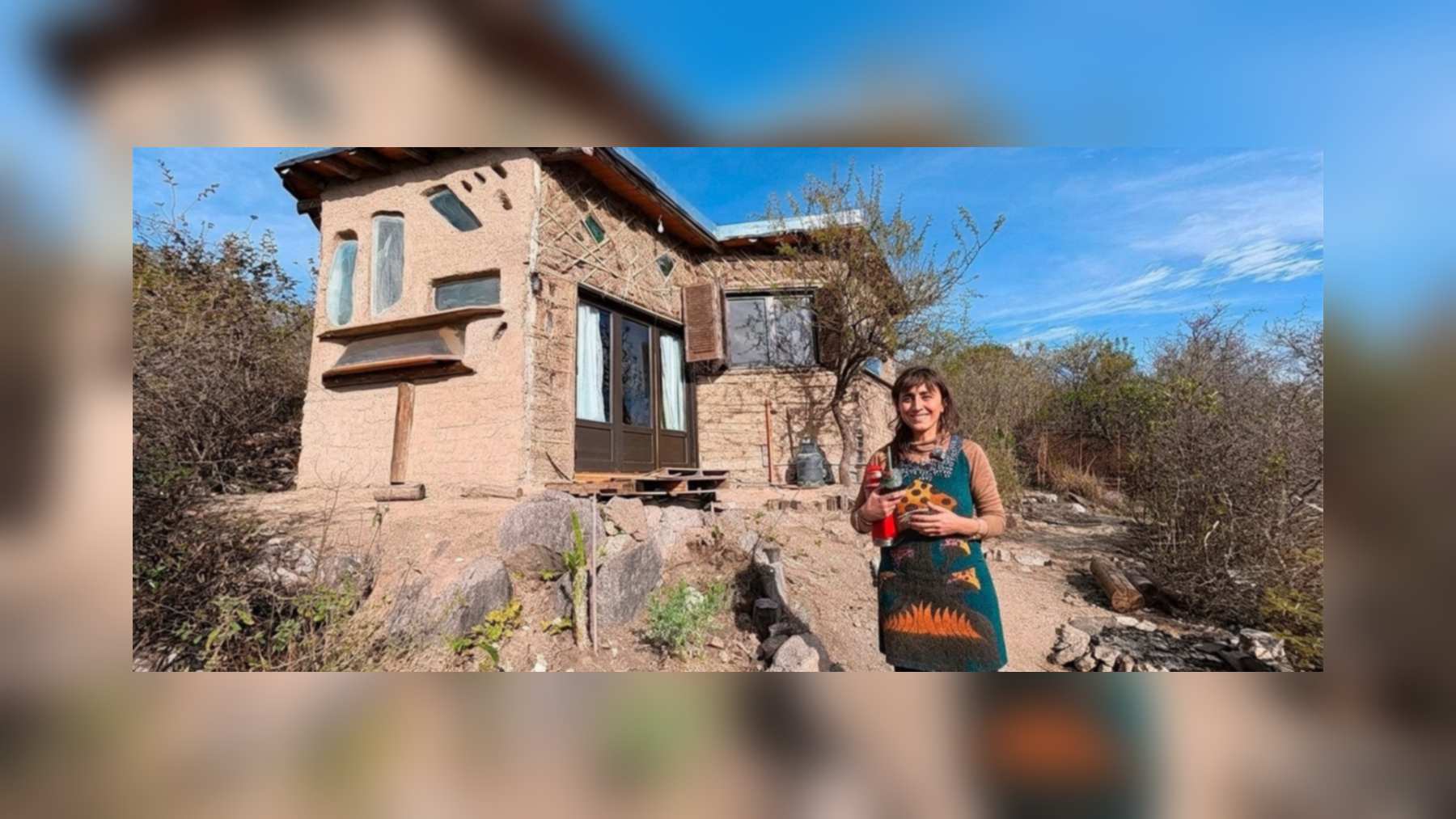
Mariana Di Pascuale, a 38-year-old painter and biodanza facilitator, built an earthen house in Los Hornillos, a village in Argentina’s Traslasierra Valley, with about 12 car windshields given to her in the town where she grew up. She raised it over a year and a half on a hillside lot in Córdoba province, with her own hands and friends who came to help, and from above its two hexagons form a heart.
She showed the house in a video tour published Aug. 21, 2026, on the YouTube channel Crónicas del Cambio – De Música Rutera, about four months after moving in. She spoke in Spanish, and her quotes here are translated. Born in Rosario, she had lived in the valley for five years and on this piece of land for three.
Windshields from a closing auction business
The glass came from Tortugas, a small town in southwestern Santa Fe province where her family moved when her mother was pregnant with her. Before the build, she asked at a local auction business what windows they had. They were closing and had a pile of windshields, and they told her to take them. One used to be a car’s back glass and still has thin lines running across it. “That’s what a town has, too,” she said of the gift.
The windshields now frame the hills as fixed windows, while a row of colored glass bottles set into the mud walls catches the first light of the day. Each bottle has a different color and works as a filter of light and color at dawn, she explained. In Brazil, a mechanic pushed a water-filled bottle through a roof tile to light rooms during the 2002 blackouts, another use for the same everyday object.
Two hexagons and a heart
The floor plan is two joined hexagons, and where they meet, two more walls close off the bathroom, as she described it on her Instagram account. A friend noticed that the roofline forms a heart from above, a shape she said was not planned at all.
The inside is divided the way a hexagon splits into three triangles. Her son, León, who loves birds, has a room with a little window and a raised bed. Her own bed sits lower and tucks away when she doesn’t need it, an idea from her years with a motor home, and a step of about 31 inches (80 centimeters) hides storage. “It’s small, but it has a sense of space,” she said. After the motor home, she wanted only a place to sleep, eat and bathe that was cozy, pretty and made of mud.
From Rosario to Uruguay
After high school she went back to Rosario to study literature and then fine arts, and fell for photography. In the summers she sold her crafts at fairs in Uruguay. The city overwhelmed her, she said, and on the Uruguayan beaches she felt free. At 22 or 23 she moved there, where she had also fallen in love with the man who would become her son’s father.
In Pueblo Centenario, a shared building project meant no running water and no electricity, so she fetched water from a neighbor in buckets and bathed with a tin can. Later came a little over two years with a motor home, more than a year of it living in the vehicle full time, as she drove south with her son and two dogs and separated from León’s father.
A year and a half of buckets and poles
The last 100 meters, about 330 feet, are uphill on foot, and every bucket of sand, clay and stones went up that path. She worked at least six hours a day on average. One afternoon she and a friend carried 20 wooden poles up the hill, and she hurt her shoulder.
Much of the help came through mingas, collective work days in which neighbors and friends build together. She called them useful but romanticized, since a call for 20 people might bring two friends. What counted was celebrating small steps, such as bringing up three buckets in a day. Other self-built homes get retold with a much bigger crowd, like a Costa Rican mother’s house of 850 recycled plastic blocks that was wrongly credited to 800 volunteers.
In 2025, halfway through the build, winter arrived as she pushed to finish a warmer place for herself and León. Her hands froze in the mud and the water came in icy, so she stopped, her sister offered to help, and she stayed three or four months in a friend’s cabin. “I don’t want this little house to be born out of sacrifice,” she said. She went back in spring, and when she gave the tour, the inside was plastered and painted but the outside plaster was still half done.
Spring water and a homemade biodigester
Water comes from a spring she shares with neighbors. She used a dry toilet while building but chose a conventional bathroom with a bathtub. Wastewater goes to a homemade biodigester of tanks set at different heights, starting with a 200-liter (about 53-gallon) tank where microorganisms break down the waste, then a lower tank and a pond. Because she had only just moved in, the system was still a trial.
She makes her living as an independent artist, painting and teaching biodanza, a group practice built on movement, music and emotion, after a training she began in Uruguay 10 years earlier.
What the windshields cannot show
The count of 12 windshields is her own estimate, and the tour gives no figures on electricity, building costs, water quality, how well the biodigester treats wastewater, or how the house holds heat.
The U.S. Environmental Protection Agency says reusing building materials can offset the impact of extracting virgin resources, according to its guidance on construction and demolition materials. Department of Energy guidance describes high-performance window glass with two or three insulated panes and low-emissivity coatings, and nobody has tested these windshields against that standard. A home built with tires that keeps a steady 68°F shows the kind of figure this house still lacks.
“I think the biggest lesson is the trust in myself that a project like this involves, and the importance of going step by step,” she wrote on Instagram.
Image: Crónicas del Cambio – De Música Rutera / YouTube