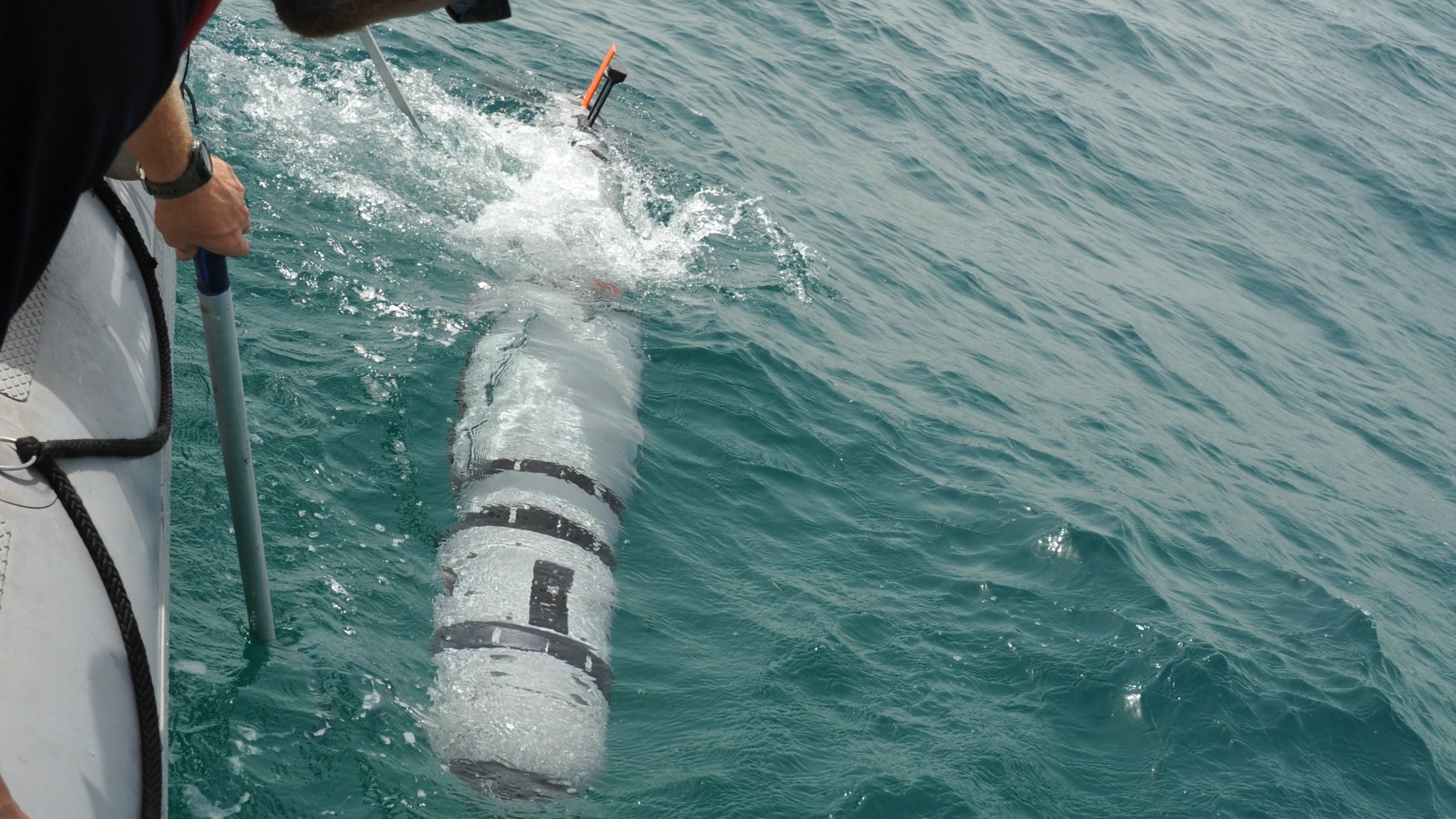
Getting an underwater robot home can be harder than sending it out. U.S. shipbuilder HII’s REMUS 620 demonstrated that return trip by docking autonomously inside a submerged torpedo-tube test fixture at Seneca Lake, New York, then backing out and separating safely.
The demonstration helped underpin a submarine launch-and-recovery contract HII announced on April 27, 2026. But there is an important boundary between the achievement and the ambition. The REMUS 620 test used equipment representing a Virginia-class submarine’s torpedo tube, not an operating submarine at sea.
A narrow opening with an important qualification
The drone’s hull measures 12.75 inches across, compared with a 21-inch torpedo tube. Subtracting those diameters gives roughly 4.1 inches on either side when centered, before accounting for the docking capsule and other hardware.
That calculation conveys the scale of the challenge, but it is not a published measurement of actual docking clearance. HII’s announcement confirms successful autonomous recovery without giving a numerical steering tolerance or describing the water’s visibility during the test.
How the drone docks and leaves backward
The REMUS 620 docked with a device called SAFECAP, short for “shock and fire enclosure capsule,” positioned inside the submerged fixture. It also demonstrated a “reverse swimout,” backing away from the tube rather than turning around inside it.
HII worked with Woods Hole Oceanographic Institution (WHOI) and the Navy’s Naval Undersea Warfare Center Division Newport on the demonstration, announced in October 2025. WHOI’s Carl Hartsfield described teams that “rapidly conducted testing runs, quickly evaluated the data, and made substantive adjustments to the vehicle.”
The practical lesson is that autonomy does not mean engineers disappear from the process. In this case, the robot performed the maneuver, while people prepared the system, reviewed results, and refined its behavior.
The 110-hour battery figure has a size penalty
HII advertises up to 110 hours of endurance and 275 nautical miles of range. Its specification sheet assigns those figures to the three-battery base configuration, measuring about 169 inches long and weighing 719 pounds.
The single-battery version is considerably smaller at 105 inches and 414 pounds, with 42 hours of endurance and 110 nautical miles of range. Moving to three batteries therefore adds about 5.3 feet and 305 pounds, not just more hours underwater.
Add sonar for detailed seafloor imaging, and the figures shift again. HII lists 50 hours and 132 nautical miles for a two-battery configuration carrying Kraken sonar, versus 80 hours and 200 nautical miles for the two-battery base vehicle. The three-battery sonar combination is marked “N/A,” without an explanation.
What the Navy has already demonstrated at sea
An older model has gone further in operational testing. The Navy reported in 2025 that a Yellow Moray vehicle based on the REMUS 600 completed three missions from USS Delaware, each lasting about six to 10 hours, without divers assisting launch and recovery.
That success followed setbacks, not a flawless first attempt. During earlier operations in a Norwegian fjord, the vehicle failed to return to the torpedo tube, was recovered by a surface vessel, and required a damaged component to be replaced before subsequent successful operations.
Those missions matter because they show why dependable recovery deserves as much attention as endurance. They also belong to the REMUS 600’s record, and should not be presented as proof that the newer 620 completed the same submarine operations.
A separate role in restoring ocean habitats
The REMUS 620 also has a documented civilian job. Separately from the naval trials, the National Oceanic and Atmospheric Administration (NOAA) has reported using two of these vehicles for high-resolution seafloor mapping in its restoration work following the 2010 Deepwater Horizon oil spill.
NOAA explains that limited information about deep habitats before the spill made assessing damage and tracking restoration difficult. The wider restoration effort has since gathered thousands of square kilometers of mapping data, helping researchers build models of where coral habitats occur.
For researchers, better maps can help turn a largely unseen landscape into something they can study and revisit. That is an environmental use of ocean robotics, separate from the military goal of launching and recovering vehicles covertly.
What the new contract does and does not establish
The April 2026 award from the Defense Innovation Unit covers a system intended to deploy and recover REMUS vehicles autonomously from Navy submarines. HII’s announcement does not disclose a contract value, delivery quantity, or schedule, and still identifies the REMUS 620 recovery as a test-fixture event.
The remaining question is how the 620’s test-fixture performance translates to an operating submarine.
The official press release on the contract was published on HII’s website.