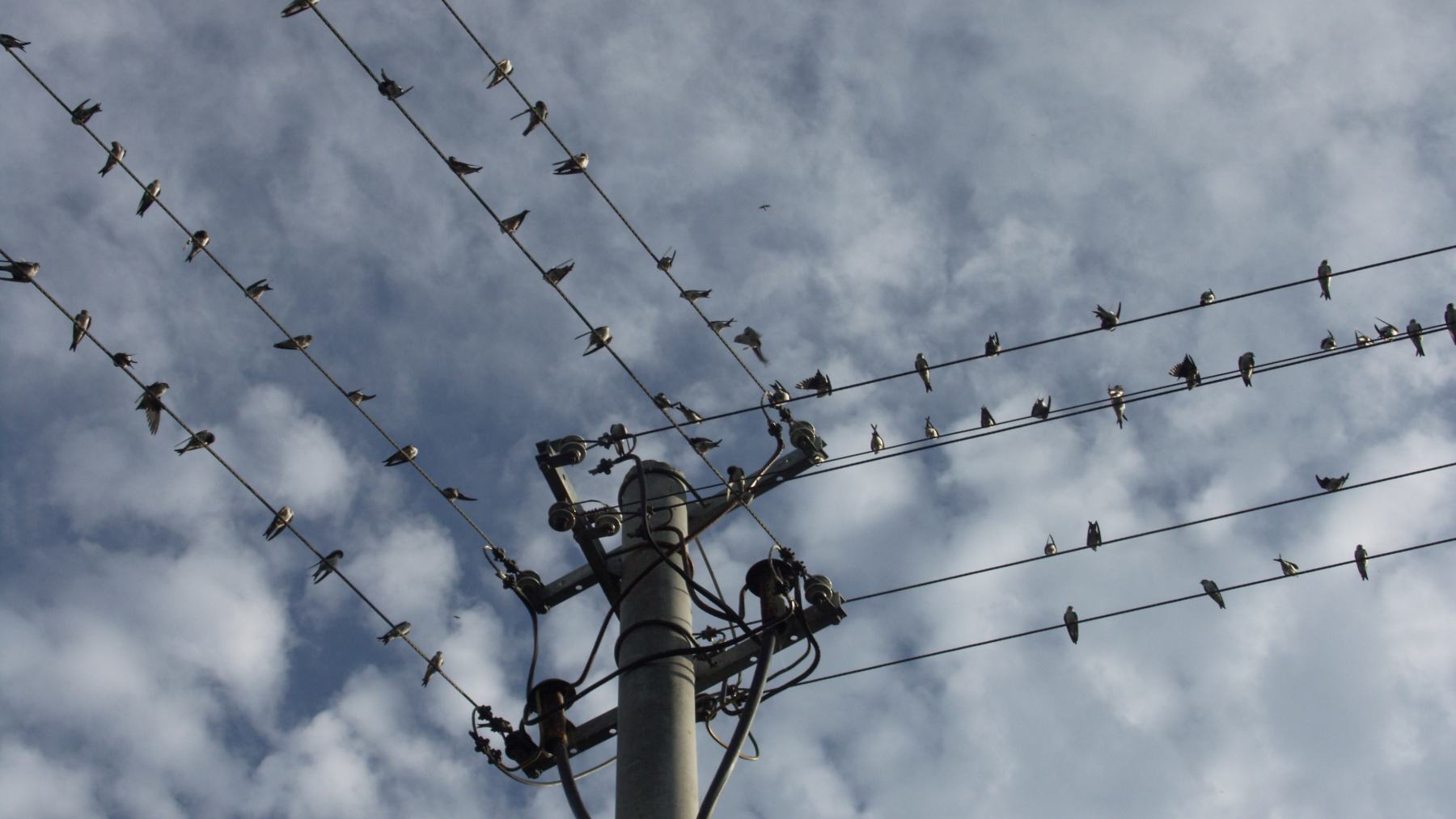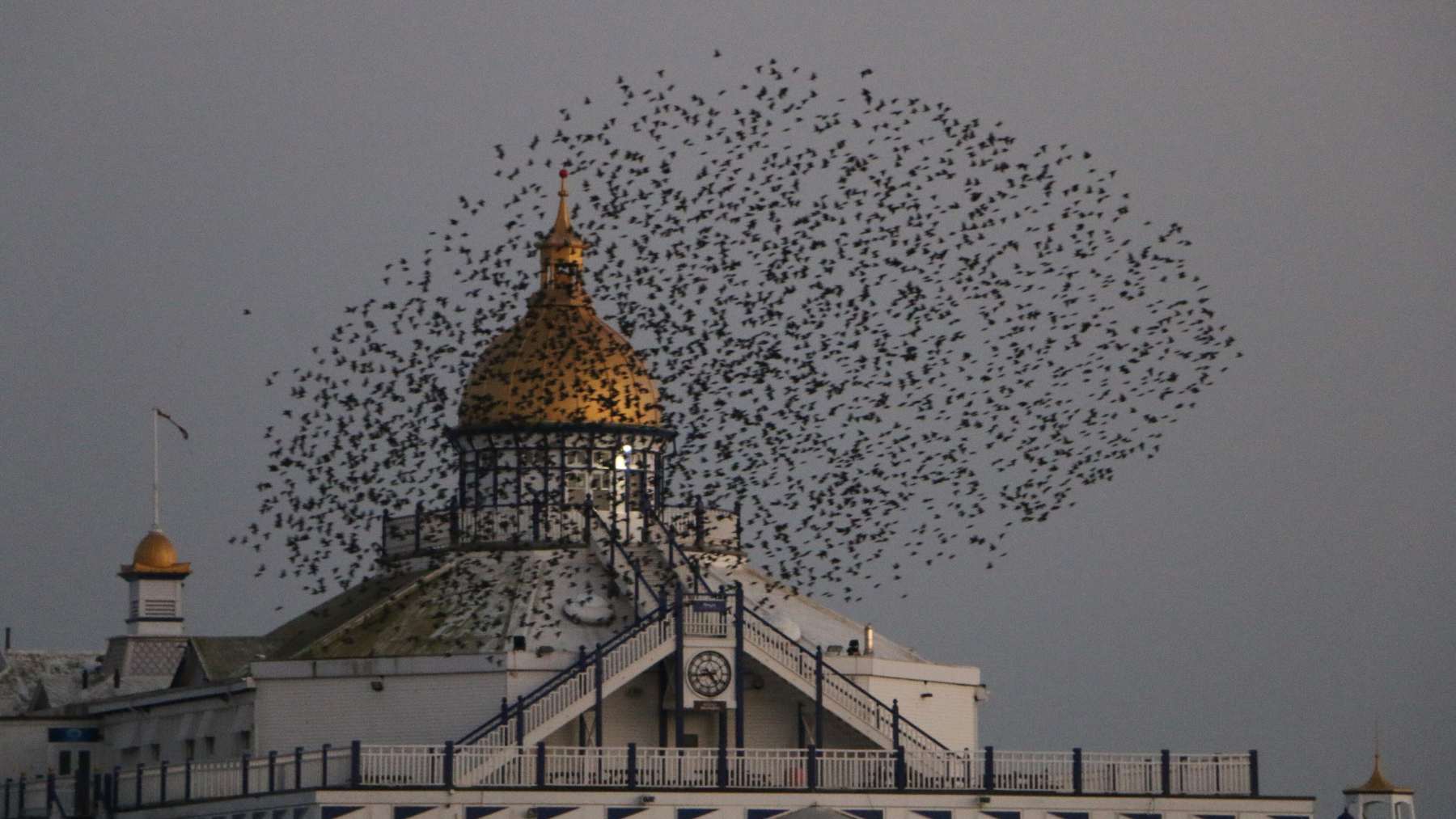
Thousands of starlings are gathering into swirling flocks over Poland this fall, and the Polish news site Interia reported on September 14 that this is precisely their season, adding that from far off a flock can look like an approaching swarm of locusts.
Why the birds perform these evening displays, known as murmurations, has puzzled scientists for decades. “Attacking an entire flock would be like trying to juggle with soot,” Anne Goodenough, a professor at the University of Gloucestershire in England, told BBC Science Focus.
Big flocks make each bird safer
“Such large groups and dispersal provide greater safety,” Piotr Tryjanowski, an ornithologist and professor at the Poznań University of Life Sciences, told Interia in Polish. “The probability that a predator will catch that particular bird drops, and the attacker is also disoriented by the size of the flock.”
Starlings have many enemies, according to the same report. The biggest threat is the sparrowhawk, a specialist in hunting birds this size, while peregrine falcons, goshawks, kites and Eurasian hobbies also catch them, and the report notes that sparrowhawks excel at surprise attacks on single birds while goshawks are skilled at striking a large cloud of prey.
Goodenough described the hunt from the raptor’s side. “Birds of prey tend to hunt by getting ‘focus lock’ on one individual starling and attacking them – they don’t just fly into a flock with their talons out and hope for the best,” she told BBC Science Focus.
Being one bird among thousands, she said, means “you reduce your chances of becoming dinner through what we call the ‘dilution effect.'” She added that “it’s a numbers game: you’re less likely to be the bird targeted by predators in a crowd,” and a crowd is a problem for any large bird of prey that needs to fix on one animal before it strikes.
Citizen scientists sent in 3,211 sightings
“Pre-roost murmuration displays by European starlings Sturnus vulgaris are a spectacular example of collective animal behaviour,” Goodenough wrote in a 2017 study with co-authors Natasha Little of the Royal Society of Biology and William Carpenter and Adam Hart of the University of Gloucestershire.
They were weighing two ideas. In the words of the paper, “possible explanations for this behaviour include reducing predation through the dilution, detection or predator confusion effects (the ‘safer together’ hypotheses) or recruiting more birds to create larger (warmer) roosts (the ‘warmer together’ hypothesis).”
Goodenough has described that second idea in plain terms, telling BBC Science Focus that “the murmuration events might effectively be advertisements for the roost site.” To test both, her team asked the public for sightings, and “in total, 3,211 records were submitted,” the authors write, from 23 countries, with UK records making up most of them.
According to the paper, flock “size increased significantly from October to early February, followed by a decrease until the end of the season in March (overall mean 30,082 birds; maximum 750,000 birds).” The mean display lasted 26 minutes, and birds of prey were recorded at 29.6 percent of murmurations, or nearly one in three,.
“The most common species was sparrowhawk followed by buzzard, marsh harrier, hen harrier, and peregrine falcon,” the researchers report. The presence of harriers, peregrines and sparrowhawks went along with bigger and longer displays, “especially when these species were flying near to, or actively engaging with, starlings,” and with flocks dropping into the roost all at once.
“Our findings suggest that starling murmurations are primarily an anti-predator adaptation rather than being undertaken to attract larger numbers of individuals to increase roost warmth,” the authors conclude.
Each bird tracks a few close neighbors
Each bird reacts to what its neighbors do and changes direction when they do, so the whole cloud moves like a school of fish, Interia explains, which is the safest way to survive attacks even by specialists such as goshawks and sparrowhawks.
“It has been suggested that birds such as starlings interact with their six to seven closest neighbours, and that such interactions suffice to explain the general aspects of collective movement of flocks,” a team from the University of Groningen wrote in a 2019 paper.
Andrea Cavagna, a physicist in Rome and co-author of earlier work on starling flocks, compared a starling to someone driving in traffic. “You interact with a fixed number of cars, maybe the one in front, the one behind, and one or two on each side, but you’re not interacting with the cars 50 meters away so you’re not distracted by them,” he told National Geographic.
Cavagna told Agence France-Presse, in a 2017 report published by the public radio program The World, that the birds get even better at this when a hunter shows up. “When starlings are under attack, they actually enhance their coordination and achieve a better global coordination of the flock,” he said, adding that “this is the opposite of what happens for humans.”
Falcon attacks filmed over two Roman winters
The Groningen paper, published in Behavioral Ecology and Sociobiology, was led by R. F. Storms with Charlotte Hemelrijk of the University of Groningen, working with Claudio Carere of the University of Tuscia and Francesca Zoratto of Italy’s Istituto Superiore di Sanità, who had shot the video.
“During two winter seasons (January–March 2006 and December–March 2006–2007), data were collected on flocks of European starlings at two urban roosting sites (Termini and Eur) in Rome, Italy,” the authors write. “Termini is situated in the city centre, and the roost there was used by up to 20,000 starlings,” while EUR, in the south of the city, held about 60,000.
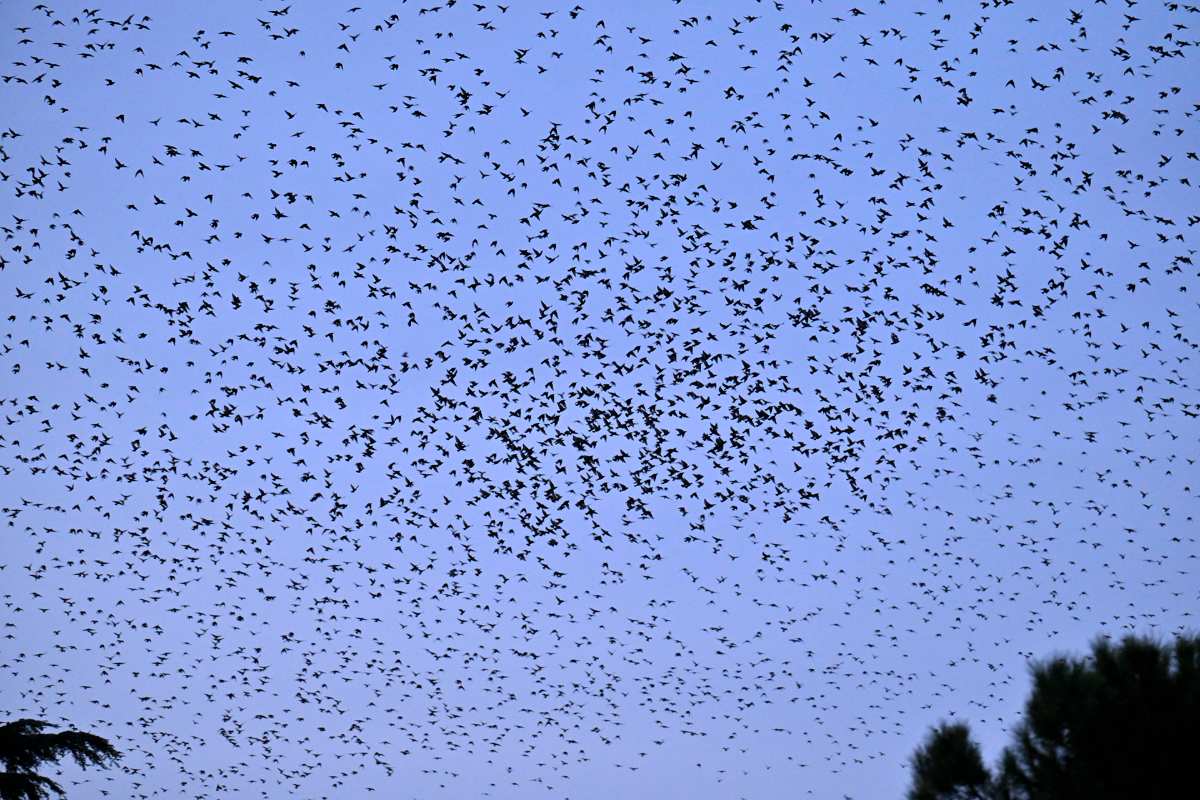
“Recording started 90 min before dusk and lasted until nightfall,” according to the paper, and the team screened 182 hunting sequences, studying 67 of them frame by frame. “A total of 795 collective events of flocks and 210 attacks by the falcon have been recorded,” the authors write. The authors describe escape patterns they call “‘flash expansion’, ‘blackening’, ‘wave event’, ‘vacuole’, ‘cordon’ and ‘split’,” and a flash expansion, in which the flock suddenly spreads outward, was more frequent when the predator came in fast and from above.
“Despite their complexity, we show that patterns of collective escape depend on the predatory threat, which resembles findings in fish,” they write.
Hemelrijk explained the dark bands that ripple across a flock under attack to Audubon magazine in 2015. “This exposes a larger area of the wing temporarily and this is seen by us as a dark band,” she said, and “it confuses the predator as to whom it should attack.”
Some researchers still see a puzzle
Without a falcon nearby, Hemelrijk, a professor of evolutionary life sciences at Groningen, sees something else. “In the absence of a predator, I do think it’s possible to see these displays as a sort of dancing,” she told National Geographic. “We don’t want to attribute too much intention, but they’re certainly very excited.”
Frank Heppner, a professor emeritus at the University of Rhode Island, is less convinced by the predator story. “The bottom line is, I’ve been studying this thing for 50 years, and I still don’t know,” he told the same magazine.
“You would think they would want to minimize flying time, but instead they go through this spectacular display for half an hour to 45 minutes, burning up energy at a ferocious rate,” Heppner said. “And meanwhile they’re actually attracting predators.”
Flocks also trade tips about food
Interia notes that the clouds often form in the evening near lakes or ponds, where starling roosts are common, before the birds spend the night together and save energy. Tryjanowski pointed to another reason. “Such flocks are, after all, information centers,” he said. “Birds exchange data about places where food can be found.”
Older sociobiology, he explained, questioned why birds would share such tips when doing so only increases competition for food. “Today, however, we know there are benefits, and they are linked precisely to safety,” he said. “Feeding in a group is safer, and it is no longer a secret that cleverer birds can lead less clever ones to feeding grounds so that they are the ones more exposed to a predator’s attack.”
Researchers keep finding surprising group behavior in other birds as well, including Australian magpies that removed each other’s GPS trackers.
What the studies cannot show
The citizen science survey depended on volunteers, and the authors acknowledge that “untrained observers were asked to give accurate estimates of bird numbers and, in common with much citizen science research, there was no way to validate the data.” Its findings are also correlations, and most of the records came from the UK.
The Rome footage has limits of its own. “Blackening and wave events may be confused depending on the position of the observer,” the Groningen team writes, and “falcons experience patterns of collective escape differently from an observer because of their closer spatial location relative to the flock.”
Even the payoff of an escape move was unclear in that study, since “the effectiveness of collective escape to prevent being caught was hard to estimate,” the authors write. Tryjanowski’s remarks about information sharing come from an interview and were not presented as new research.
Where to watch a murmuration
Water is the best bet, according to Interia, because starlings are easiest to see near lakes and ponds in the evening, before they settle down to sleep. “You never get the same display twice, even at the same location. It’s almost like music,” Goodenough said, and regular evenings outdoors may bring other rewards too, if research on how birdwatching affects the brain is any guide.
The citizen science study was published in PLOS ONE.