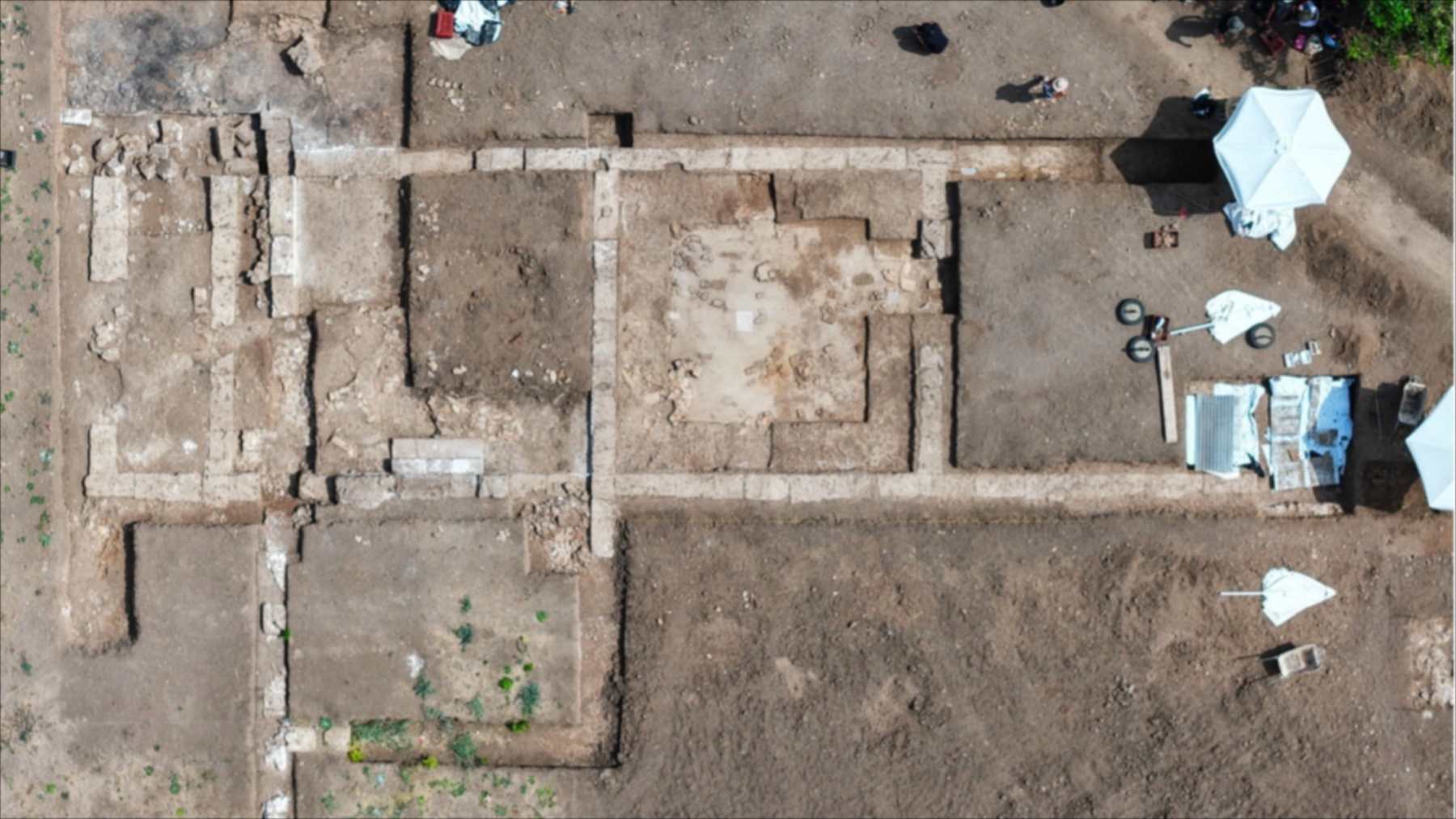
Archaeologists digging at ancient Mieza, near Naousa in northern Greece, have uncovered two banquet halls with mosaic floors in the royal gymnasium that their excavation director identifies as the school where Aristotle taught Alexander the Great.
“We are completely sure that this is the school that Philip II founded,” Angeliki Kottaridi, the archaeologist who leads the excavation, told the Spanish news agency EFE in Athens, in remarks translated from Spanish.
Philip II had this school built “for the education of his son Alexander and the children of the noble Macedonians,” Kottaridi told Live Science in an email.
Plutarch’s own account, in Bernadotte Perrin’s translation of the Life of Alexander, says Philip “would not wholly entrust the direction and training of the boy to the ordinary teachers of poetry and the formal studies, feeling that it was a matter of too great importance,” so “he sent for the most famous and learned of philosophers, Aristotle, and paid him a noble and appropriate tuition-fee.”
Two dining rooms for 20 guests
“A particularly important find is the large tripartite complex, covering more than 160 square meters, in the ‘Didaskaleion,’ with a central antechamber and two andrones, symposium halls,” Greece’s Ministry of Culture said in a statement released in Greek on September 3, 2026. That works out to roughly 1,720 square feet.
“Both preserve mosaic floors, while the raised platforms for the couches confirm their use as symposium spaces,” the ministry wrote. “Each andron had ten couches, allowing at least 20 diners to be hosted.”
“The quality and technique of the floors show impressive similarities with those of the palace of Aigai,” the statement adds, referring to the residence of the Macedonian kings at modern Vergina.
“Alexander studied there under Aristotle so it is exciting to excavate the very school rooms where his teacher shaped his formative years,” Graham Wrightson, a professor of history at South Dakota State University who was not involved in the work, told Live Science.
Lecture halls with stone benches
“A few years ago, I identified the ancient remains next to the ancient theater of Mieza,” Kottaridi told Live Science. Her team began excavating in 2024 under an agreement between the ministry and the Municipality of Naousa.
“This year the research focuses on the eastern side of the unified complex made up of the palaestra and the ‘Didaskaleion,’ where the lecture halls with the stone benches were identified,” the ministry wrote. The palaestra was the courtyard where young men wrestled and exercised, and Didaskaleion means “place of teaching.”
Kottaridi told EFE that Mieza was “what today would be described as an elite school,” where, according to the agency, the sons of the most illustrious Macedonians trained for war with classes in tactics, strategy and physical training.
In a statement reported by Greek City Times, she called it “the very place where Aristotle taught Alexander the Great and the young Macedonians who would go on to become leaders across the known world.”
A gymnasium built to a single plan
The dig covers about 30,000 square meters (7.4 acres). “Particularly impressive is the xystos, a roofed stoa about 200 meters long,” the ministry wrote of the covered track, roughly 656 feet, where athletes could run in any weather.
An earlier ministry report, from August 2025, said the excavation “confirmed the construction of the whole in the middle of the 4th century according to a single plan, and consequently the association with Philip II (359-336 BC) and Alexander the Great.”
The same report describes how “the natural bedrock was carved away to form three huge, horizontal, perfectly level terraces,” covering about 14,000 square meters (3.5 acres). White plaster on the columns of the xystos, it adds, is the same as that of the royal tombs and the palace of Aigai.
This year the team also recovered pieces of an Ionic frieze and an Ionic capital. “Particularly rare and important is the section of a corner Doric architrave of the peristyle, which is expected to contribute to a more accurate reconstruction of the architecture of the palaestra,” the ministry wrote.
Mosaic floors were a sign of wealth across the ancient Mediterranean, as in a luxury Roman house found near the Colosseum, and Culture Minister Lina Mendoni said the Mieza excavation “shows significant analogies with the models we know from the palace of Aigai.”
“For Alexander and his companions, Mieza was the place of initiation and preparation for leadership,” Mendoni said in her address during a visit to the region that included a tour of the dig.
Styli and olive oil from Athens
Coins, pottery and four styli, pointed tools for writing on wax tablets, have been recovered so far. The 2025 report spelled out why the oil jars and the styli matter.
“Anointing the young athletes with oil was an absolutely essential element of life in the gymnasium,” it said. “The fragments of Panathenaic amphorae found in the xystos and the palaestra reveal that the young scions of the Macedonian elite preferred the select and far from cheap oil of the sacred trees of Athens; however, the most moving find is four styluses of the kind Aristotle’s students used to write their exercises.”
Amphorae, two-handled ceramic jars, carried oil and wine across the Greek world, and the Panathenaic type was linked to the oil of Athens.
Wrightson told Live Science that the discovery of “four stylus writing implements allows us to dream that one belonged to Alexander.” “Still, it allows us to put ourselves in the shoes of the young Alexander and understand more how he became the famous king,” he said.
Plutarch’s precinct of the nymphs
Philip II invited Aristotle in 343 BC “to supervise the education of his thirteen-year-old son and the other royal children, the scions of noble Macedonian families,” according to the ministry’s Cultural Egnatia guide to Mieza.
Plutarch, writing about four centuries later, places the lessons at a shrine near Mieza: “as a place where master and pupil could labour and study, he assigned them the precinct of the nymphs near Mieza, where to this day the visitor is shown the stone seats and shady walks of Aristotle.”
Fotis Petsas, who excavated at Mieza in the 1950s and 1960s, identified a cave sanctuary of the nymphs west of the city as the “School of Aristotle.” The guide says that “the idyllic scene does indeed recall Plutarch’s description,” but that the school’s premises “should rather be sought in the monumental building of the Gymnasium.”
Historians outside the dig agree
“I agree that all the evidence suggests this is the school Philip provided for Aristotle to tutor the young Alexander and his fellow students,” Jeanne Reames, director of the Ancient Mediterranean Studies program at the University of Nebraska at Omaha, told Live Science. She hopes the find will “shed more light on elite education in Macedonia in the second half of the 4th century” BC.
Elizabeth Baynham, a senior lecturer at the University of Newcastle in Australia, noted that Mieza lay about 27 miles (43 kilometers) from the capital at Pella, “far enough away to potentially give Alexander a chance for escape if his father was assassinated.”
“Alexander, who by all accounts was highly intelligent, was taught by one of the finest minds of the ancient world in terms of range and insight,” Baynham told Live Science. “Aristotle would have only been in his early 40s.”
Kottaridi told EFE that “these gymnasia in which letters, the art of war, culture and the Greek language were learned will accompany Alexander on his military campaign and will become the cornerstone of the Hellenistic period.”
The excavation data are not yet published
Historian Miltiades Hatzopoulos told Live Science that the complex is likely the school where Alexander was taught, but that “the excavator has given interviews, but has not yet published a paper with the relevant testimonies.”
The ministry’s statements do not mention any inscription naming Aristotle or Alexander, and none of the styli can be tied to a particular student. Plutarch himself wrote only of “the precinct of the nymphs near Mieza,” which earlier excavators placed at the caves west of the city.
“Despite the systematic dismantling of the buildings by the Romans after the second battle of Pydna, important architectural remains have survived, walls with plaster of exceptional quality and ancient floors, preserved beneath layers of destruction and an extensive fire,” the ministry wrote, referring to the Roman victory of 148 BC that ended Macedonian resistance.
The full excavation update was published in Greek by the Hellenic Ministry of Culture on September 3, 2026, and quotes from the ministry and from Mendoni have been translated into English.
“Step by step, layer by layer, Mieza is revealing its secrets,” Kottaridi wrote in her statement. “And this is only the beginning.”
Photo: Hellenic Ministry of Culture