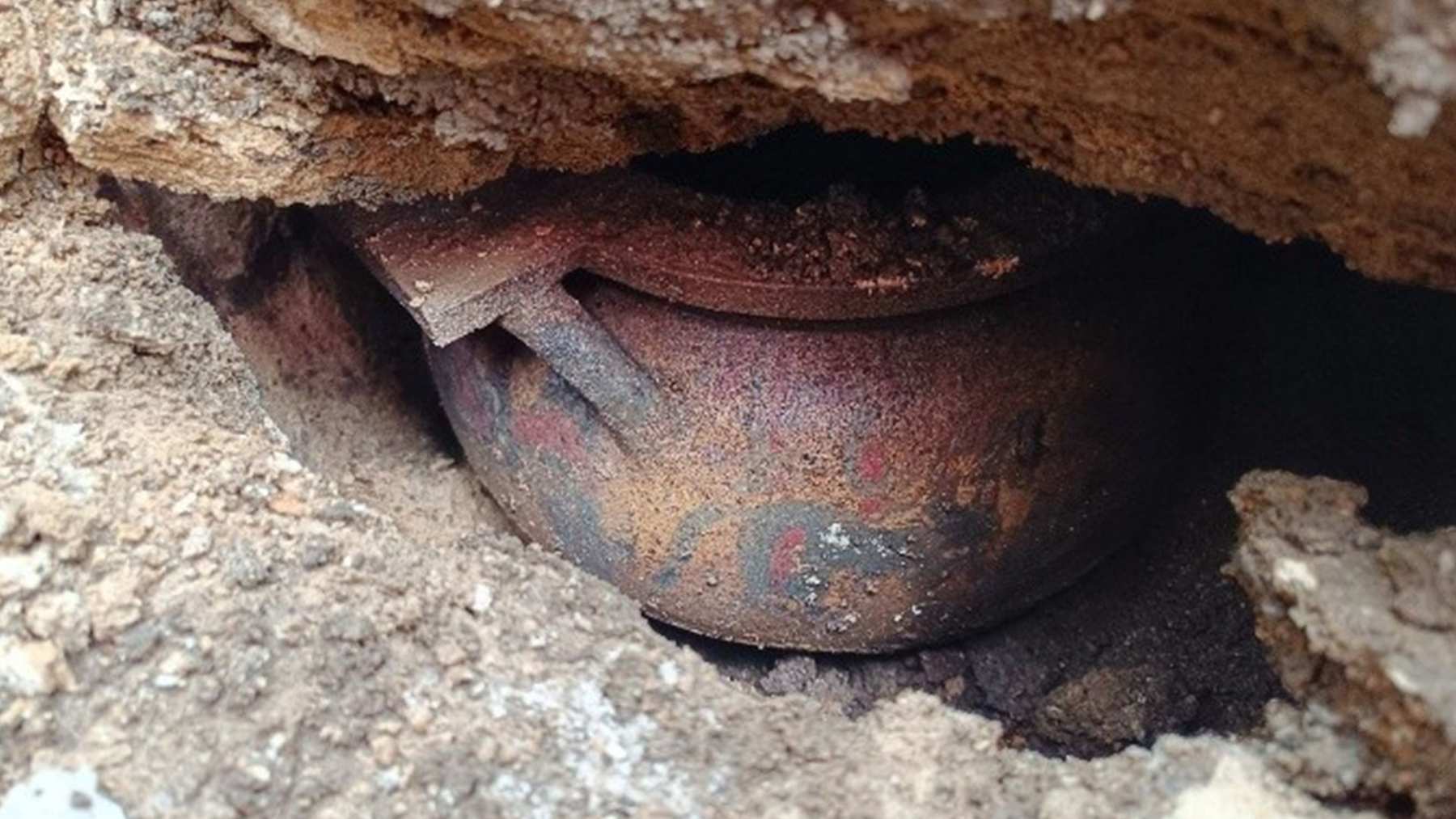
Archaeologists investigating a planned private construction project in southern Italy have uncovered a rare Etruscan burial dating back roughly 2,600 years. Inside a stone enclosure at Pontecagnano Faiano, a decorated vessel imported from Greece held the cremated bones of the deceased.
Known as Tomb 10188, the discovery points to someone of high standing in the ancient community, according to Italy’s heritage authorities. It also brings together two revealing clues about that person’s burial, a locally unusual tomb design and a Greek vessel associated with elite drinking gatherings.
Four graves beneath a modern town
The discovery emerged during archaeological investigations ahead of construction in the town’s urban center. Researchers uncovered another section of the ancient settlement’s western necropolis, or cemetery, including four graves in the southern part of the building plot. Authorities announced the find in September 2026, following excavations in the preceding months.
The burials date to the first half of the sixth century BC, approximately 600 to 550 BC. A modern sewer system had partially destroyed the group, according to the official discovery announcement, illustrating how closely ancient remains and everyday infrastructure overlap beneath a living town.
A wine vessel with a different final purpose
At the center of Tomb 10188 was a krater, a large vessel made in Corinth, Greece. Travertine stone formed a protective enclosure around it, closed at the top by a covering slab.
Why would a wine vessel become a funerary urn? In ancient Greek society, kraters were used to mix wine with water during a symposium, an organized drinking gathering associated with aristocratic men, conversation, music, and shared social customs. The Metropolitan Museum of Art’s account of these gatherings helps explain why such a vessel could carry meaning beyond its practical use.
The decoration offers another glimpse into that world. According to the Italian Ministry of Culture, one side shows galloping horsemen, while the other depicts a siren between riders facing one another. Those images decorate an object that ultimately served to preserve human remains.
What makes this burial unusual
The enclosure belongs to a funerary type known as a “cube tomb.” Although this design is familiar in northern Campania, authorities report only two previously known examples at Pontecagnano, Tombs 1840 and 9954, both already in the national archaeological museum’s collection.
Officials interpret the combination of architecture, cremation, imported pottery, and the krater’s ceremonial associations as evidence of a “person of high rank” (translated from Italian). The published announcements do not identify the deceased by name or establish their age, sex, or exact social position. The painted riders, on their own, cannot establish the person’s occupation.
An Etruscan community connected to the Mediterranean
The Greek origin of the vessel fits a much broader history of contact. Museum research on Pontecagnano describes an ancient community open to exchanges with different Mediterranean peoples, supported by productive farmland and a coastal position that offered access by sea.
That background helps explain how an object made in Corinth could become part of an Etruscan burial in southern Italy. It also suggests a useful way to read this discovery, as evidence of objects and customs moving between communities. The vessel’s place of manufacture alone does not establish where the deceased came from.
Protecting the pottery after excavation
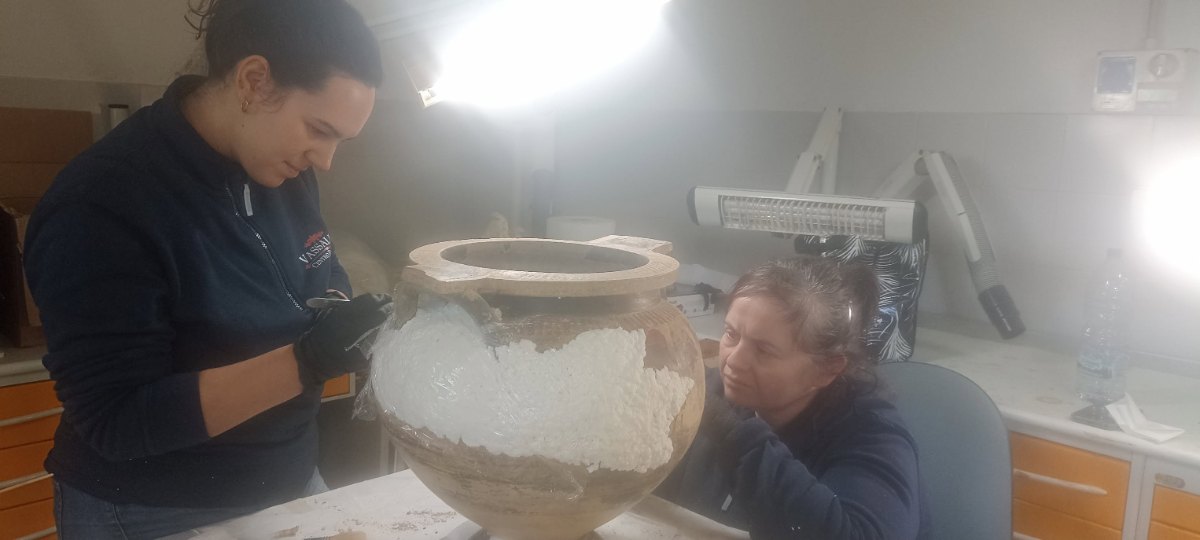
Recovering the vessel was only one stage of the work. In a September 22, 2026, update, the local heritage authority reported that the pottery had undergone careful cleaning and consolidation in laboratories provided by Pontecagnano’s National Archaeological Museum, known as MAP.
Conservators also applied a poultice treatment to the krater to extract soluble mineral salts from its surface. The authority explained that these salts could contribute to deterioration over time, putting the object and its painted decoration at risk. The treatment addresses a problem visitors may never see, but one that matters to the vessel’s survival.
When visitors can see the discovery
The finds are scheduled for public presentation on September 27, 2026, in the temporary exhibition “Cavalieri e sirene, nuove storie dalla terra” at MAP. The Ministry of Culture’s exhibition announcement says the display will remain open through October 25, bringing Tomb 10188 together with the two previously known cube tombs and objects from the recently excavated cemetery.
For visitors, that arrangement offers a chance to compare the new discovery with the site’s two previously known cube tombs. The latest official update on the restoration was published on September 22 on the website of the Soprintendenza for Archaeology, Fine Arts and Landscape for Salerno and Avellino.
Photo: Ministero della Cultura